During recruitment, some tanker seafarers are now being asked a question that would have seemed unusual under normal circumstances:Are you willing to sail to the Strait of Hormuz?
The security situation around the Strait of Hormuz has created a serious dilemma for the maritime industry, particularly for tanker crews. While shipping companies are facing operational, financial and security challenges, seafarers remain the people physically onboard the vessels and therefore face the most direct consequences when a voyage enters a high-risk area.
a simple question about a seafarer’s availability or willingness to work in different trading areas. But for someone looking for employment, the answer may have much bigger consequences.
If a seafarer says “No,” could another candidate who says “Yes” be selected instead?
And if additional financial compensation is offered for entering a high-risk area, how much risk is a seafarer expected to accept for a higher salary?
These questions are becoming increasingly important for tanker crews.
The Question That Can Change a Job Interview
For tanker officers and ratings looking for their next contract, recruitment interviews usually focus on experience, certificates, tanker background, previous vessels and technical knowledge.
However, there is now another question that can enter the conversation:
“Are you willing to go to the Strait of Hormuz?”
But what exactly does the company want to know when asking this question?
Is it simply a survey to understand the availability of its crew?
Or could the answer influence the selection process?
This is where the situation becomes complicated.
I was personally asked this question by a well-known crewing company. My answer was no.
Later, I spoke with a Filipino crew member who had also been asked about his willingness to sail to the region. His answer was very different. He told me that he would say:
“Of course I would go. I would do anything for my company.”
However, he also explained that if the vessel actually entered an extremely dangerous area, he would reconsider his decision because, ultimately, nothing is more important than his life.
This raises an uncomfortable question.
What if that person is selected instead of another candidate simply because he answered “yes” during the interview?
Is that fair?
And what happens to a less experienced seafarer who has fewer employment opportunities and cannot easily choose which vessel or trading area he wants to join?
These are questions that deserve an honest discussion within the maritime industry.
What Happens If a Seafarer Says “No”?
At the moment, it is difficult for seafarers to know exactly what happens behind the recruitment process when one candidate says no and another says yes.
Does the company continue the recruitment process with the person who is willing to enter a high-risk area?
Does the candidate who refuses simply remain on standby?
Or is the question being asked only to understand how many available crew members would potentially accept such an assignment?
Without transparency from companies and crewing agencies, seafarers may naturally question how their answers are being used.
The financial aspect makes the decision even more complicated.
High-risk voyages can involve significant additional compensation, particularly when war-risk premiums and special allowances are included. For some seafarers, the financial difference can be substantial.
For a rating, the additional income could potentially be several times their normal salary, while officers may also receive significantly higher compensation depending on the vessel, company and specific voyage.
For someone with a mortgage, debts, family expenses or other financial responsibilities, turning down a highly paid contract is not necessarily an easy decision.
A seafarer may understand the risks but still think:
“I need the money.”
This is where employment pressure and personal safety begin to collide.
Saying Yes vs. Saying No
There are two obvious choices for a seafarer.
Option 1 — Say Yes
Saying yes could provide several potential advantages:
You may remain eligible for the position.
You may have access to more employment opportunities.
You demonstrate flexibility to the company.
You may qualify for additional compensation if the vessel enters a designated high-risk area.
However, there are also disadvantages:
You are potentially accepting additional personal risk.
The security situation can deteriorate rapidly.
The actual circumstances of a voyage may be different from what was expected during recruitment.
You may later decide that you are no longer comfortable entering the area.
Option 2 — Say No
Saying no can also have clear advantages:
You are being honest about your personal safety limits.
You avoid a voyage that you consider unacceptable.
You may have greater peace of mind about the contract you are accepting.
But there is an obvious concern:
What if another candidate who says yes becomes more attractive to the employer?
That is the part seafarers cannot easily know.
And this leads to perhaps the most important question in this entire discussion:
Can a seafarer’s decision really be considered completely voluntary if saying “no” could potentially affect his employment?
What Should the Company Be Responsible For?
This does not mean that shipping companies should simply ignore the willingness of their crew.
Companies have legitimate operational requirements. A tanker company needs qualified crew members who can operate vessels across different trading areas, including regions where security risks may exist.
However, there should also be transparency.
If a company asks a seafarer whether they are willing to sail to the Strait of Hormuz, the seafarer should ideally understand what that answer actually means.
Is the question asking:
“Would you work for our company if our vessels trade in this region?”
Or:
“Would you personally accept a voyage into a high-risk area under the current security conditions?”
These are two completely different questions.
A seafarer might be willing to work for a tanker company without being willing to enter every high-risk area under every possible security condition.
For example, a seafarer could reasonably say:
“If the current security situation improves and the area is considered sufficiently safe for commercial shipping, I have no problem sailing there. However, under the current circumstances, I would prefer not to enter the area.”
That is very different from simply refusing to work for the company.
Can Safety Be Guaranteed?
This is perhaps the most difficult question.
Can a company guarantee that a seafarer will return home safely?
Realistically, no company can guarantee that.
Shipping has always involved risk. Weather, mechanical failures, piracy, collisions and other unexpected events can occur.
But a conflict zone creates a different level of uncertainty.
A seafarer could therefore reasonably ask the company:
What is the current security assessment?
What measures are being taken to protect the crew?
Is the voyage covered by appropriate war-risk arrangements?
What additional compensation is being offered?
What happens if the security situation deteriorates?
What happens if the crew member no longer considers the voyage acceptable?
Are these conditions clearly reflected in the employment agreement?
These questions are not signs of weakness.
They are reasonable questions from someone whose physical safety depends on the decisions being made ashore.
The Same Problem Can Affect Other High-Risk Areas
The Strait of Hormuz is not the only region where this issue can arise.
The Black Sea has also demonstrated how quickly commercial shipping can become exposed to military and geopolitical risks.
For seafarers, the problem is not limited to one specific geographical location.
The larger question is:
How should the maritime industry deal with crew employment when commercial vessels are operating close to active conflict zones?
A company may have a legitimate commercial reason to operate in a particular region. A seafarer may have a legitimate personal reason to refuse.
Both sides have interests that need to be considered.
More Money Does Not Automatically Mean Less Risk
Higher salaries and additional war-risk compensation can make a dangerous voyage financially attractive.
For some seafarers, the difference may be enough to significantly improve their family’s financial situation.
But money cannot remove the physical risk.
A seafarer can calculate a salary.
He cannot calculate the value of returning home safely to his family.
This does not mean that every seafarer should refuse to sail into a high-risk area. Different people have different risk tolerances, financial circumstances and professional decisions.
The important point is that the decision should be informed and genuinely voluntary.
What Should Seafarers Ask Before Accepting a High-Risk Voyage?
Before accepting a tanker position involving potentially high-risk trading areas, seafarers should consider asking the company for clear information about the voyage and the applicable conditions.
Questions could include:
Will the vessel actually enter the Strait of Hormuz or another designated high-risk area?
What is the current security assessment?
What additional compensation is provided?
Are war-risk arrangements clearly defined?
What security measures are available onboard?
What happens if the security situation suddenly deteriorates?
Are the relevant conditions included in the employment agreement?
The objective is not to create conflict between seafarers and companies.
It is to make sure that both sides understand what they are agreeing to.
The Real Strait of Hormuz Dilemma
The question is ultimately bigger than whether a seafarer says yes or no during a job interview.
It is about the pressure behind that answer.
A seafarer looking for employment may need the salary. A company may need crew members willing to operate its vessels in challenging areas. At the same time, the seafarer is the person who will physically be onboard if the security situation deteriorates.
That creates a difficult balance between employment, income and personal safety.
Perhaps the maritime industry should therefore move beyond simply asking:
“Are you willing to go to the Strait of Hormuz?”
A better question might be:
“Under what conditions would you be willing to go, and what information and protections do you need to make that decision?”
Seafarers are not simply another operational resource. They are the people who ultimately carry the physical consequences of decisions made both onboard and ashore.
And while higher compensation can recognize additional risk, it cannot eliminate that risk.
For every seafarer facing this question, the decision remains deeply personal:
How much is your safety worth, and should your employment depend on the answer?
Why do seafarers have to extend their contracts? Explore crew change problems, missing relievers, poor planning and the impact on seafarers and their families.
Why Do Seafarers Still Have to Extend Their Contracts?
I have been working on ships for more than 10 years and have completed more than 20 contracts. Out of all those contracts, I was able to sign off on time only once or twice.
But why?
Why can’t we join or leave ships on time?
Why do we have to extend our sea service contracts and stay onboard longer than agreed?
And why do almost all seafarers suffer from this problem?
Some seafarers cannot even attend their own weddings, see the birth of their children, or be with their families when a close relative passes away—even when companies are informed about these important events well in advance.
But what about seafarers from developed countries?
Well, to be honest, after many years of working on different types of ships with people from different nationalities, I definitely believe there is a form of discrimination in the shipping industry.
Unfortunately, this is similar to what happens in many other parts of the world. If you do not have enough power to defend yourself or demand your rights, some people will use that weakness until the very last second.
There are many reasons for this situation, but I believe incompetent shore-based management and crewing agencies are among the biggest ones.
Seafarers have a very strange working system.
Normally, we work under a contract. When that contract ends, our salary also stops until we find another ship and start working again.
When we are ashore, we need enough savings to cover our expenses. At the same time, however, we cannot stay ashore for too long because our savings will eventually disappear.
So we have to maintain a very difficult balance.
If you save $10,000 and decide to stay ashore for three months, you might already start looking for your next job after one and a half months.
After two and a half months, you may start looking much more actively.
During this period, you might receive an offer from a good company. But if you accept it, your three-month vacation may suddenly become only two months.
If you reject the opportunity and do not find another job by the end of the third month, a dangerous period begins.
You start desperately looking for a ship.
And sometimes, you may even accept a lower salary or a position that you would normally reject simply because you need to start earning again.
Are all seafarers like this?
No.
I will come back to this point later because I believe there is also a form of discrimination in the shipping industry based on nationality.
The Dream We Had at the Beginning
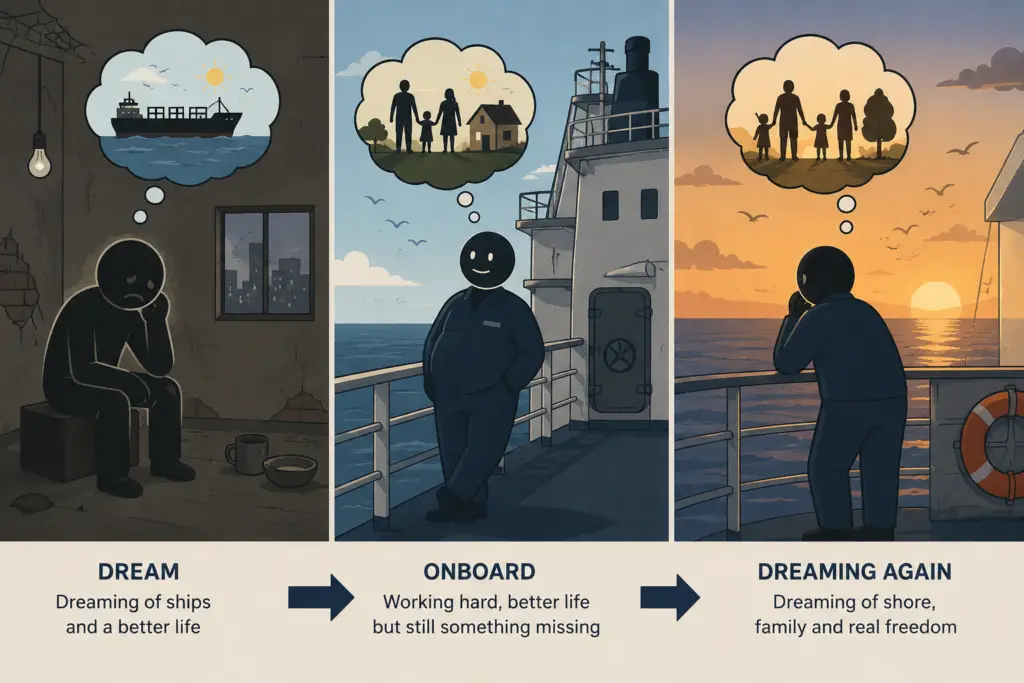
At the beginning of our careers, almost everyone has the same dream.
“I will work for 10 months, save enough money, build some wealth, and leave the sea within five years.”
But here we are.
Many of us are still trapped onboard.
Even when inflation increases, salaries often do not increase at the same rate. Meanwhile, seafarers continue to face dangerous working conditions, vessel attacks, accidents and, in the worst cases, the deaths of crew members.
So for a moment, compare yourself with someone working ashore.
What if you were an Uber driver in Europe, a delivery driver in the UK, or an Amazon warehouse worker in the United States?
To be honest, until you reach Chief Officer level, a seafarer’s income is not always dramatically higher than some shore-based jobs. In some cases, ratings and junior officers may earn similar amounts—or even less—than workers in certain developed countries.
We are the people who keep global trade moving, yet we often struggle to receive even the basic things we ask for.
We stay far away from our loved ones.
We work through rough weather.
We accept responsibility for millions of dollars of cargo and equipment.
And when our contract finally comes to an end, we sometimes hear:
“Sorry, there is no reliever available.”
Or:
“The crew change has been postponed.”
How many of you have received a joining offer only 24 hours before you were expected to board a ship?
I have rejected two such offers myself.
They called me only 24 hours before joining.
Can you imagine being told today that you have to join a ship tomorrow, knowing that you may be away from your family for months?
Why Do Crew Changes Get Delayed?
There are many reasons.
Sometimes the port does not allow a crew change. This can happen in some ports, although it is not always a valid reason.
Sometimes the seafarer does not have the required visa.
Sometimes nobody thought about the visa requirement until the last minute.
Sometimes the reliever becomes sick.
Sometimes the reliever has a family emergency.
Sometimes the company wants to change several crew members at the same time to reduce costs.
And sometimes the company simply wants to wait for a cheaper port.
These are some of the most common reasons why seafarers are forced to extend their contracts.
But do you know what I believe is one of the biggest reasons?
During my career, I have rarely seen a crewing operation that I would describe as truly professional and well-organized.
Think about your previous crewing agencies.
Do you really trust them?
Do you really believe every email they send regarding your contract extension?
Why do so many seafarers onboard automatically become suspicious when they receive an email saying that their contract needs to be extended?
Because, unfortunately, there have been too many situations involving poor communication, excuses, disorganization and, sometimes, simple lies.
Imagine the responsibilities onboard.
As a Captain, you cannot simply say:
“I couldn’t prepare the pre-arrival forms on time.”
As a Chief Engineer, you cannot say:
“I couldn’t complete the fuel oil changeover.”
As a rating, you cannot say:
“I couldn’t prepare the pilot ladder on time.”
If these jobs are not completed, there can be serious consequences.
But when it comes to the office side, crew changes sometimes seem much easier to postpone.
There is a lack of professionalism in some parts of this process.
And there are two sides to the story.
If the head of a crewing department has a strong seafaring background, they usually understand what contract extensions mean to people onboard. They know how difficult it can be for a seafarer to remain onboard for another two or three weeks.
But someone without a seafaring background may see the situation differently.
Crew Changes Are Also About Money
If you run a vessel, you know approximately how much fuel the ship will consume at a certain speed.
You calculate your voyage based on those figures.
You cannot simply tell the Chief Engineer:
“From now on, use half the fuel.”
Fuel is a necessary operating cost.
Crew changes are also a cost.
But unlike fuel consumption, there is sometimes a certain flexibility with crew-change dates.
Now imagine a company with a fleet of 20 vessels.
If every crew change is extended by an average of 15 days, the company may potentially save a significant amount of money over the course of a year.
That saving goes directly into the owner’s pocket.
And for a crewing agency, it can become an opportunity to show the owner:
“Look how much money we saved on crew changes.”
But what happens when a crew member stays onboard too long?
Motivation decreases.
Mental fatigue increases.
Patience becomes shorter.
People become angry and frustrated.
And eventually, the risk of human error increases.
A single mistake caused by an exhausted or demotivated seafarer can cost millions of dollars.
In the worst case, it can even result in the loss of a vessel or human life.
Companies usually prepare financially for bad-case scenarios. They have insurance, emergency procedures and contingency plans.
But somehow, the consequences of prolonged contract extensions are often underestimated.
The “Office Worker” Mentality
Unfortunately, some crewing agencies are a very good example of what I would call the “office worker mentality.”
On paper, everything looks perfect.
The documents are complete.
The schedules look organized.
The spreadsheets are updated.
But sometimes the people managing the process are not fully aware of what is actually happening onboard.
They wait until the last moment.They start making calls,discover that a visa is required,realize that a certificate has expired,discover that the reliever is not available.
And suddenly, the easiest solution is:
“Let’s extend the crew onboard.”
I believe that a large percentage of contract extensions are caused by poor planning, incompetent management or a lack of organization within the crewing process.
Imagine a crewing department with a fixed monthly budget for crew changes.
Suppose they have planned 10 crew changes.
If they find a cheaper port or cheaper crew-change option, they may wait for that opportunity because the company will be happier with the lower cost.
Unfortunately, cheaper does not always mean better.
In some countries, crewing agencies may also have closer relationships with government authorities or other institutions. This can sometimes make it more difficult for seafarers to complain or demand their rights.
A seafarer may simply be expected to say:
“Yes, sir.”
And this is how shipowners can gradually create an environment where they have a large pool of workers who are willing to accept almost anything.
When Personal Connections Matter
I have also seen situations where personal connections make a big difference.
For example, I once knew an officer who had a close friend working in a crewing agency.
Because of that connection, he could arrange certain visas or documentation much more easily than other seafarers.
This creates another problem.
If some people can solve their problems through personal connections while others have to wait weeks or months, the system is clearly not equal.
The people working in the office may benefit from these relationships, while the seafarer’s personal life and mental health become secondary considerations.
And if you have a Captain onboard who always says “yes” to the office, never challenges the crewing department and is willing to accept every extension request, that Captain may become very valuable to the company.
But is that good for the vessel?
I don’t think so.
Most Crew Changes Can Be Planned in Advance
Let’s imagine that a crewing agent calls you today and says:
“You will join a vessel within 10 days. The vessel is going to the United States.”
The first questions should be simple:
Do you have a US visa?
Are all your STCW certificates valid?
Is your medical certificate valid?
Is your seaman’s book valid?
Is your passport valid?
If everything is confirmed, the company already knows that you are ready.
The only uncertainty may be the exact crew-change location, such as whether the vessel will be at anchor or alongside.
The same applies to Europe.
If you have a valid Schengen visa and the vessel is expected to call at a European port within the next 10 days, the company can plan accordingly.
If the vessel is going to Singapore and everyone knows that crew changes are planned there, why wait until the last day to call the seafarer?
The Captain sends the ETA months in advance.
The information is available.
The documents can be checked.
The flights can be arranged.
The reliever can be prepared.
So why does everything sometimes happen at the last minute?
Poor organization on the shore side creates unnecessary problems for everyone.
What About Seafarers From Developed Countries?
Now let’s look at another important question.
What happens to seafarers from developed countries?
Are they facing exactly the same problems?
In many cases, their situation can be very different.
If you are a citizen of a developed country, you generally have stronger legal protections and access to government systems that can help protect your employment rights.
You may pay a lot of taxes, but you can also expect a certain level of protection from the system.
For example, imagine a US citizen working under short-term contracts.
A contract extension may not be treated as something that can simply continue indefinitely. The company may have to plan the employment period much more carefully.
Even if the seafarer is not working in US waters, the company may arrange the contract around the vessel’s schedule so that the seafarer can finish the agreed period and leave the vessel at a suitable port.
Some contracts can be only four to eight weeks long.
The vessel may leave China, cross the Pacific and eventually reach the United States, where the seafarer signs off.
The same can be true for German seafarers working on German-flagged vessels.
Depending on the employment arrangement, some may have long-term contracts similar to shore-based employment, with schedules such as two months onboard and two months off, or other rotational systems.
They may continue receiving a salary throughout the year.
Imagine finishing two months onboard, travelling home, spending your time with your family, and already knowing when and where your next assignment will begin.
You know your joining date.
You know your sign-off date.
You can plan your life.
For many seafarers from other countries, this level of certainty is still a dream.
We Accepted the Job—but Did We Accept Everything?
Contract extensions are a headache.
Missing relievers are a headache.
Cancelled flights are a headache.
Cancelled family holidays are a headache.
Missing weddings, birthdays and important family events can be heartbreaking.
And losing the opportunity to be with your family when someone passes away is something you can never get back.
Some people will say:
“That’s part of the job.”
Maybe it is.
We chose this profession,accepted that we would spend months away from our families challange rough weather,difficult working conditions high responsibility.
But did we accept being treated as if our personal lives do not matter?
Did we accept unlimited contract extensions?
Did we accept poor planning?
Did we accept being informed at the last minute?
I don’t think so.
We accepted the responsibility of being seafarers.
We did not give up our right to be treated professionally.
Until we become financially independent, many of us will continue to depend on this industry.
And sometimes, that means accepting things we should not have to accept.
Maybe the only thing we can do for now is remind ourselves:
Our time matters too.
Because behind every contract extension is not just a name on a crew list.
There is a husband.
A wife.
A father.
A mother.
A son.
A daughter.
A family waiting at home.
And they are waiting for their seafarer to come back.
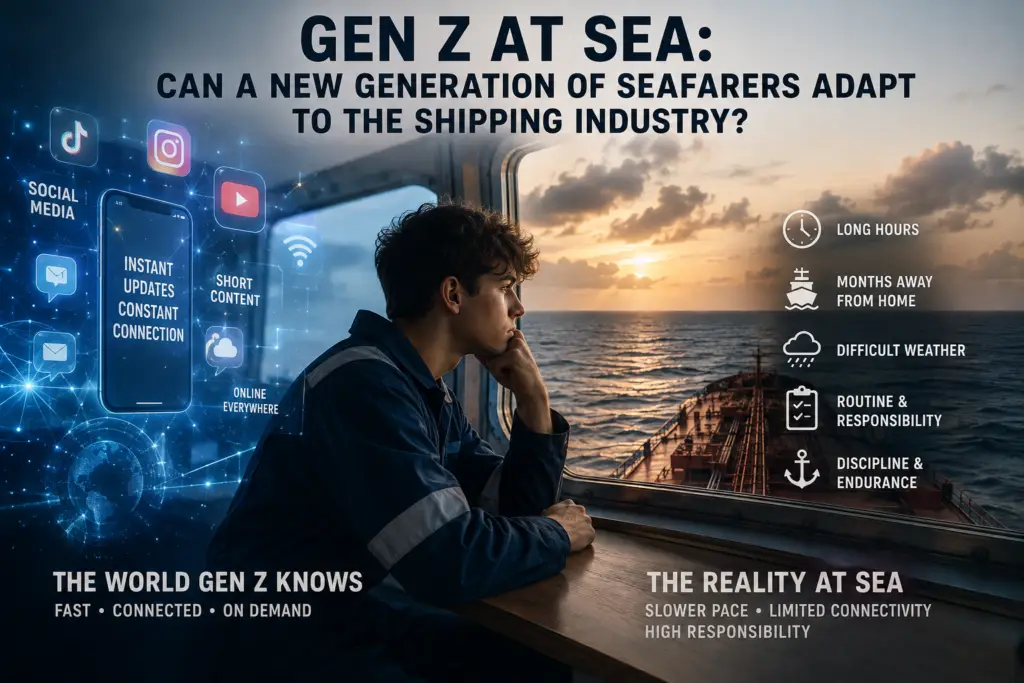
The maritime industry has always been built around discipline, patience and endurance. Seafarers are expected to work long hours, deal with difficult weather, spend months away from home and remain professional under pressure.
But a new generation is entering the industry.
Generation Z, generally referring to people born between the late 1990s and early 2010s, is now becoming part of the modern maritime workforce. Compared with previous generations, Gen Z has grown up with smartphones, social media, instant communication and rapid technological development.
This raises an important question for shipping companies:
Can traditional shipboard working culture adapt to the expectations of a new generation of seafarers?
The answer could have a major impact on the future of the maritime industry.
Gen Z Has Never Known a World Without Instant Communication
One of the biggest differences between Gen Z and previous generations is their relationship with technology.
For many young people today, information is available within seconds. A smartphone can provide entertainment, communication, news, education and social interaction almost anywhere in the world.
Short-form content such as TikTok, Instagram Reels and YouTube Shorts has also changed the way people consume information. Content is fast, visual and constantly changing.
Life at sea is almost the complete opposite.
A vessel may travel at around 15–20 knots and still require weeks or even months to complete a voyage. There may be long periods when nothing significant happens. A seafarer can spend days watching the horizon, maintaining equipment, completing paperwork or waiting for the next port.
For someone who has grown up with constant stimulation, this lifestyle can be a significant adjustment.
Imagine asking a 20-year-old cadet to spend several months on a ship, away from friends and family, with limited entertainment and a completely different daily routine.
The challenge is not necessarily that Gen Z is unwilling to work.
The challenge may be that the psychological environment they grew up in is very different from the environment found on board a ship.
Is Gen Z Really Less Patient?
There is a common argument that younger generations have shorter attention spans and less patience because of social media.
There may be some truth behind this perception, but the situation is more complicated.
Gen Z has also grown up in a period of rapid technological change. They are generally comfortable learning new digital tools, communicating online and adapting to new technology.
Shipping is becoming increasingly digital. Electronic navigation, automation, remote monitoring, digital reporting, advanced cargo systems, artificial intelligence and other technologies are changing the way ships operate.
A generation that is already comfortable with technology may therefore be particularly well positioned to adapt to the digitalisation of shipping.
The problem may not be their ability to work.
The problem may be how we teach them to work.
The Traditional Shipboard Culture
Anyone who has worked on ships knows that life at sea is not easy.
Seafarers can be required to work long hours, operate machinery in difficult conditions, deal with heavy weather and remain alert during emergencies.
There are also night watches, cargo operations, port manoeuvres, drills and unexpected situations that can interrupt sleep and personal time.
Consider a winter manoeuvring operation.
It is the middle of the night. The temperature is -10°C. The vessel is preparing to manoeuvre, and a young crew member is required on deck.
For an experienced seafarer, this may simply be part of the job.
For a young person who has never experienced this type of environment, it can be a completely different psychological experience.
They may not immediately think:
“This experience will make me stronger.”
They may think:
“Why am I doing this?”
And if the answer is never properly explained, they may eventually decide that they do not want the job.
This is where maritime leadership becomes extremely important.
“We Suffered, So You Should Too” Is Not the Answer
One of the biggest problems in a multi-generational workplace is the belief that younger seafarers should experience exactly what previous generations experienced.
Older seafarers often had extremely difficult careers. Many worked without modern communication systems, had limited access to the internet, spent long periods away from their families and experienced working conditions that would be unacceptable today.
Their experience deserves respect.
But that does not necessarily mean the industry should reproduce every difficulty they experienced.
There is a dangerous mentality in some workplaces:
“We suffered, so you should suffer too.”
This approach may create unnecessary conflict between generations.
A better approach would be:
“We experienced these difficulties. Let us explain why they happened, what we learned from them and how we can make the next generation better prepared.”
Gen Z does not necessarily need a softer maritime industry.
It may need a better-managed maritime industry.
Training Gen Z Requires a Different Approach
Traditional shipboard training can sometimes be based on observation, repetition and direct instruction.
These methods remain important, particularly for safety-critical operations.
However, younger seafarers may respond better when the purpose behind a task is clearly explained.
Instead of simply saying:
“Do this because I told you to.”
A senior officer could explain:
“This is why we are doing it this way. This is the risk we are controlling, and this is what could happen if we do it incorrectly.”
That small difference can have a major effect.
Young seafarers often want to understand the reason behind a procedure rather than simply follow an instruction without context.
This does not mean that a ship should become a democracy.
The Master remains the Master. Officers remain responsible for their duties, and safety procedures must be followed.
But authority and explanation can exist together.
Mentoring Could Become More Important
One of the most effective ways to help younger seafarers adapt could be a stronger mentoring culture.
A cadet or junior officer may be afraid to ask a senior officer what they consider to be a basic question.
If they receive a negative reaction, they may stop asking.
That can create a serious problem.
A good senior officer should be able to say:
“You don’t know it yet. That’s why you are here to learn.”
A simple mentor system could help young seafarers understand not only what they are doing, but also why they are doing it.
This could include:
Regular discussions between senior and junior crew members
Clear training objectives
Short practical learning sessions
Constructive feedback
Opportunities to ask questions without embarrassment
Clear explanations of career progression
Greater involvement in practical operations
For a young seafarer, having one experienced person on board who is willing to teach rather than simply criticise can make a significant difference.
Connectivity Is No Longer a Luxury
There is another major difference between generations: communication with the outside world.
Previous generations could spend weeks or months at sea with very limited communication with their families.
Today, connectivity has become an important part of life at sea.
Video calls, messaging applications and social media allow seafarers to remain connected with their families and friends.
For Gen Z in particular, constant digital communication is normal.
Therefore, reliable internet access should increasingly be considered part of crew welfare rather than simply an entertainment benefit.
A seafarer who can speak to their family after a difficult day may be psychologically better prepared to continue working.
This is particularly important for young crew members experiencing their first contract.
Gen Z May Actually Help Maritime Technology
There is an interesting contradiction here.
The same generation that some people describe as impatient may also be one of the most technologically adaptable generations entering shipping.
Modern ships are becoming more dependent on digital systems.
Electronic navigation systems, automated machinery, digital documentation, remote monitoring and data-driven operations are becoming increasingly common.
Young seafarers who have grown up using smartphones and computers may adapt quickly to these systems.
The industry therefore needs to avoid viewing Gen Z only as a challenge.
They could also become one of shipping’s biggest technological advantages.
The key is to connect their technological skills with traditional maritime knowledge.
A young officer who understands both traditional seamanship and modern digital systems could become extremely valuable to the future shipping industry.
But Gen Z Is Not the Same Everywhere
It is also important not to treat Gen Z as one single group.
A 20-year-old from a wealthy country and a 20-year-old from a developing country may have completely different expectations about work.
For some young people, leaving a ship after a difficult contract may be a realistic option.
For others, the salary from a maritime job may be essential for supporting their family.
Economic conditions therefore influence how young people perceive difficult working environments.
This is one reason why general statements such as “Gen Z does not want to work hard” are misleading.
Some young people may leave a difficult job because they have other opportunities.
Others may continue working because they have no alternative.
The maritime industry is global, and its workforce comes from very different social and economic backgrounds.
The Real Threat: Losing Young Seafarers
The biggest concern should not be whether Gen Z likes ships.
The real question is whether the maritime industry can retain enough young people to replace the experienced seafarers who will eventually leave the workforce.
Shipping already depends heavily on a global workforce.
Experienced captains, chief engineers, chief officers and other senior crew members cannot be replaced overnight.
Training a competent seafarer takes years.
If large numbers of young people enter the industry but leave after one or two contracts, shipping companies could face a serious manpower problem in the future.
This makes retention just as important as recruitment.
Hiring young people is not enough.
The industry needs to give them a reason to stay.
Shipping Does Not Need to Become Easy
There is an important distinction between making shipping more attractive and making shipping easier.
Ships will always require discipline.
Cargo operations will remain dangerous.
Bad weather will still exist.
Emergency situations will still require people to work under pressure.
A vessel will still need crew members who are willing to wake up at 3 a.m. for manoeuvring operations in freezing weather.
These realities cannot simply disappear because a new generation has different expectations.
But the way those realities are communicated can change.
Young seafarers need to understand that difficult situations are sometimes unavoidable.
At the same time, senior management should ask whether every difficult practice on board is actually necessary.
Hard work is part of shipping. Unnecessary hardship does not have to be.
The Future Captain May Need to Be a Better Mentor
The maritime officer of the future may need more than technical knowledge.
Leadership, communication and mentoring could become equally important.
A captain or chief officer managing a multinational crew already needs strong interpersonal skills. With several generations working together, these skills will become even more important.
The future leader may need to know when to be strict, when to explain, when to listen and when to support.
That does not mean lowering standards.
In fact, good communication can make standards stronger.
A young seafarer who understands why a safety procedure matters may be more likely to follow it correctly than someone who follows it only because they are afraid of punishment.
Can Gen Z Adapt to Life at Sea?
Yes.
But the maritime industry must also adapt.
Every generation enters the workforce with different expectations.
Previous generations adapted to the ships of their time. Gen Z will need to adapt to the realities of maritime life as well.
However, shipping companies cannot expect the next generation to behave exactly like the previous one.
The industry is changing.
Ships are becoming more technologically advanced. Communication is improving. Automation is increasing. Crew welfare is receiving greater attention.
The people operating these ships are changing too.
Perhaps the future of shipping does not depend on forcing Gen Z to become exactly like previous generations.
Perhaps it depends on combining the resilience and practical experience of older seafarers with the technological ability and new perspectives of younger ones.
The sea will always be difficult.
The question is whether we can build a maritime industry where young people are prepared to face those difficulties — rather than simply being expected to tolerate them.
Shipping needs strong seafarers. But strength does not always mean suffering in silence. Sometimes, real strength comes from learning how to adapt.
How many seafarers are there in the world? Explore the latest 2026 BIMCO figures, the largest seafarer-supplying countries, global demand and 2030 forecasts.
The global maritime industry relies on millions of seafarers working on merchant ships around the world. According to the latest BIMCO Seafarer Workforce Report, there are approximately 2.5 million seafarers serving the global merchant fleet.
With almost 85,000 vessels in the global fleet, seafarers remain one of the most important parts of the international shipping industry.
So, which countries supply the largest number of seafarers? And how many officers and ratings are currently working at sea?
Which Countries Have the Most Seafarers?
According to estimates of national contributions to the current global supply of seafarers, the five countries supplying the largest number of seafarers in 2026 are the Philippines, India, China, Russia, and Indonesia.
Together, these five countries account for approximately 56.25% of the global seafarer workforce.
The estimated number of officers and ratings supplied by each country is:
Philippines: 203,179 officers and 256,968 ratings
India: 140,718 officers and 171,218 ratings
China: 110,893 officers and 199,107 ratings
Russia: 85,816 officers and 153,541 ratings
Indonesia: 72,304 officers and 110,940 ratings
The figures demonstrate how strongly the global maritime workforce depends on Asian seafarer supply, with the Philippines, India, China, and Indonesia among the world’s most important sources of maritime manpower.
Philippines: The World’s Largest Seafarer Supplier
The Philippines has remained the world’s leading seafarer-supplying country for decades, making its maritime workforce one of the most important in the international shipping industry.
The country’s success has developed over many years through maritime education, training institutions, government-supported programs, and strong connections with international shipping companies.
The rise of Filipino seafarers is also an interesting example of how an Asian country became one of the most important suppliers of manpower to the global shipping industry.
The global seafarer workforce is also becoming more diverse.
The BIMCO report indicates that the number of female seafarers increased significantly in 2026, with much of this growth concentrated in officer positions.
Only one administration reported a decline in the number of female seafarers, and this decrease was recorded among deck ratings. Meanwhile, the majority of respondents reported that the number of female ratings had remained broadly unchanged.
Although women still represent a relatively small proportion of the global seafarer workforce, the continued increase in female officers is a positive development for the maritime industry.
How Many Seafarers Are Needed Worldwide?
The global demand for STCW-certified seafarers is estimated at 2,547,790 seafarers in 2026.
This includes:
1,088,080 officers
1,459,710 ratings
The demand for STCW-certified seafarers has increased by approximately 35% compared with the previous reports published in 2021 and 2015.
The increase has been particularly significant among ratings. Compared with 2021, global demand for officers has increased by 23.1%, while demand for ratings has increased by 46.3%.
Global Seafarer Demand in 2026
Seafarer Category
Global Demand
Officers
1,088,080
Ratings
1,459,710
Total
2,547,790
These figures highlight the continuing challenge faced by the shipping industry: the global merchant fleet requires a large and continuously available pool of qualified seafarers.
Which Ship Types Need the Most Seafarers?
The demand for seafarers is not distributed equally across all sectors of the merchant fleet.
According to the BIMCO report, the three industry segments responsible for the largest shares of global demand for STCW-certified officers are:
General cargo ships – 21.4%
Bulk carriers – 18.9%
Cruise ships – 14.0%
These sectors also account for some of the highest demand for ratings.
For ratings, the largest shares of demand are:
Cruise ships – 22.5%
Bulk carriers – 18.4%
General cargo ships – 18.0%
The cruise industry is particularly interesting for European seafarers, as cruise companies continue to employ officers and ratings from a wide range of European countries.
The demand for seafarers is expected to continue increasing over the coming years.
According to the baseline forecast, global demand in 2030 is expected to reach:
1,162,716 officers
1,558,973 ratings
This represents a continued increase in demand for qualified maritime professionals as the global merchant fleet expands and shipping companies face the need to replace retiring seafarers.
Projected Global Seafarer Demand in 2030
Seafarer Category
Projected Demand
Officers
1,162,716
Ratings
1,558,973
Total
2,721,689
The baseline forecast estimates that the shipping industry will need approximately 22,747 additional officers every year to meet projected officer demand in 2030.
This represents roughly a 2% annual increase in the number of officers required.
The report also provides alternative scenarios based on different levels of global fleet growth, including high-growth and low-growth forecasts for officer and rating demand in 2030.
The Future of the Global Seafarer Workforce
The numbers show that seafarers will remain essential to the global shipping industry throughout the coming decade.
The continued growth in demand for STCW-certified officers and ratings could create new opportunities for maritime professionals, particularly in countries that already have strong maritime education and training systems.
At the same time, the shipping industry will need to address several challenges, including the recruitment and retention of qualified officers, the increasing demand for specialized skills, and the need to attract more young people to maritime careers.
Countries such as the Philippines, India, China, Russia, and Indonesia are likely to remain major suppliers of seafarers, while demand for qualified maritime professionals is expected to continue growing as the global fleet develops.
For anyone considering a career at sea, these figures demonstrate that the maritime industry continues to offer opportunities for qualified deck officers, engine officers, and ratings around the world.
Survival of a nation from zero to hero of the shipping industry…
According to the latest BIMCO report, there are currently around 2,565,580 seafarers working in the global maritime industry. The distribution of seafarers by nationality shows one country standing clearly above the rest: the Philippines.
But how did this happen?
When did the Philippines become one of the world’s largest suppliers of seafarers? Why have Filipino seafarers remained so important to the international shipping industry for decades? And what are the real reasons behind this success?
To understand the answer, we need to go back several decades.
The Early Years of Filipino Seafarers
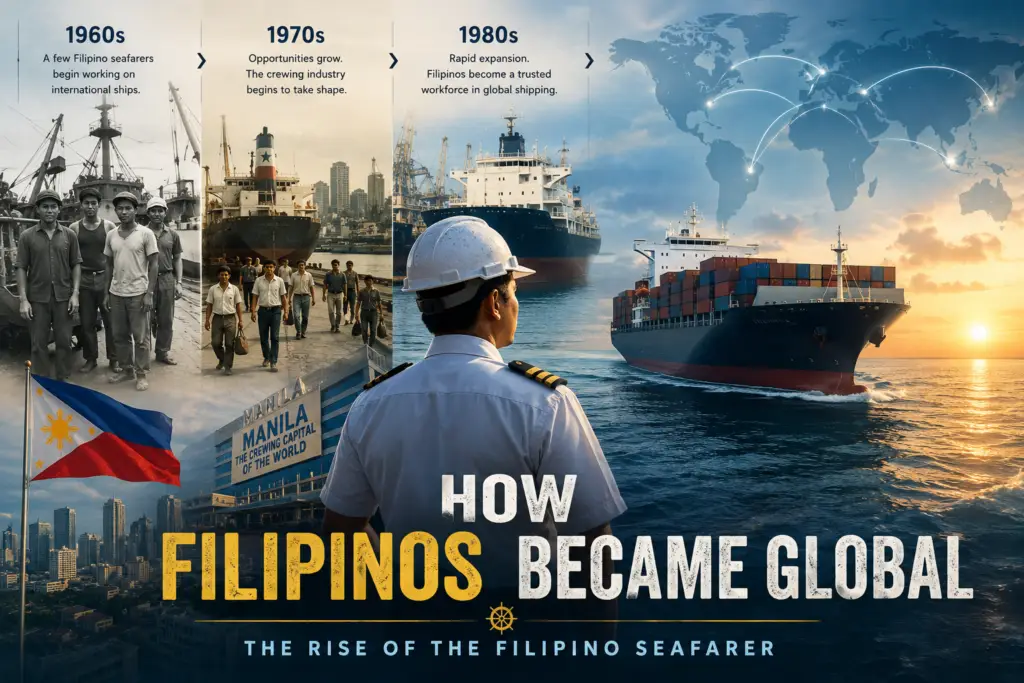
In the 1960s, it was estimated that only around 2,000 Filipino seafarers were working on international ships.
By 1975, this number had increased to approximately 23,534, and the number continued to grow during the following years (McKay, 2007).
The growth became particularly significant during the 1980s. By the end of that decade, the number of Filipino seafarers had increased dramatically, and the Philippines had established itself as one of the world’s most important sources of maritime labour.
Since around 1987, the Philippines has remained at or near the top of the global rankings for supplying seafarers.
So how did a country that had only a few thousand seafarers working internationally in the 1960s become a global maritime labour powerhouse?
The answer is not simply cheap labour.
It was the combination of English-language skills, overseas employment, government policy, maritime education, private crewing companies, international standards, and the growing demand for lower-cost seafarers.
Why Did the Philippines Have the Right Conditions?
The rise of Filipino seafarers cannot be separated from the country’s history.
The Philippines spent centuries under Spanish rule before coming under American control. The American period had a particularly important long-term effect on the country because English became deeply established in the education system and wider society.
This later became one of the Philippines’ biggest advantages in the international maritime labour market.
At the same time, the Philippines was a developing country with limited domestic employment opportunities. Working overseas therefore became an increasingly attractive option for many Filipinos.
For many families, overseas employment offered something that was difficult to find at home: higher wages and the ability to send money back to their families.
This created a strong culture of overseas employment.
Filipinos began working in many different sectors around the world, and maritime employment became one of the most important of them.
The Philippines had the foundations of a global maritime labour market.
The Oil Crisis Changed the Shipping Industry
The 1970s were a turning point for the global shipping industry.
The oil crisis dramatically increased operating costs and created serious financial pressure for shipowners. Labour costs became an increasingly important issue, particularly for shipping companies operating large fleets.
Shipowners therefore began looking for ways to reduce operating expenses while still maintaining safe and efficient operations.
This created an opportunity for countries that could provide trained seafarers at competitive costs.
The Philippines recognized this opportunity.
Instead of treating overseas maritime employment simply as individual migration, the country increasingly developed it into an organized industry.
The government supported the development of maritime education, training institutions and manning agencies, while private companies became increasingly involved in recruiting and supplying Filipino seafarers to international shipowners.
This was one of the most important developments in the history of Filipino seafarers.
From Individual Workers to an Organized Crewing Industry
During the early stages, Filipino seafarers were gradually introduced into international ship crews.
According to accounts from seafarers and historical discussions of the period, Filipino workers were initially employed heavily in ratings positions. As shipowners became more familiar with Filipino crews and gained confidence in their performance, their presence expanded to other positions onboard.
This created an important feedback loop.
More Filipino seafarers gained experience.
More shipowners became familiar with Filipino crews.
More manning agencies were established.
More Filipino workers entered the industry.
And the cycle continued.
This can be described as a classic network effect:
More shipowners → More manning agencies → More Filipino seafarers → More experience → More international trust → More shipowners
Once this cycle started, the industry became increasingly difficult for competitors to catch.
The Birth of the Philippine Crewing Industry
The development of the manning industry was another major turning point.
During the early 1970s, manning companies in Manila began to organize themselves more formally. By the middle of the decade, industry associations were being established to represent companies involved in the employment of Filipino seafarers.
This helped transform Manila into one of the most important centres of international maritime recruitment.
The growth of private crewing companies was particularly important because the industry was closely connected to the needs of foreign shipowners.
Instead of simply producing maritime graduates, the Philippines was developing a system designed to connect those workers directly with the international shipping market.
This distinction is extremely important.
The Philippines was not only producing seafarers.
It was building a maritime labour export industry.
Maritime Education Became a Major Part of the Strategy
Training was another critical part of the process.
As the demand for Filipino seafarers increased, the country needed institutions capable of producing larger numbers of qualified maritime professionals.
Maritime schools, training centres and other educational institutions expanded.
One important development was the establishment of the National Maritime Polytechnic in 1978, which later became an important institution for maritime training and research in the Philippines.
The objective was increasingly clear:
Produce seafarers who could meet international standards and work effectively on foreign-owned ships.
This became even more important as international maritime regulations developed.
International Standards Gave the Philippines Another Advantage
Cheap labour alone cannot explain the long-term success of the Philippines.
A shipowner cannot simply hire inexpensive workers. Seafarers must also have the necessary qualifications, training and certification.
This is where compliance with international maritime standards became extremely important.
The Philippines worked toward aligning its maritime education and training system with international requirements, including the standards associated with the STCW Convention.
This allowed Filipino seafarers to become increasingly integrated into the global maritime labour market.
The strategy was therefore based on two major objectives:
Make the Philippines attractive to international shipowners and maritime employers.
Maintain the country’s position as a reliable supplier of internationally qualified seafarers.
The second objective was just as important as the first.
If Filipino seafarers had been inexpensive but poorly trained, the industry would not have survived for decades.
The Philippines needed to become both competitive and reliable.
But India Had Already Started Building a Maritime Labour System
At this point, an interesting question appears.
If the oil crisis and maritime labour demand created such a major opportunity in the 1970s, why did the Philippines eventually become more dominant than India?
India had already developed organized maritime employment institutions much earlier.
For example:
1954 → Mumbai Seamen’s Employment Office
1955 → Calcutta Seamen’s Employment Office
India also had a huge population and a long history of maritime employment.
Today, India remains one of the world’s largest suppliers of seafarers.
So why did the Philippines manage to build such a strong position despite having a much smaller population?
Philippines vs. India: Why Did the Philippines Gain the Advantage?
There is no single answer.
Several factors appear to have worked together.
1. English Language
One of the Philippines’ biggest advantages was English proficiency.
Because of the historical influence of the United States and the use of English throughout the education system, Filipino workers were relatively well positioned to communicate with international employers.
English is extremely important onboard ships.
The captain, officers, ratings and shore management may come from completely different countries.
A common working language is therefore essential.
The Philippines already had a large population of workers who could operate in an English-speaking environment.
2. Strong Overseas Employment Networks
Another important advantage was the development of an established overseas employment system.
Once thousands of Filipinos began working abroad, networks developed around them.
Families became familiar with overseas employment.
Recruitment agencies developed experience.
Training centres expanded.
Shipowners became familiar with Filipino crews.
And experienced seafarers could recommend the industry to younger generations.
This created a self-reinforcing system.
3. Private Manning Companies
The growth of private crewing companies was perhaps one of the most important differences.
The Philippine maritime labour industry became strongly connected to international shipowners through private manning agencies.
These companies had a direct commercial incentive to understand what foreign shipowners wanted.
If a shipowner wanted properly trained seafarers, the agencies had to provide them.
If a shipowner wanted lower costs, the agencies had to remain competitive.
If a shipowner wanted reliable crews, the agencies had to build a reputation for reliability.
In other words, the market itself created pressure to meet the requirements of international shipowners.
Why Shipowners Kept Coming Back
This is where the Filipino seafarer story becomes particularly interesting.
Shipping is an extremely international industry.
A vessel may be owned by a company in one country, managed from another, registered under a third country’s flag and operated by a crew consisting of people from five or six different nationalities.
For shipowners, therefore, reliability and predictability are extremely valuable.
A shipowner does not only consider salary when selecting a nationality.
They also consider:
Training quality
English communication
Availability of crew
Certification
Experience
Cultural compatibility
Contract flexibility
Labour costs
Reliability
Existing relationships with manning companies
The Philippines gradually developed strengths across many of these areas.
Once a shipowner had a positive experience with Filipino crews, there was a strong incentive to continue using the same labour source.
That created another powerful cycle:
Good experience → More trust → More Filipino crew contracts → More experienced Filipino seafarers → More experienced officers → More trust
This is one of the main reasons the Philippines was able to maintain its position for such a long period.
The Government’s Role
The government played an important role, but the story was not simply about government control.
The Philippine model increasingly combined government regulation and support with private-sector participation.
The government could establish regulations, education standards and international compliance requirements.
Private companies could then connect Filipino workers with foreign shipowners.
This combination created an environment where the maritime labour market could grow rapidly.
The strategy was relatively simple:
Train the workers → certify the workers → connect them with foreign employers → gain international experience → build trust → expand the industry.
Over time, this became one of the Philippines’ most important economic advantages.
Why Filipino Seafarers Became Global
The rise of Filipino seafarers was therefore not caused by one event.
It was the result of several factors coming together at exactly the right time.
The Philippines had:
A large working-age population
Relatively low labour costs
Strong English-language skills
A growing culture of overseas employment
Maritime education and training institutions
Private crewing companies
Government support and regulation
International maritime certification
Increasing experience with foreign shipowners
A growing global reputation
The oil crisis created the opportunity.
The government helped build the framework.
Private manning companies connected the workers with international shipping companies.
Maritime schools produced the workforce.
And shipowners provided the demand. Once these elements came together, the industry created its own momentum.
If you wonder future of shipping compare to Asian and European officer and rating issues , read this article
European vs Asian seafarers: why shipowners often rely on Asian maritime labor, what this means for European officers, and how the industry may evolve.
The maritime industry has always been international. Ships operate across borders, and crews are often made up of people from many different countries.
But there is an interesting question that is becoming increasingly relevant:
What will happen to European officers as shipowners increasingly rely on Asian seafarers?
If you are interested in how Filipinos become biggest workforce of the shipping industry , you can read the article
Is the future of the maritime industry going to be dominated by lower-cost Asian labor, while European officers move toward specialized vessels and shore-based positions?
To understand this, we need to look at several different factors, including nationality restrictions, crew costs, contract duration, established maritime labor markets, and the changing expectations of seafarers.
Are Seafarers Allowed to Work on Ships of Any Nationality?
In theory, shipping is a global industry.
An officer with a valid Certificate of Competency (CoC), the necessary endorsements, and the required qualifications can potentially work for a foreign company or on a foreign-flagged vessel.
However, in reality, nationality restrictions still exist in several countries.
The United States is one of the best-known examples.
The Jones Act, formally Section 27 of the Merchant Marine Act of 1920, regulates transportation of goods between U.S. ports and includes requirements relating to U.S.-built, U.S.-flagged, and U.S.-owned vessels. In certain domestic trades, additional requirements regarding U.S. citizens and workers also apply.
But the United States is not the only country where national regulations can influence crew nationality.
Countries such as Australia, Canada, Norway, Turkiye, the United Kingdom,Spain and Germany have various forms of national or regulatory requirements affecting maritime employment, depending on the vessel, trade, flag, position, and applicable agreements.
The important point is that these regulations are not always absolute.
When There Are Not Enough Local Seafarers
This is where the situation becomes more interesting.
I currently work on a German-flagged tanker, and I have seen how the shortage of national officers can create practical problems for shipowners.
German regulations have traditionally included nationality requirements for certain senior positions, while other crew members may work with the appropriate endorsements.
However, when there are not enough qualified German officers available, flexibility or exemptions can become necessary.
The reason is simple:
A ship cannot continue operating if there are not enough qualified officers available to crew it.
I have also seen a Turkish-owned vessel trading in Spanish cabotage waters where the vessel operated under the Spanish flag. The captain was Spanish, while the remaining crew members were Turkish.
Stories like these make us ask an important question:
If shipping companies can increasingly recruit internationally, what does the future look like for officers from developed countries?
Why Do Shipowners Often Prefer Asian Seafarers?
There is no single answer.
It is tempting to say that Asian seafarers are preferred simply because they are cheaper, but the reality is more complicated.
Several factors influence a shipowner’s decision.
These include:
Lower overall crew costs
Longer contract durations
Established Asian maritime labor markets
Large and experienced crewing agencies
Availability of qualified seafarers
Familiarity with multinational crews
Operational flexibility
Let’s look at these factors one by one.
1. Lower Overall Crew Costs
Shipping is a business, and crew costs are an important part of operating a vessel.
International organizations and collective agreements establish minimum wage scales for seafarers, but actual salaries can be considerably higher depending on the vessel, position, company, nationality, experience, and employment agreement.
In general, salary expectations in some Asian maritime labor markets can be lower than those expected by officers from Western European countries.
This does not necessarily mean that Asian seafarers are less qualified.
Rather, the labor market itself is different.
For a shipowner operating several vessels, even a relatively small difference in monthly crew costs can become significant when multiplied across an entire fleet.
This is one reason why shipowners may look toward established Asian maritime labor markets.
2. Contract Duration
Contract duration is another important factor.
Imagine a vessel with approximately 20 crew members.
If crew members have relatively short contracts, the company may need to arrange crew changes several times a year.
Every crew change involves costs such as:
Flights
Port agents
Immigration procedures
Transportation
Hotels when necessary
Documentation
Medical arrangements
Launch or boat services in some ports
Even if the direct cost of one crew change is relatively modest, the total can become significant over an entire fleet.
Now consider a crew structure where ratings remain onboard for around eight months and officers for around six months.
The number of crew changes can be reduced considerably.
For shipowners, fewer crew changes mean lower logistical costs and less administrative work.
Therefore, longer contract durations can be an important advantage when selecting a particular labor market.
3. Established Asian Maritime Labor Markets
Another major advantage is the established maritime labor infrastructure in countries such as the Philippines.
The Philippines has developed a huge maritime workforce and a large network of manning and crewing agencies.
This creates an ecosystem where shipowners do not necessarily have to search for individual seafarers themselves.
Instead, a company can contact a crewing agency, provide the vessel details and required positions, and request qualified candidates.
The agency may already have a large database of officers and ratings with different levels of experience.
This makes the recruitment process much easier for shipowners.
For a company operating a large fleet, this can be extremely valuable.
Instead of spending significant time searching for individual crew members, the company can rely on an established recruitment network.
4. Experience and Reliability
There is another factor that is often discussed onboard: the quality of the crew.
In practice, shipowners do not simply want the cheapest possible crew.
A cheap crew can become extremely expensive if poor performance results in:
Equipment damage
Cargo contamination
Delays
Accidents
Maintenance problems
Human-error-related incidents
Therefore, experienced shipowners often look for a balance between salary and competence.
In other words:
The cheapest seafarer is not necessarily the cheapest option for the shipowner.
A more experienced officer or rating may cost more but can potentially reduce operational risks and maintenance problems.
This is why large crewing markets can offer different levels of experience and salary expectations, allowing companies to select crews according to their operational requirements and budget.
5. Language and Multinational Crews
Modern ships are often multinational workplaces.
A single vessel can have crew members from the Philippines, India, Turkiye, Romania, Ukraine, Russia, Greece, Croatia, and several other countries.
English is generally the working language onboard international ships.
Therefore, the ability to communicate effectively in English and work within a multinational team is often more important than nationality itself.
This is another reason why countries with large and established maritime labor markets have become important suppliers of seafarers.
What About European Seafarers?
At this point, it may sound like European seafarers are simply disappearing from the industry.
I don’t think that is necessarily the case.
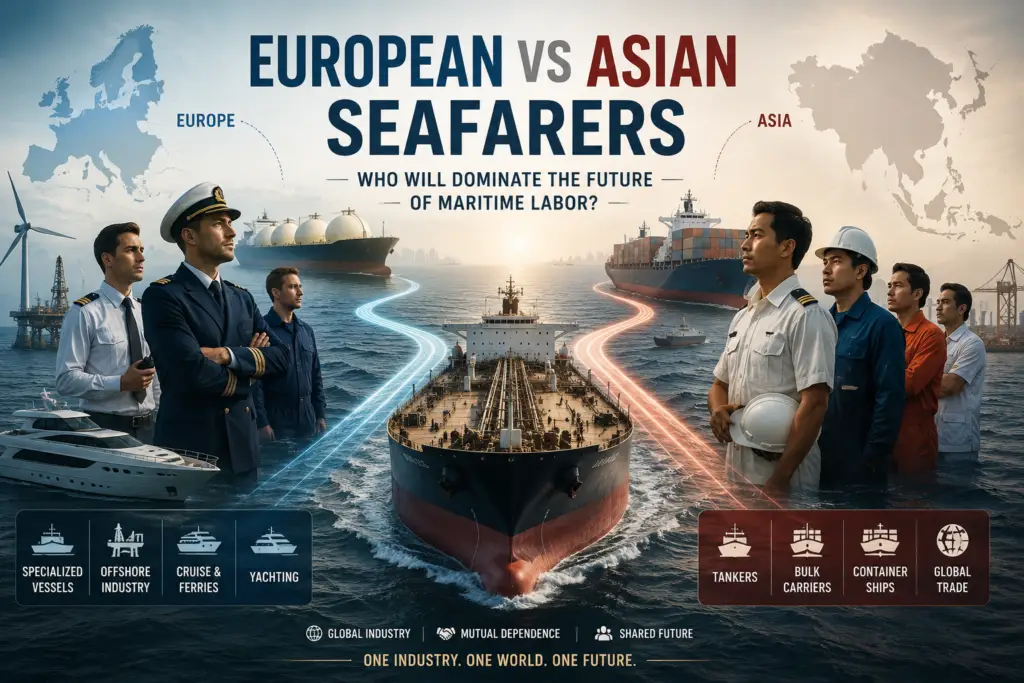
European seafarers still have important advantages, especially in specialized sectors.
They can be found in areas such as:
Northern European shipping
Offshore operations
Specialized vessels
LNG and LPG shipping
Cruise ships
Ferries
Government-related shipping
Inland European shipping
Yachting
Companies operating under strong national labor agreements
The situation is therefore more complicated than simply saying:
“Asian seafarers will replace European seafarers.”
A more realistic possibility is that the two labor markets may gradually become more specialized.
European Officers May Move Toward Specialized Jobs
European officers often have access to opportunities that may be less attractive or less available to lower-cost international labor markets.
Contract duration is also an important consideration.
Many European seafarers prefer shorter contracts and longer periods of leave.
This can make them more expensive from a shipowner’s perspective, but it can also make certain European officers attractive for specialized operations where experience, communication, local regulations, and customer expectations are particularly important.
The yachting industry is another interesting example.
For high-end yacht owners, employing officers from countries with strong maritime traditions can sometimes be seen as a sign of professionalism and prestige.
The cruise industry also continues to employ officers from Europe and North America, particularly in senior positions.
The Future May Be About Specialization, Not Disappearance
So, what will happen to European officers?
I don’t believe European officers will simply disappear from the maritime industry.
Instead, the industry may become increasingly divided into different labor markets.
Asian seafarers may continue to dominate many conventional commercial shipping positions because of the combination of availability, established crewing networks, competitive salaries, and longer contracts.
European officers, meanwhile, may increasingly concentrate on specialized vessels, offshore operations, cruise ships, ferries, yachting, inland shipping, and shore-based maritime careers.
This does not necessarily mean that one group is better than the other.
It simply means that the global maritime labor market is adapting to economic realities.
So, Is It All About Money?
Not entirely.
If it were only about salary, the cheapest possible crew would always win.
But shipping companies also care about:
Competence
Reliability
Experience
Safety
Crew stability
Communication
Vessel type
Operational requirements
Regulatory compliance
A shipowner may save money by employing cheaper crew members, but if the crew creates more operational problems, those savings can disappear very quickly.
This is why experienced shipowners often look for the best balance between cost and performance, rather than simply the lowest salary.
The Real Question: Who Will Work at Sea?
The maritime industry is often discussing a future shortage of qualified officers.
There may indeed be a shortage of seafarers in certain positions and regions.
But the more interesting question is:
Which seafarers will fill those positions?
The global maritime labor market has created strong incentives for people from developing countries to enter the profession.
In countries where maritime employment provides significantly better income than many shore-based alternatives, becoming a seafarer can be an attractive career.
This creates a continuous supply of new seafarers.
At the same time, people from developed European countries may have more attractive shore-based alternatives.
They may have stronger labor protections, shorter working hours, better social security systems, and more opportunities to build a career without spending months away from home.
This creates a completely different incentive structure.
A Changing Maritime Workforce
The maritime industry has changed over the last few decades.
In some countries, governments and educational institutions actively encouraged people to enter the maritime profession when shipping companies faced officer shortages.
As maritime academies and private training institutions expanded, the number of potential officers increased.
Today, the situation in some countries is almost the opposite.
Shipping companies can have access to large pools of qualified applicants and can select candidates according to their requirements.
This is a major change in the maritime labor market.
The industry is no longer asking only:
“Where can we find an officer?”
It is increasingly asking:
“Which officer gives us the best combination of competence, availability and cost?”
What Does This Mean for European Officers?
European officers still have a future at sea.
However, the traditional model of having large numbers of European seafarers working on every type of commercial vessel may continue to decline.
Instead, European maritime professionals may increasingly move toward positions where their experience, qualifications and local knowledge provide additional value.
This could include:
Offshore
LNG and LPG
Cruise
Yachting
Specialized vessels
Maritime administration
Pilotage
Ship management
Marine surveying
Port operations
Shore-based management
In countries such as Germany, the Netherlands, Greece, Italy, France, Norway and Denmark, the maritime industry remains extremely important.
Many globally recognized shipping companies are based in Europe.
Therefore, European maritime professionals are unlikely to disappear.
But their role in the global seafarer labor market may change.
Conclusion
The future of European and Asian seafarers is not simply a competition between two groups.
It is a result of economics, regulations, labor markets, demographics and the changing expectations of people who work at sea.
Asian seafarers are likely to remain a major part of the global commercial shipping workforce because of established maritime labor markets, large crewing networks, competitive employment costs and longer contract structures.
European officers, meanwhile, may increasingly focus on specialized sectors and positions where experience, qualifications, local knowledge and working conditions justify higher employment costs.
The global shipping industry needs both.
The real question is not:
“Will Asian seafarers replace European seafarers?”
The better question is:
“How will the global maritime labor market divide and specialize in the future?”
And from what we can see today, that process has already started.
Here is the third serie of our article of sea life if you want to start from beginning of the journey here and then for the second blog
Every milestone starts with a single step.
If you do not have the courage to start what you want, how can you ever become what you want to be?
Some of us dream of becoming a seaman. Others want to become an officer. Then, after becoming an officer, the next goal is often to become a captain. The same applies to engineers: starting as a third engineer and eventually becoming a chief engineer.
But when you finally become what you wanted to be, are you actually happy and satisfied?
Have you ever considered what you left behind, what you missed, and what you never got to see?
Is it only difficult for us to leave the people we love behind and go onboard, or are they also suffering silently without us?
There are millions of jobs in the world, so why do we choose to work onboard ships?
Are we weak or strong? Smart or foolish? Rich or poor?
Why Do People Choose a Life at Sea?
Since the beginning of my career, I have rarely seen a truly wealthy person working onboard.
Most of us come from ordinary or difficult backgrounds. We start working at sea because it offers something that many other jobs cannot: the opportunity to earn an above-average income and change our lives.
But what is the final destination?
Eventually, we will all die. Yet during our careers, many of us spend most of our time seeing only the sea and ships.
I recently met a safety officer in Fawley who told me about his life. He had worked at the terminal for more than 30 years. He started at the security gate and eventually became a safety officer before reaching retirement age.
He also told me about his brother-in-law, who built a successful business, sold it for millions, and started travelling around the world in a caravan.
Unfortunately, his brother-in-law has already passed away.
Now, this safety officer is planning to buy his own caravan and travel around the world.
The only difference between them was around ten years.
When you become wealthy, you may achieve your dreams 10 or 15 years earlier.
But eventually, death finds everyone.
What Are We Sacrificing to Work Onboard?
Okay.
If we are all going to die eventually, then why do we stay away from the people we love for so long?
At least 70% of seafarers probably start this career as a temporary 5–10 year project.
The plan is usually simple:
Work hard → earn money → buy a house → secure your future → leave the ships.
But somehow, many of us cannot escape.
Five years become ten.
Ten years become twenty.
During this time, your children grow up. Family members pass away. You miss weddings, birthdays, parties, meetings, and countless small moments that you can never get back.
And what do you earn in return?
Money.
You work hard and sacrifice part of your life for the people you love. You send your children to private schools, buy a nice car, purchase another house, and try to build wealth.
But sometimes you realise that you are collecting wealth instead of memories.
Even if you try to explain your life onboard to people ashore, they often cannot understand what you are talking about.
They do not know what a gangway is.
They do not understand the provision store, chipping and painting, cargo operations, watchkeeping, or what it feels like to spend months surrounded by the same steel walls.
At some point, you simply stop explaining.
You just continue living your life.
Life Onboard Is Not the Same Anymore
I am sure almost every seafarer had a dream before starting this career.
Some wanted to start a business.
Some wanted to build wealth and quit shipping.
Some simply wanted a decent and comfortable life.
But if you decide to become an officer between the ages of 20 and 30, you may spend around six years of your life onboard during your early career.
Six years onboard.
Think about that.
That is a significant part of your youth spent working at sea.
How many times did you actually go ashore?
How many times did you meet new people?
How many people you met during your voyages are you still in contact with today?
Older generations of seafarers were sometimes luckier in this regard.
Ships could stay in ports for weeks or even a month. Seafarers had time to explore the local area, meet people, build friendships, and sometimes even meet their future partners.
Today, the situation is very different.
For tankers and container ships, port stays can sometimes be only one or two days.
In some ports, shore leave is also restricted or difficult.
You may spend more than six months onboard, surrounded by steel, with very limited opportunities to experience the places you are actually travelling to.
So how do you enjoy the world when you barely have the opportunity to see it?
Your Mental Health Matters Onboard
Even if you have strong mental health, there can be a point where the pressure starts affecting you.
Loneliness, isolation, long working hours, separation from family, lack of shore leave, and repetitive routines can slowly become difficult to handle.
So what can keep a seafarer going?
One of the best answers is having a purpose.
Dreaming is good.
But dreaming can also be dangerous.
If you only dream about changing your life but never take action, eventually those dreams can become another source of frustration.
You start thinking:
“What if I had started earlier?”
“What if I had tried?”
“What if I had left the ship?”
That is why having a dream is not enough.
You need a plan.
What Should a Seafarer Do?
First of all, do your job properly.
Never forget that you are the most valuable thing you have.
There is an important principle in first aid: protect yourself first, because if you become unable to help, you cannot help anyone else.
The same principle applies to your career and your life.
Take care of yourself first.
Then write down your dreams.
Do not just keep them in your head.
Write them somewhere and start creating a realistic plan to achieve them.
Build Something Ashore
Since we work onboard, we cannot easily manage a traditional business from the ship.
That is why it is important to find trustworthy people ashore who can help you operate your business while you are onboard.
Try to stay involved, even when you are at sea.
And remember that being a seafarer gives you something very valuable: worldwide experience.
Use it.
For example, if you visit France and discover an amazing type of cake, learn how it is made.
If you want to open a café one day, perhaps you can bring that experience into your own business.
Every country you visit can teach you something.
Every port can give you an idea.
Every person you meet can potentially change your perspective.
Create an Income Outside Shipping
Another important goal for a seafarer can be building an income source outside the ship.
It could be a rental property, a small business, investments, or an online business.
The important thing is to build something that can continue generating income if you eventually decide to leave shipping.
Why?
Because when you leave the ships, your income can suddenly decrease.
And nobody wants to see their quality of life collapse after leaving a career they spent 10, 20, or 30 years building.
Sometimes people start seeing you only as the person who provides money.
Not as a husband.
Not as a brother.
Not as a friend.
Not as a relative.
Just as money.
And this is one of the saddest things that can happen after spending years working for your family.
Turn Your Skills Into a Business
Your experience onboard can also become an advantage ashore.
If you are a bosun, why not consider a hardware or marine equipment business?
If you are a donkeyman or an experienced engine-room worker, why not consider a welding equipment or technical supply business?
If you are an officer, your knowledge of shipping, logistics, safety, navigation, or cargo operations could potentially become the foundation of a business.
Try to connect your skills at sea with opportunities ashore.
You already have knowledge that many people do not have.
You just need to find a way to use it.
You Can Start From the Bottom
I have heard stories about people who started their careers onboard as stewards and eventually became shipowners with fleets of more than 20 vessels.
Whether every story is completely accurate or not, the principle remains the same:
Why not you?
You do not have to start with millions of dollars.
You do not need a perfect plan.
You need to take the first step.
Everything starts with a step.
Do not be afraid.
Do not be ashamed of starting small.
Do not think too small.
We work at sea and sometimes fight against waves that are more than 10 metres high.
If we can handle that, perhaps we can also handle the challenges of building a different life.
Start Small and Stay Consistent
Make your plan using small steps.
Then try to execute those steps safely and consistently.
If you feel that you do not belong on ships, that feeling may not disappear by itself.
I remember my first contract as a cadet.
I told myself:
“This job is not for me.”
Now I am a chief officer, and sometimes I still think the same thing.
The difference is that I never took serious action to change my situation.
I dreamed many times about leaving the ships, but I never really worked toward it.
If you are still young and already know that you do not want to spend your entire life at sea, take action early.
Do something that adds value to your life.
Do not only dream about it.
Wealth Does Not Always Mean Happiness
I have seen many able seamen who had more wealth than some officers and even captains.
Why?
Because when they started working, their families were not living a wealthy lifestyle.
Some came from villages or modest backgrounds.
They focused on saving and buying assets.
Meanwhile, some officers start earning a higher salary and immediately change their lifestyle.
A better car.
A bigger house.
More expensive holidays.
More spending.
Eventually, despite earning more money, they still cannot escape the ships.
Your salary does not make you wealthy.
What you do with your salary does.
What Is the Real Meaning of Life Onboard?
Life onboard a ship is not only about the sea, ships, cargo, watches, salaries, and contracts.
It is also about what you sacrifice to earn that money.
Every seafarer has a different story.
For some, working at sea is the best career they could have chosen.
For others, it is simply a way to reach another destination in life.
The important thing is knowing which one you are.
If you want to stay at sea for 30 years, there is nothing wrong with that.
If you want to become a captain, become the best captain you can be.
But if you want to leave shipping one day, do not spend 20 years only dreaming about it.
Start working toward it.
Because anyone can dream.
But only consistent action can turn a dream into reality.
Consistency is one of the most important things when achieving a dream.
Remember:
You cannot control how long you will live.
But you can control what you do with the time you have.
So take the first step.
And make it count.
Share Your Seafarer Story
Have you ever thought about leaving the ships?
What made you start working at sea?
What have you sacrificed during your seafarer career?
And if you eventually left shipping, what did you do after leaving?
If you have a story or experience you would like to share with other seafarers, send it to us through the contact section below or by email.
Your story might help another seafarer make a decision that changes their life.
Calculation is the most important part for chief officer however not the hardest one anymore
Oil tankers are designed to carry different types of petroleum products, including gasoline, fuel oil, Jet A-1, diesel, vacuum gasoil (VGO), heavy fuel oil, and many other clean and dirty petroleum products. The cargoes a particular tanker can carry depend on the vessel’s Certificate of Fitness, approved cargo list, and applicable regulations.
Once the voyage order is received, the cargo quantity is generally given in metric tonnes (MT). This is a measurement of mass. However, a tanker also has a limited tank volume, normally expressed in cubic metres (m³). Therefore, before loading, we need to make sure that the required cargo quantity will physically fit inside the available tanks.
This is where density, volume, and temperature become very important.
1. The Relationship Between Mass, Volume, and Density
The basic formula is:
Density = Mass / Volume
Therefore:
Volume = Mass / Density
If we know the cargo mass and density, we can calculate the approximate volume required and compare it with the available tank capacity.
Example: Checking Tank Capacity
Suppose tank 2P has a capacity of 2,675 m³, according to the vessel’s tank plan.
The voyage order requires:
Cargo quantity: 2,500 MT
Cargo density: 0.91 t/m³
Tank capacity: 2,675 m³
First, calculate the required volume:
Volume = Mass / Density
Volume = 2,500 / 0.91
Volume = 2,747 m³
The required volume is approximately 2,747 m³, but the tank capacity is only 2,675 m³.
Therefore, the cargo cannot fit into the tank at this quantity. The quantity must be reduced or additional suitable tank capacity must be used.
Important: This is only a basic calculation. Actual cargo planning must also consider tank restrictions, maximum filling limits, temperature, trim, stability, strength, segregation, free-water content, and the vessel’s approved loading computer/calculation procedures.
2. Why Density and Temperature Are Important
When calculating cargo capacity on an oil tanker, two of the most important factors are:
Cargo density
Cargo temperature
These factors directly affect the volume occupied by the cargo.
For example, a high-density product occupies less volume for the same mass than a low-density product.
A simple way to understand this is:
1 MT of a high-density product → relatively small volume
1 MT of a low-density product → relatively large volume
Temperature is also important because petroleum products expand when their temperature increases. This means that a cargo loaded at a relatively low temperature can occupy a larger volume after it is heated during the voyage.
This is one of the reasons why a vessel may have enough deadweight capacity to carry a particular cargo but still not have enough available tank volume.
3. Manual Cargo Calculation — Step by Step
Modern oil tankers normally have an approved loading computer or loading calculation system. The officer can enter the intended cargo quantities, densities, temperatures, and tank allocations, and the system calculates the corresponding volumes and checks various loading conditions.
However, every deck officer involved in cargo operations should understand the basic principles behind these calculations.
Let’s take a simple example.
Step 1 — Receive the Voyage Order
Suppose the voyage order is:
Load 30,000 MT of fuel oil
The vessel’s DWT is approximately:
30,000 MT
At first glance, it may appear that the vessel can load the entire 30,000 MT.
However, the DWT cannot simply be treated as cargo capacity.
Step 2 — Check Bunkers and Fresh Water
Before loading cargo, check whether the vessel will receive or already has bunkers, fresh water, stores, and other weights that need to be considered.
For example:
Bunkers + fresh water = 500 MT
Therefore:
30,000 − 500 = 29,500 MT
The vessel can theoretically carry approximately 29,500 MT after allowing for these weights, before considering the vessel’s constant and other loading restrictions.
Step 3 — Consider the Ship’s Constant
The ship’s constant represents the difference between the vessel’s calculated lightweight and its actual lightweight and can include items such as accumulated stores, spare parts, equipment, and other variable weights.
Suppose the ship’s constant used for the calculation is:
2,500 MT
Then:
29,500 − 2,500 = 27,000 MT
Therefore, based purely on this simplified weight calculation, the maximum cargo intake would be approximately:
27,000 MT
This example shows why a vessel with a nominal DWT of 30,000 MT cannot necessarily load 30,000 MT of cargo.
The actual cargo intake depends on the vessel’s loading condition and the weights of all other items onboard.
4. Do You Have Enough Tank Volume?
Now we know that the vessel has enough weight capacity for 27,000 MT.
But another question remains:
Do we have enough volume to physically contain the cargo?
This is where cargo density becomes important.
For example, imagine two different materials:
1 kg of iron
1 kg of cotton
They have the same mass, but the cotton occupies much more space because it has a lower density.
The same principle applies to petroleum products.
Therefore, when preparing the cargo stowage plan, you need the cargo density to convert the ordered cargo quantity from metric tonnes into volume.
For example:
Cargo quantity = 27,000 MT
Cargo density = 1.000 t/m³
Then:
Volume = 27,000 / 1.000 = 27,000 m³
You can then compare this volume with the available cargo tank capacity.
5. The Effect of Temperature
There is another important factor: temperature.
Petroleum products expand as their temperature increases.
For example, a cargo loaded at a relatively low temperature may occupy one volume during loading. If the cargo is subsequently heated, its volume will increase.
This is particularly important for products such as fuel oil, which may require heating during loading, discharge, or the voyage.
To account for the effect of temperature, the industry uses a Volume Correction Factor (VCF).
VCF is used to convert the observed volume of petroleum cargo at its current temperature to a reference temperature, commonly 15°C for metric calculations under the applicable standard.
The appropriate VCF is obtained from the applicable ASTM/API petroleum measurement tables or from the vessel’s approved loading computer.
The exact factor depends on the cargo’s density and temperature, so it should not be guessed.
6. What Happens When the Surveyor Comes Onboard?
Imagine you have prepared your cargo plan and arrive at the loading port.
The terminal and cargo surveyor inform you:
“The vessel will load 25,000 MT.”
Now the calculation becomes more important because the cargo temperature can change during the loading operation.
The cargo may enter the tanks at one temperature and gradually become warmer or cooler during loading.
Therefore, the volume observed in the tank can change even though the actual mass of cargo has not changed.
This is why officers should understand the terminology used by the loading computer and cargo surveyors.
Some of the most important terms are:
TOV — Total Observed Volume
GOV — Gross Observed Volume
GSV — Gross Standard Volume
VCF — Volume Correction Factor
VEF — Vessel Experience Factor
Density in VAC
Density in AIR
Let’s look at these one by one.
7. What Is TOV?
TOV means Total Observed Volume.
It is the total volume observed in the cargo tank at the measured temperature and includes the contents measured in the tank before deductions such as free water.
In simple terms:
TOV = Total volume observed in the tank
TOV is an important figure during cargo operations because tank levels and volumes are monitored during loading and discharge.
For example, if the loading computer shows a certain TOV, the officer can use the information together with the loading rate to monitor the operation and estimate the Estimated Time of Completion (ETC).
8. What Is GOV?
GOV means Gross Observed Volume.
GOV is obtained after deducting the measured free water and sediment, where applicable, from the TOV.
A simplified representation is:
GOV = TOV − Free Water and Sediment
For example:
TOV = 20,000 m³
Free water = 2,000 m³
Therefore:
GOV = 20,000 − 2,000
GOV = 18,000 m³
This means that the observed volume attributable to the oil/product is 18,000 m³.
The exact measurement procedure depends on the cargo, terminal, survey method, and applicable petroleum measurement standard.
9. What Is GSV?
GSV means Gross Standard Volume.
Petroleum products have different volumes at different temperatures. Therefore, to compare and calculate cargo quantities consistently, the observed volume is corrected to a standard reference temperature.
For metric petroleum calculations, this is commonly 15°C.
The correction is made using the Volume Correction Factor (VCF).
The basic relationship is:
GSV = GOV × VCF
Let’s use an example.
Suppose:
GOV = 18,000 m³
Cargo temperature = 60°C
VCF = 0.9676
Then:
GSV = 18,000 × 0.9676
GSV = 17,416.8 m³
Therefore, the Gross Standard Volume is approximately:
17,417 m³ at 15°C
The VCF in this example is only for illustration. The actual VCF must be obtained from the applicable ASTM/API tables or the approved loading computer using the correct cargo density and temperature.
10. From GSV to Metric Tonnes
Once we have the GSV, we can calculate the cargo mass.
Suppose the cargo density at the reference condition is:
0.9158 t/m³
Then:
Mass = GSV × Density
Therefore:
Mass = 17,416.8 × 0.9158
Mass ≈ 15,950 MT
So the calculation becomes:
TOV → Deduct Free Water → GOV → Apply VCF → GSV → Apply Density → Metric Tonnes
Using our example:
Calculation
Result
TOV
20,000 m³
Less free water
2,000 m³
GOV
18,000 m³
VCF
0.9676
GSV
17,416.8 m³
Density
0.9158 t/m³
Cargo mass
≈ 15,950 MT
This is the basic calculation chain used to convert an observed cargo volume into a standard volume and then into mass.
11. Density in VAC and Density in AIR
Another point that can sometimes cause confusion during cargo operations is the difference between density in vacuum (VAC) and density in air.
Petroleum cargo densities are commonly reported by surveyors at the reference temperature and under a specified basis, often referred to as density in vacuum (VAC).
If a calculation specifically requires density in air, the appropriate conversion should be made according to the applicable measurement standard or the vessel’s approved calculation system.
For a simplified example, if the density is given as:
Density in VAC = 0.9158
and the applicable conversion requires subtracting 0.0011:
Density in AIR = 0.9158 − 0.0011
Density in AIR = 0.9147
Then:
GSV × Density in VAC → Metric tonnes in vacuum
while:
GSV × Density in AIR → Metric tonnes in air
Using our example:
17,416.8 × 0.9158 ≈ 15,950 MT
while:
17,416.8 × 0.9147 ≈ 15,931 MT
However, the exact conversion should always follow the applicable ASTM/API standard and the requirements of the terminal, surveyor, charterer, and bill of lading calculation.
12. What Is VEF?
You may also see VEF, which means Vessel Experience Factor.
VEF is used in petroleum measurement to account for the vessel’s historical measurement performance compared with shore measurements.
It is calculated from qualifying historical vessel and shore figures according to the applicable industry standard.
VEF is therefore not a volume correction factor and should not be confused with VCF.
In simple terms:
VCF → Corrects volume for temperature and density/reference conditions.
VEF → Accounts for the vessel’s historical measurement experience when applicable.
13. Why Understanding the Loading Computer Is Important
Modern loading computers make cargo calculations much easier.
Usually, you enter information such as:
Cargo quantity
Cargo density
Cargo temperature
Tank allocation
Free water, where applicable
Loading condition
The system can then calculate:
Tank volume
Filling percentage
TOV
GOV
GSV
VCF
Cargo weight
Drafts
Trim
Stability
Shear forces
Bending moments
However, using a loading computer does not mean that the officer should simply trust the numbers without understanding them.
If a surveyor, terminal representative, or loading master asks:
“How did you arrive at this figure?”
you should understand what each number represents.
A good officer should be able to follow the calculation from tank measurement → observed volume → corrected volume → density → cargo mass.
14. The Basic Cargo Calculation Flow
The entire process can be simplified into the following sequence:
1. Receive the cargo order
Determine the required cargo quantity in MT.
↓
2. Check the vessel’s weight capacity
Consider DWT, bunkers, fresh water, stores, constant, ballast, and other weights.
↓
3. Check cargo density
Use the correct density supplied by the terminal, charterer, surveyor, or cargo documentation.
↓
4. Convert mass to volume
Volume = Mass / Density
↓
5. Check tank capacity
Make sure the required volume fits within the available and permitted tank capacity.
↓
6. Consider cargo temperature
Determine how temperature affects the cargo volume.
↓
7. Apply the appropriate VCF
Convert the observed volume to the applicable reference temperature.
↓
8. Determine GSV
GSV = GOV × VCF
↓
9. Calculate cargo mass
Mass = GSV × Density
↓
10. Verify the final figures
Check the loading computer, cargo plan, stability, strength, tank limits, terminal requirements, and surveyor’s calculations before finalizing the cargo quantity.
To Sum Up
Cargo calculation on an oil tanker is much more than simply dividing metric tonnes by density.
A proper cargo calculation requires an understanding of mass, volume, density, temperature, tank capacity, VCF, TOV, GOV, GSV, VEF, and the applicable measurement standards.
The most important concept to remember is that mass and volume are not the same thing.
A vessel may have enough deadweight capacity for a cargo but still be unable to load the full quantity because the cargo occupies too much tank volume.
Similarly, a cargo may fit during loading but require careful temperature and filling-limit considerations if it is heated afterward.
Modern loading computers perform most of these calculations automatically, but the officer responsible for cargo operations should still understand the principles behind the figures.
Ultimately, accurate cargo calculations help prevent overfilling, cargo shortage claims, incorrect documentation, and unsafe loading conditions.
Important: The examples in this article are simplified for educational purposes. Actual cargo calculations should always be performed using the vessel’s approved loading computer, applicable ASTM/API petroleum measurement standards, cargo documentation, terminal requirements, and company procedures. Never rely on an illustrative VCF or density conversion as an operational value.
Well, it is definitely signing off day , this post is the continou of previous blog how did a seafarer born can reach and start from beginning
We seafarers have had many different job experiences, either ashore or before becoming seafarers. At some point, however, we realise that a routine life has its own good sides and enjoyable moments, especially for people who have a good salary and live close to their homes.
But around the world, the number of people who have this opportunity is actually quite low. Having a good salary means being able to compensate for all your expenses, enjoy family dinners, go shopping, and at the same time live in a nice house with a good car, etc. We seafarers do not always have such facilities, or maybe we simply don’t want this type of life. I am still confused about it.
I think there are a few different types of seafarers onboard.
People comes from poor life
One type comes from a poor family, and their only purpose is to become a seafarer. Otherwise, they may have to live in difficult conditions. These are the people who work onboard for their entire lives.
I think it is a human thing. When you have a job that pays you well and completely changes your lifestyle compared to where you came from, you naturally become attached to that job and loyal to it.
Or maybe they simply know how to be a seafarer and cannot imagine changing to another lifestyle.
Middle class family members
Another type comes from a middle-class family. Their parents may have government jobs, working from 9 to 5. They see their parents’ working schedule and think that this lifestyle is difficult, so they try to become seafarers.
However, this type of person generally becomes an officer and eventually leaves shipboard life when they become a captain or chief engineer. They then move to shore-based shipping company jobs such as inspectors, technical superintendents, surveyors, and similar positions.
Generally, this transition happens after they start a family or have a child, which is quite understandable.
Because when you talk to your child on the phone while you are thousands of kilometres away, it can be very disappointing to know that you cannot be there with them.
Family tradition
There is another type who chooses this industry for professional reasons and because they want to increase their knowledge and awareness of the maritime industry.
For some people, it is also a family tradition.
I once saw a post from a captain working on a cruise ship. His father and even his grandfather had also been captains. So, for them, being a seafarer is almost a family tradition.
I totally understand the dynamics behind this, and I truly respect it. The shipping industry can only continue to improve through the culture and mentality of people like this.
Even though we have many hardworking people in the industry, sometimes they don’t know what hard work actually means or how it should be done. They may create unnecessary pressure, engage in mobbing, or push people to do things they should not have to do.
From my working experience, what I have realised is that, more or less, all nationalities have the same job responsibilities onboard.
However, when you work with a multinational crew, people are generally more polite, kind, and calm towards each other. Politeness seems to take priority.
I don’t know exactly why, but I guess it is because you don’t know the personal dynamics of the other people. When you work with people from the same country, the dynamics can be completely different.
Gossip, arguments, unhappy faces, and high expectations can increase quickly.
For example, if you work on a mixed-crew vessel and the cook makes pizza, you probably won’t complain about it. If it tastes good, then everything is fine and everyone is happy.
But if you work on an Italian vessel where everyone is Italian and the cook makes pizza, they might complain about the spices, the way it was sliced, the type of cheese used, or even the fact that pineapple was added. They could get really angry about it.
So, from this point of view, mixed-crew ships can sometimes be better than same-nationality crews.
Rare but gold type
And then there is the last type of seafarer.
They are very rare and limited in number. These are the people who choose this profession mainly for adventure.
They are a little crazy, but in a good way.
They want to see the world, enjoy life, have fun, and experience new things.
If the vessel has a relaxed working environment and the captain is a good person who doesn’t disturb people with unnecessary company orders or excessive pressure, they can actually be happy and work well onboard.
Then, whenever they reach a port, they can go ashore, meet different people from all around the world, make amazing connections, build friendships, and enjoy their shore leave.
And if they have a talent for creating content, they can become bloggers, vloggers, or YouTubers and share their experiences with people around the world.
Actually, I believe this type of seafarer can be the happiest one.
But they are very rare to find onboard.
If you want to be happy, take a camera and start recording wherever you go.
Record the environment. Meet new people. Try new foods. Visit new places. Share your experiences with people on social media.
You can do all of this while continuing your shipboard career.
And the best part is that your maximum expenses might only be around 20% of your monthly salary. That is still quite acceptable compared to many shore-based jobs. You can continue saving money while also enjoying your life.
Unfortunately, many seafarers who go ashore simply focus on buying things from the market, eating something as cheaply as possible, such as McDonald’s or Burger King, and then returning to the ship.
But since our salaries are relatively high compared with many other jobs, we should also try to increase our quality of life.
Instead of buying a cheap snack from the supermarket and eating it somewhere outside, go and try a local dessert with a nice coffee.
Spoil yourself.
Buy a book. Go outside. Sit somewhere and read it. Watch other people living their lives.
Clear your mind.
Life onboard can be hard, exhausting, bad, sad — whatever negative words you want to use may fit.
But even people living in war zones or prisons find ways to feel happy and enjoy small moments.
So why don’t we try to enjoy the moments of our own lives as well?
Sometimes, it only takes simple things.
If you don’t like the environment onboard, whenever you have the opportunity to go ashore, take it.
Go outside and relax your mind.
Even three or four hours ashore can give you an unexpected boost that can last for quite a long time.
And don’t forget:
The crew members you don’t like today will probably no longer be part of your life once you finish your contract.
So don’t waste your time and energy being unhappy because of them.
Go outside.
See the world.
Meet people.
Try something new.
And enjoy the life you are working so hard to build.
One of the best parts of working at sea is seeing marine animals in their natural habitat. Far away from the shore, there is a wide variety of wildlife such as dolphins, whales, flying fish, and of course seagulls. Watching them freely enjoy the ocean is always an amazing experience, even during rough weather. For many seafarers, these moments become unforgettable memories.
Dolphins Love Racing Ships
Dolphins are probably the most exciting animals to watch from a ship. They often swim alongside the bow and seem to challenge the vessel by racing with it. Nobody knows if they really think it is a game, but it definitely looks like they enjoy it.
For the crew, it is always a pleasure to watch them jumping through the waves and keeping up with a huge ship. Many seafarers have captured incredible videos of dolphins racing alongside vessels.
Unfortunately, Not Every Encounter Ends Happily
Sometimes the story is different for whales. Every year, some whales are struck by ships while travelling through busy shipping routes.
Scientists are still studying why these accidents happen. It may be because whales misjudge the speed of large vessels, fail to hear them in time, or simply cannot avoid them because of their size. Whatever the reason, collisions between ships and whales can unfortunately end with serious injuries or the death of the animal.
Most seafarers never want to experience such an accident, but with thousands of ships sailing around the world every day, these incidents still happen from time to time.
Seagulls: Beautiful Visitors with an Unexpected Problem
Seagulls are probably the marine animals that crews see the most. Sometimes they follow ships looking for fish, while other times they simply land on board to rest.
Their favorite places are usually the highest parts of the ship, such as the forward mast, cranes, bridge wings, or other elevated structures where they can safely watch the sea.
Although they are beautiful to watch, they can also create a serious maintenance problem.
If only a few seagulls visit the vessel, there is usually nothing to worry about. But imagine hundreds of them staying on board for days. Eventually, the entire deck becomes covered with bird droppings.
Besides looking unpleasant, bird droppings are acidic and can slowly damage the ship’s paint.
How Bird Droppings Damage Ship Paint
Many people think the paint on a ship is only for appearance, but its main purpose is to protect the steel structure from corrosion caused by seawater, salt, moisture, and harsh weather.
When bird droppings remain on painted surfaces for a long time, their acidic nature can weaken the coating. Once the paint is damaged, the steel underneath becomes more exposed to rust and corrosion.
As a result, the crew needs to clean affected areas, repair damaged paint, and sometimes repaint large sections of the deck much earlier than planned. This means more maintenance, more paint consumption, and additional costs for the ship owner.
How Ships Can Keep Seagulls Away
Fortunately, there are several simple methods to reduce this problem.
One common solution is using the ship’s horn. Seagulls generally dislike loud noises, so a short blast can make them fly away for a while. However, this is only a temporary solution because they often return after some time.
In some ports and terminals, bird protection systems are installed because seagulls can also damage pipelines, cranes, and terminal equipment.
One of the cheapest and most effective methods used on ships is fishing line.
The fishing line is stretched between two points on top of masts, cranes, railings, or other places where birds usually land. Because the line is thin and unstable, seagulls cannot get a proper grip. They lose their balance and quickly choose another place to rest.
Since they naturally prefer high locations instead of the main deck, protecting these elevated areas with fishing line is often enough to keep most birds away.
It is a simple, inexpensive solution that helps protect the ship’s paint, reduces cleaning work, and prevents unnecessary corrosion over the long term.
A complete seafarer packing checklist before joining a vessel. Learn what experienced sailors bring onboard, from documents and clothes to electronics, medicines, and personal items.
Joining a ship, whether it is your first contract or your last one, always requires proper preparation. A seafarer’s bag is not just a normal travel bag; it becomes your small home for months. Once the vessel leaves the port, you may not have the opportunity to buy missing items easily. Therefore, having a proper checklist before joining can save you from many unnecessary problems during your contract.
Before starting your packing process, you should first make a list of the items you need to buy or prepare. However, this list can change depending on the type of vessel, trading area, and duration of your contract.
For example, if you are joining an offshore platform or a vessel with limited shore leave opportunities, expensive clothes and fashionable outfits are usually unnecessary because you may not have enough time or permission to go ashore.
The same applies to many VLCC (Very Large Crude Carrier) vessels. These ships usually spend four to six months at sea and may only visit three or four ports during a contract. In many cases, these ports are located far away from city centers, meaning shore leave opportunities are limited. Therefore, carrying too many casual clothes only creates extra weight in your luggage.
On the other hand, the working environment and climate should always be considered before packing.
Every seafarer usually knows the common trading areas of different vessel types. For example, if you are joining a chemical tanker trading in the ARA region (Amsterdam, Rotterdam, Antwerp, Ghent, Le Havre, and Northern Europe), you should prepare according to the season.
Between April and September, some long-sleeve clothes may be enough. However, outside this period, especially during winter operations, a warm jacket and proper cold-weather clothing are highly recommended.
If you are planning to buy new clothes before joining, remember that Europe generally has reasonable prices and many options. Therefore, there is no need to carry excessive clothing from your home country.
Essential Documents Before Joining a Ship
The most important items in your luggage are not your clothes or electronics; they are your professional documents. Without valid documents, you may not even be allowed to join the vessel.
Passport
A valid passport is the first requirement for every seafarer.
Before joining, always check your passport expiry date carefully. Many countries do not allow seafarers to sign off if their passport has less than three to six months of validity remaining after the end of their contract.
For example:
Imagine you join a vessel tomorrow with a passport that has one year remaining before expiry. Your contract duration is nine months. When you complete your contract, your passport will only have three months validity left.
If the vessel arrives at a port such as the Netherlands and you expect to sign off there, authorities may refuse your disembarkation depending on their regulations.
Every country has different rules. Some countries may accept shorter validity periods, while others may require more time. To avoid unexpected problems, it is recommended to have at least two years of passport validity before joining a vessel.
Seaman’s Book
A seaman’s book is another essential document for every sailor.
It is similar to a passport but specifically proves your identity as a seafarer and records your professional sea service.
The expiry rules depend on your nationality. Some countries require renewal after a certain period, while others have different regulations. For example, some seaman’s books may not have a fixed expiry date.
Although it may not always create an immediate problem, shipping companies usually recommend keeping it updated because unexpected delays, extended contracts, or changes in sign-off plans can happen.
STCW Certificates
Every seafarer must carry valid STCW certificates proving that they have completed the required maritime training.
For beginners and cadets, the basic STCW training certificates are essential. These certificates prove that you are trained and qualified to work safely onboard.
However, additional certificates are required depending on your vessel type and rank.
Examples:
Tanker vessels require basic tanker training.
Officers working on tankers require advanced tanker certificates.
LNG vessels require basic and advanced gas tanker certificates.
As you progress in your career, your certificate requirements will increase.
Medical Fitness Certificate
A valid medical fitness certificate is also mandatory before joining a vessel.
This certificate proves that you are physically fit and able to perform your duties onboard.
Make sure:
The certificate is valid.
All required sections are correctly completed.
Your officer qualifications are properly indicated.
For example, deck officers should ensure that the GMDSS officer section is correctly included if required by their administration. During inspections, missing information may create unnecessary problems.
Yellow Fever Vaccination
If your vessel operates in certain regions, especially Africa and some tropical areas, a yellow fever vaccination certificate may be mandatory.
Always check your vessel’s trading area before joining.
Work Clothing and Personal Protective Equipment (PPE)
If you are joining a vessel operated by a local shipping company, especially one located close to your hometown, the company may invite you to their office before joining and provide your working clothes.
However, if you are working for a large international shipping company or a ship management company, most required working equipment will usually be provided onboard when you join the vessel.
Before joining, always ask your company what equipment will be supplied and provide your correct body measurements. This is an important detail because incorrect sizes can create serious discomfort during your daily work.
For example, if your boiler suit is too small, it can restrict your movement during cargo operations, maintenance work, or emergency situations. The same applies to safety shoes; uncomfortable footwear can become a serious problem during long working hours.
Generally, the following working clothes and safety equipment are provided onboard:
Boiler Suit
Usually, two boiler suits are provided. One is used as the main working suit, while the second one is kept as a spare.
Keeping a spare boiler suit is important because your working clothes can become dirty or damaged during operations, maintenance, or cargo-related activities.
Safety Shoes
Safety shoes are one of the most important pieces of equipment for every seafarer.
They must fit properly because you may wear them for many hours during:
Cargo operations
Deck maintenance
Engine room work
Emergency drills
A wrong size can cause foot pain and reduce your working efficiency.
Safety Helmet
A safety helmet is mandatory during many operations onboard.
Always inspect your helmet before use and replace it if it becomes damaged.
Safety Goggles
Safety goggles are generally provided for protection during dangerous operations.
However, remember that not every type of safety glasses should be used for every activity.
For example, do not use your expensive chemical or cargo operation goggles for activities such as chipping paint or removing rust. They can quickly become scratched, dirty, and unusable.
For maintenance activities like chipping, grinding, or rust removal, always use suitable working goggles.
Working Gloves
Different operations require different types of gloves.
You may need:
General working gloves
Chemical-resistant gloves
Heat-resistant gloves
Cargo operation gloves
Always select the correct protection according to the job.
These are the basic working clothes and PPE items that are normally provided onboard. However, before joining, always confirm with your company because requirements can be different depending on the vessel type and company policy.
Casual Clothing: What Should a Seafarer Bring?
A seafarer does not wear a boiler suit all day.
We normally use working clothes during deck operations, engine room activities, cargo operations, or maneuvering. Outside working hours, we have our own life onboard.
We wear normal clothes when:
Going to the mess room for meals
Spending time with colleagues
Walking around the accommodation
Sitting in our cabin
Watching movies or relaxing
Standing bridge watches (depending on company rules)
Your casual clothing should mainly be comfortable and suitable for life at sea. However, avoid extremely short or inappropriate clothes because you are sharing a limited living environment with other people.
Remember that a ship is a small community. Personal appearance and respect for others are important parts of professional seafaring life.
The amount of clothing you bring should depend on your vessel’s trading area.
For example:
Warm Climate Areas
If your vessel operates in regions such as South America, the Middle East, or tropical areas:
2–3 T-shirts
Comfortable trousers or jeans
Light clothing
One outfit for shore leave
will usually be enough.
Cold Climate Areas
If your vessel operates in Northern Europe, Russia, or other cold regions:
You should consider bringing:
A warm jacket
Sweater or jumper
Extra trousers
Long-sleeve shirts
Thermal clothing if necessary
Moderate Climate Areas
For vessels operating in areas with moderate weather conditions:
A simple combination of:
Long-sleeve shirts
Jeans
Comfortable daily clothes
will normally be enough.
Do not forget that every additional kilogram in your luggage matters. Bring what you really need, not everything you own.
Footwear: How Many Shoes Should a Seafarer Bring?
During working hours, you will normally use your safety shoes. This includes deck work, cargo operations, and many operational activities.
However, outside working hours, having different footwear is highly recommended.
A practical combination would be:
1. Daily Casual Shoes
A comfortable pair of shoes for:
Accommodation
Mess room
Walking onboard
Relaxing
2. Shore Leave Shoes
If you have the opportunity to go ashore, having a cleaner and more presentable pair of shoes is useful.
3. Sports Shoes
If you use the gym, play table tennis, or participate in sports activities onboard, a separate pair of sports shoes is recommended.
Using one pair of shoes for everything can cause:
Bad smell
Faster deformation
Poor hygiene
The most important footwear item that many new seafarers forget is:
Slippers
Always bring your own slippers for bathroom and shower use.
Even if you have your own cabin, wearing slippers in shared shower areas is a good hygiene practice. Floors can become slippery, and you do not know how many people have used the area before you.
A simple pair of slippers can prevent many unnecessary problems.
Personal Hygiene Products: A Seafarer’s Responsibility
Personal hygiene is extremely important onboard because we live and work closely with other people for months.
Being clean, smelling good, and maintaining good personal care is not only about appearance; it is about respecting your colleagues.
A professional seafarer should always represent discipline, responsibility, and good habits.
Before joining, consider bringing:
Toothbrush
Toothpaste
Mouthwash
Dental floss
Nail cutter
Shampoo
Shower gel
Electric shaver or razor
Shower cap (if needed)
Hand and face moisturizer
Vitamins
Deodorant
For a worldwide trading vessel, it is better to bring extra supplies because you may spend 40–60 days at sea without access to shops.
A practical amount could be:
3 toothbrushes
2 toothpaste tubes
500 ml mouthwash
2 nail cutters
However, if your vessel operates mainly in Europe, where ports are usually close to cities and shopping facilities are easily available, you do not need to carry excessive amounts.
One thing is always necessary:
Deodorant
Nobody wants to work or live next to someone with poor hygiene.
Using deodorant regularly is a simple way to show respect to your colleagues.
Prescribed Medicine and First Aid: What Should Seafarers Know?
Every vessel has a medical facility onboard according to the requirements of the Maritime Labour Convention (MLC).
The onboard hospital is usually a small medical room equipped with essential medicines and medical equipment required for common illnesses and emergency situations.
Depending on the vessel and flag requirements, the medical inventory may include medicines for:
Pain relief
Fever
Sore throat
Cough
Seasickness
Stomach problems
Allergic reactions
Emergency situations
In addition to medicines, vessels are equipped with important emergency medical equipment, including oxygen equipment and devices required for serious medical situations.
Therefore, seafarers generally do not need to carry a complete pharmacy in their luggage.
However, if you use any prescribed medication, you must bring it with you and inform the responsible officer onboard.
The company and ship’s medical officer should know about your medication because it needs to be recorded properly.
Never hide your medical condition or medication usage.
Some countries have strict regulations regarding medicines. If port authorities discover medication that you cannot explain or prove with medical documentation, it may create serious problems, including possible fines.
Never Hide a Medical Condition Before Joining a Ship
One of the biggest mistakes a seafarer can make is hiding an existing medical condition because they are afraid of losing their job.
A few years ago, I worked with a third engineer from China who had asthma. He was using an inhaler spray that helped him breathe normally.
Before joining the vessel, he did not inform the company or the ship’s management about his condition. He brought only a limited number of inhalers, thinking that he would manage without them.
Unfortunately, the vessel was trading in difficult areas where shore leave was not possible. After around three months, his inhalers were finished.
Instead of informing the captain and requesting assistance, he tried to continue without the medication.
After departing from Busan, South Korea, his condition became much worse. He had serious difficulty breathing and the situation became life-threatening.
The vessel had to arrange an emergency helicopter evacuation, and he was transferred to a hospital.
Fortunately, he survived. However, the situation could have ended differently.
The company also faced additional costs and complications because the medical condition had not been declared before joining.
After this incident, he decided to leave the sea and continue his life ashore.
The lesson is simple:
If you have a medical condition, inform your company and your vessel before joining. A responsible company will help you prepare and ensure your safety onboard.
Electronics: The Most Valuable Items for Modern Seafarers
Technology has completely changed life at sea.
In the past, seafarers had limited communication opportunities and could sometimes spend months without contacting their families.
Today, electronics are one of the most important parts of a seafarer’s luggage.
You are generally allowed to bring personal electronic devices such as:
Mobile phones
Laptop
Tablet
Headphones
Electric shaver
Playstation
Cameras
These devices are not only for entertainment; they are also important tools for communication and maintaining mental health onboard.
Life at sea can sometimes become repetitive and isolated. A movie, a video call with family, or listening to music after a long watch can make a huge difference.
Always Bring Two Mobile Phones
One of the most important recommendations for every seafarer is:
Bring two mobile phones.
Many sailors use a main phone such as an iPhone for daily communication, but carrying a second affordable Android phone can save you from major problems.
A backup phone is especially useful because Android phones often have good network reception and can be used with local SIM cards when arriving in different countries.
Imagine this situation:
You are anchored offshore. The vessel is waiting for cargo operations or berth availability. Suddenly, your phone breaks.
This happened to me while the vessel was anchored in Ukraine.
My phone stopped working, and I completely lost communication with the outside world. I did not know when we would arrive alongside, and I had no possibility to go ashore and buy a new phone.
After a few days without communication, I had to ask another crew member if he could sell me his phone. I paid more than the normal price because I urgently needed it.
Since then, I always recommend carrying a backup phone.
A simple second phone can prevent a very stressful situation.
Action Camera: Record Your Life at Sea
If you are new to the maritime industry, bringing an action camera is a great idea.
During your career, you will experience many unforgettable moments:
Beautiful sunrises and sunsets
Heavy weather
Unique ports
Ocean wildlife
Remote areas of the world
Years later, these recordings become valuable memories that you can share with your family.
Many seafarers realize the value of these moments only after leaving the industry.
Chargers and Power Protection
Always carry extra charging cables.
A good preparation would be:
At least two Type-C charging cables
Spare adapters
A power bank
Charging cables can easily become damaged due to daily usage. Having a spare cable prevents unnecessary frustration.
If you use multiple Apple devices such as:
iPhone
iPad
Apple Watch
Wireless headphones
a multi-device charging station can be extremely useful.
It reduces cable clutter and allows you to charge everything in one place.
Protect Your Electronics
Ships have complex electrical systems, and voltage fluctuations can sometimes happen.
Using a suitable power protection device can help protect your electronics and extend their lifespan.
A laptop, phone, or tablet may be expensive and difficult to replace during a long contract, so taking care of your equipment is important.
Internet and Communication Essentials for Seafarers
For modern seafarers, internet access has become one of the most important parts of life onboard.
Being able to contact family, follow world events, and maintain social connections has a huge impact on mental health.
One of the best technologies available today is eSIM.
Always Check Your Phone Has eSIM Support
Before joining a vessel, check whether your phone supports eSIM technology.
eSIM can be extremely useful because you can purchase a mobile package online without physically visiting a shop.
Sometimes vessels stay at anchorage areas for weeks or even months. Agents do not always provide local SIM cards, and shore leave may not be available.
With eSIM, you can simply purchase a package online and connect immediately.
Choosing an eSIM Provider
There are many eSIM companies available today, but it is usually safer to choose established telecom operators.
Examples include:
Orange
Vodafone
Other major regional operators
For example, when operating in European waters, European packages can provide excellent coverage across multiple countries.
Always check:
Coverage area
Data limits
Validity period
Registration requirements
Some European SIM cards and eSIM services require registration within a certain period after activation. If you do not complete the process, the service may be suspended.
Starlink Maritime
Satellite internet has changed the maritime industry significantly.
If your vessel has Starlink Maritime installed, communication and entertainment possibilities are much better compared with traditional satellite systems.
Some seafarers who have Starlink access can enjoy:
Faster communication
Video calls
Online entertainment
Better connection with family
If you personally have access to Starlink services, always check current maritime plans and company policies before bringing or using any equipment onboard.
Entertainment Onboard: How Seafarers Spend Their Free Time
Life onboard is completely different from life ashore.
A vessel is an isolated environment where you may spend months away from normal social life. Therefore, finding healthy ways to spend your free time is extremely important for your mental and physical condition.
Every vessel has different facilities depending on its size, company policy, and age. Some modern vessels may have excellent recreation areas, while older ships may have only basic facilities.
However, even with limited resources, seafarers can create a comfortable lifestyle onboard.
Gym and Exercise
Many vessels have a small gym onboard.
Of course, you should not expect a gym similar to those found ashore with hundreds of machines and professional equipment.
Usually, an onboard gym may include:
One multi-purpose exercise station
A bench press
Several dumbbells
Basic training equipment
Although the facilities are limited, it is still possible to maintain a good physical condition if you know how to train properly.
A few dumbbells and bodyweight exercises can be enough to stay healthy.
Exercise is not only important for your body; it is also valuable for your mental health.
Long contracts, repetitive routines, and being away from family can create stress. A simple workout after duty can help clear your mind and improve your mood.
Avoid Unhealthy Habits
Unfortunately, ships can sometimes encourage unhealthy habits.
Some crew members choose to spend their free time smoking, drinking, or simply sitting in their cabins for months.
It can feel easier than going to the gym or creating a healthy routine.
However, seafarers already sacrifice many years away from normal social life. If we also damage our health during this time, we lose one of the most valuable things we have.
The goal should not only be earning money at sea.
The goal should be returning home healthy and enjoying the life we work so hard for.
Even if you start with only 15–20 minutes of exercise per day, it is better than doing nothing.
Social Activities Onboard
Entertainment onboard is not only about individual activities.
Social interaction is extremely important because your colleagues are also the people you live with for months.
Many vessels have activities such as:
Table tennis
Card games
Movie nights
Board games
Reading areas
Swimming pools
Sauna facilities
Table tennis, in particular, is one of the most popular activities onboard.
It is suitable for almost every age group and helps people socialize while also providing physical activity.
Sometimes a simple game after dinner can improve the atmosphere onboard and create friendships that last for years.
Financial Preparation Before Joining a Ship
Before joining a vessel, you should always prepare financially.
Even though you are going onboard to earn money, unexpected situations can happen.
You should always carry:
Emergency cash
A credit card
The amount of cash depends on your personal situation and joining location.
A useful way to think about it is:
If something goes wrong and you need to leave the vessel immediately, do you have enough money to return home?
For example:
Emergency flight ticket
Transportation expenses
Hotel accommodation if required
You should have enough financial backup to handle unexpected situations.
Why a Credit Card Is Important
Many people still prefer cash, but modern travel is becoming increasingly dependent on electronic payments.
In many countries, you may face situations where:
Hotels require credit cards
Transport services do not accept cash
Online bookings require cards
Therefore, having a credit card available is highly recommended for every seafarer.
Always keep it safely in your wallet and ensure it is active before joining.
Snacks and Favorite Food From Home
Bringing your favorite snacks onboard may seem like a small thing, but psychologically it can make a big difference.
After months away from home, familiar tastes can create a strong feeling of comfort.
If you have enough space in your luggage, consider bringing:
Favorite snacks
Local sweets
Special food from your country
Coffee or tea that you enjoy
However, my personal advice is:
Do not consume everything during the first weeks of your contract.
Save some of your favorite snacks for later.
After three or four months onboard, when you start missing home more, those small items can become much more valuable.
Bring Gum From Your Country
Even simple things like chewing gum can feel different onboard.
Every country has different brands and flavors. Bringing your favorite gum is a small but enjoyable comfort.
Slop Chest Onboard
Most commercial vessels have a small onboard shop called a slop chest.
Depending on the company and vessel, it may contain:
Snacks
Chocolates
Soft drinks
Cigarettes
Personal care products
Other daily necessities
Therefore, do not worry if you cannot fit everything into your luggage.
Sometimes small items onboard can make a difficult day much better.
Cabin Comfort Items: Make Your Room Feel Like Home
Your cabin is where you spend a large part of your free time onboard.
Although companies provide basic items such as:
Bed sheets
Blankets
Towels
bringing some personal comfort items can improve your quality of life.
Extra Bed Sheets and Towels
Having an extra set is always useful.
During long voyages, changing your own bedding regularly helps maintain better hygiene and comfort.
Recommended:
One extra bed sheet
One extra towel
Several pillow covers
Bring Your Own Pillow
One of the most common complaints among seafarers is the pillow quality onboard.
Many ship pillows are not comfortable for everyone.
A good pillow can significantly improve your sleep quality, especially because rest is extremely important for a seafarer working long hours.
If your luggage space allows, bringing your own pillow can be one of the best decisions you make.
Cold Weather Essentials for Seafarers
If your vessel operates in cold regions, proper preparation is extremely important.
Cold weather at sea can be much more challenging because of:
Strong wind
Humidity
Long exposure periods
Working outside during operations
Even if the company provides protective clothing, having your own personal cold-weather items is useful.
Recommended items:
Thermal underwear
Wool socks
Warm gloves
Winter hat
Scarf
Additional warm layers
Thermal Clothing
Thermal underwear is one of the most valuable items for cold-weather operations.
It helps maintain body temperature and protects you from cold exposure during long working hours.
Especially for deck officers, engineers, and ratings who spend time outside, proper clothing is not a luxury; it is a necessity.
Essential Items Every Cadet Should Carry
A cadet’s main purpose onboard is not only to complete the contract.
The most important mission of a cadet is:
Learn as much as possible and become a competent officer.
Your preparation should support this goal.
Notebook and Pen
Always carry a small notebook.
During your cadetship, you will receive a huge amount of information every day.
Write down:
New procedures
Equipment names
Safety information
Navigation notes
Cargo operation details
Questions you want to ask later
A simple notebook can become one of your most valuable tools onboard.
Additional Useful Items for Cadets
Other useful items include:
Personal lighter (except tanker vessels where safety regulations apply)
Glass cleaner if you use glasses
Spare glasses if possible
Personal coffee cup
Hand moisturizer
Sunscreen
Small items can make daily life much easier.
Preparation Makes Your Contract Easier
Everything mentioned in this article can usually be found onboard or purchased somewhere during your career.
Seafarers are known for adapting to difficult situations and solving problems with limited resources.
However, good preparation can make your contract much smoother and more comfortable.
A well-prepared seafarer does not only carry a bag full of items.
He carries confidence, discipline, and the ability to adapt to life at sea.
After many years onboard, you realize that the most important things you bring with you are not always inside your luggage.
Your experience, mindset, and ability to handle challenges are the real equipment of a professional seafarer.
Seafarer Joining Checklist – Before Going Onboard
📄 Essential Documents
☐ Passport (valid at least 2 years recommended) ☐ Seaman’s Book ☐ Medical Fitness Certificate ☐ STCW Certificates ☐ Tanker / Gas / Additional Certificates (if required) ☐ Yellow Fever Certificate (if required) ☐ Employment Contract Copy ☐ Flight Tickets & Travel Documents
👕 Work Clothing & PPE
☐ Boiler Suits (check company provides) ☐ Safety Shoes ☐ Safety Helmet ☐ Safety Goggles ☐ Working Goggles ☐ Working Gloves ☐ Thermal Working Clothes (cold regions)
☐ Prescribed Medicines ☐ Medical Prescription / Doctor Letter ☐ Seasickness Medication ☐ Personal Emergency Medicines ☐ Basic First Aid Items
📱 Electronics
☐ Main Mobile Phone ☐ Backup Mobile Phone ☐ Laptop / Tablet ☐ Headphones ☐ Action Camera ☐ Power Bank ☐ Extra Charging Cables ☐ Type-C Cable ☐ Universal Adapter ☐ Charging Station (optional)
🌐 Internet & Communication
☐ Check eSIM Support on Phone ☐ Download Important Apps Before Joining ☐ Prepare SIM Card / eSIM Plan ☐ Check Starlink Availability (if applicable) ☐ Save Family & Emergency Contacts Offline
🎮 Entertainment
☐ Movies / Series Downloaded ☐ Books / E-books ☐ Music Playlist ☐ Gaming Device (optional) ☐ Sports Equipment (optional) ☐ Playing Cards / Board Games
💰 Financial Preparation
☐ Emergency Cash ☐ Credit Card ☐ Bank Access & Mobile Banking ☐ Emergency Flight Money
🍫 Snacks & Comfort Food
☐ Favorite Snacks ☐ Chocolate / Sweets ☐ Coffee / Tea ☐ Chewing Gum ☐ Food From Home
🛏 Cabin Comfort
☐ Extra Bed Sheet ☐ Extra Towel ☐ Pillow Cover ☐ Personal Pillow (optional) ☐ Small Storage Bags ☐ Laundry Bag
❄️ Cold Weather Preparation
☐ Thermal Underwear ☐ Wool Socks ☐ Warm Gloves ☐ Winter Hat ☐ Scarf ☐ Extra Warm Layers
When people hear the word seafarer,nowadays also shefarer is popular word. They usually imagine endless oceans, beautiful sunsets, and traveling around the world. Others picture long contracts, isolation, and missing birthdays, weddings, and family gatherings.
The truth is that both pictures are correct.
As someone who has spent years working at sea, I often receive the same question:
“Are seafarers really happy?”
There is no simple yes or no answer because every seafarer has a different story. But there is one thing many of us have in common—we didn’t choose this career simply because we love the sea. We chose it because it offered opportunities we could never have found at home.
Imagine you are 18 years old.
You have never left your village. Your family works hard just to pay the bills, and finding a job that pays even USD 200 per month is considered a good opportunity. University may not be affordable, and supporting your family becomes more important than following your dreams.
Then someone tells you about the ships.
After completing the required training, you join your first vessel as an Ordinary Seaman. Suddenly, your monthly salary may be three or four times higher than anything you could earn back home.
Your accommodation is provided.
Your meals are provided.
You don’t pay rent.
You don’t pay electricity or water bills.
Even internet access, although often limited, is usually available onboard.
Your contract may last around six months, and if you manage your money wisely, you can return home with significant savings—something that would have been almost impossible in your previous circumstances.
For many people, shipping is not just a profession.
It is a way to completely change the future of an entire family.
If you have the opportunity to study at a maritime academy, the possibilities become even greater. Graduating as a Third Officer or Third Engineer can lead to starting salaries of around USD 3,000 or more, depending on the company, vessel type, and nationality. With experience, promotions to Chief Officer, Chief Engineer, or Captain can provide incomes that many people in developing countries could never imagine.
That is why countries such as the Philippines supply one of the largest numbers of seafarers in the world.According to International Chamber of Shipping 1,9 million seafarers exist all around the ships and 460.000 of Filipino men and women work onboard merchant ships because the profession offers financial stability not only for themselves but also for their families waiting at home.
This pattern is repeated across many countries in Asia, Eastern Europe, Africa, and South America.
Many of us come from modest backgrounds. Shipping became our opportunity to build a better life.
But there is another side to the story.
Every dollar earned at sea comes with a price.
You miss birthdays.
You miss anniversaries.
Sometimes you miss the birth of your own child.
You spend months away from your partner, parents, and friends. You celebrate holidays through video calls, and sometimes poor internet means you cannot even do that.
People often ask whether life onboard is difficult and sometimes it really is , lonely , exhausting.
But sometimes, at two o’clock in the morning, when your watch is quiet and the ocean is completely calm, you look up at a sky filled with thousands of stars. There are no city lights, no traffic, no noise—only the sound of the sea.
In those moments, you realize that very few people on Earth will ever experience what you are seeing.
That feeling is impossible to describe unless you have lived it yourself.
So, are seafarers happy?
Some are.
Some are not.
Most of us simply accept that this career is a trade-off. We sacrifice time with the people we love in exchange for opportunities that can transform our lives and the lives of our families.
For many of us, the sea is not our dream.
It is the bridge that allows us to reach it.
This article is the first in my Life at Sea series, where I’ll share real experiences, honest opinions, and untold stories from the world of merchant shipping.
If you’ve never worked onboard, I hope these articles help you understand what life at sea is really like.
And if you’re a fellow seafarer, you may find parts of your own story here as well.
Join Our Seafarers Community
Stay connected with seafarers worldwide. Get maritime news, professional updates, industry insights, and project announcements directly in your inbox.
This website uses cookies
We use cookies to personalize content, provide social media features, and analyze our traffic. We also share information about your use of our site with our analytics partners. You can change your preferences at any time.