Well, it is definitely signing off day , this post is the continou of previous blog how did a seafarer born can reach and start from beginning
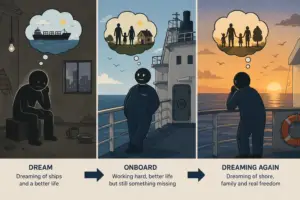
We seafarers have had many different job experiences, either ashore or before becoming seafarers. At some point, however, we realise that a routine life has its own good sides and enjoyable moments, especially for people who have a good salary and live close to their homes.
But around the world, the number of people who have this opportunity is actually quite low. Having a good salary means being able to compensate for all your expenses, enjoy family dinners, go shopping, and at the same time live in a nice house with a good car, etc. We seafarers do not always have such facilities, or maybe we simply don’t want this type of life. I am still confused about it.
I think there are a few different types of seafarers onboard.
People comes from poor life
One type comes from a poor family, and their only purpose is to become a seafarer. Otherwise, they may have to live in difficult conditions. These are the people who work onboard for their entire lives.
I think it is a human thing. When you have a job that pays you well and completely changes your lifestyle compared to where you came from, you naturally become attached to that job and loyal to it.
Or maybe they simply know how to be a seafarer and cannot imagine changing to another lifestyle.
Middle class family members
Another type comes from a middle-class family. Their parents may have government jobs, working from 9 to 5. They see their parents’ working schedule and think that this lifestyle is difficult, so they try to become seafarers.
However, this type of person generally becomes an officer and eventually leaves shipboard life when they become a captain or chief engineer. They then move to shore-based shipping company jobs such as inspectors, technical superintendents, surveyors, and similar positions.
Generally, this transition happens after they start a family or have a child, which is quite understandable.
Because when you talk to your child on the phone while you are thousands of kilometres away, it can be very disappointing to know that you cannot be there with them.
Family tradition
There is another type who chooses this industry for professional reasons and because they want to increase their knowledge and awareness of the maritime industry.
For some people, it is also a family tradition.
I once saw a post from a captain working on a cruise ship. His father and even his grandfather had also been captains. So, for them, being a seafarer is almost a family tradition.
I totally understand the dynamics behind this, and I truly respect it. The shipping industry can only continue to improve through the culture and mentality of people like this.
Even though we have many hardworking people in the industry, sometimes they don’t know what hard work actually means or how it should be done. They may create unnecessary pressure, engage in mobbing, or push people to do things they should not have to do.
From my working experience, what I have realised is that, more or less, all nationalities have the same job responsibilities onboard.
However, when you work with a multinational crew, people are generally more polite, kind, and calm towards each other. Politeness seems to take priority.
I don’t know exactly why, but I guess it is because you don’t know the personal dynamics of the other people. When you work with people from the same country, the dynamics can be completely different.
Gossip, arguments, unhappy faces, and high expectations can increase quickly.
For example, if you work on a mixed-crew vessel and the cook makes pizza, you probably won’t complain about it. If it tastes good, then everything is fine and everyone is happy.
But if you work on an Italian vessel where everyone is Italian and the cook makes pizza, they might complain about the spices, the way it was sliced, the type of cheese used, or even the fact that pineapple was added. They could get really angry about it.
So, from this point of view, mixed-crew ships can sometimes be better than same-nationality crews.
Rare but gold type
And then there is the last type of seafarer.
They are very rare and limited in number. These are the people who choose this profession mainly for adventure.
They are a little crazy, but in a good way.
They want to see the world, enjoy life, have fun, and experience new things.
If the vessel has a relaxed working environment and the captain is a good person who doesn’t disturb people with unnecessary company orders or excessive pressure, they can actually be happy and work well onboard.
Then, whenever they reach a port, they can go ashore, meet different people from all around the world, make amazing connections, build friendships, and enjoy their shore leave.
And if they have a talent for creating content, they can become bloggers, vloggers, or YouTubers and share their experiences with people around the world.
Actually, I believe this type of seafarer can be the happiest one.
But they are very rare to find onboard.
If you want to be happy, take a camera and start recording wherever you go.
Record the environment. Meet new people. Try new foods. Visit new places. Share your experiences with people on social media.
You can do all of this while continuing your shipboard career.
And the best part is that your maximum expenses might only be around 20% of your monthly salary. That is still quite acceptable compared to many shore-based jobs. You can continue saving money while also enjoying your life.
Unfortunately, many seafarers who go ashore simply focus on buying things from the market, eating something as cheaply as possible, such as McDonald’s or Burger King, and then returning to the ship.
But since our salaries are relatively high compared with many other jobs, we should also try to increase our quality of life.
Instead of buying a cheap snack from the supermarket and eating it somewhere outside, go and try a local dessert with a nice coffee.
Spoil yourself.
Buy a book. Go outside. Sit somewhere and read it. Watch other people living their lives.
Clear your mind.
Life onboard can be hard, exhausting, bad, sad — whatever negative words you want to use may fit.
But even people living in war zones or prisons find ways to feel happy and enjoy small moments.
So why don’t we try to enjoy the moments of our own lives as well?
Sometimes, it only takes simple things.
If you don’t like the environment onboard, whenever you have the opportunity to go ashore, take it.
Go outside and relax your mind.
Even three or four hours ashore can give you an unexpected boost that can last for quite a long time.
And don’t forget:
The crew members you don’t like today will probably no longer be part of your life once you finish your contract.
So don’t waste your time and energy being unhappy because of them.
Go outside.
See the world.
Meet people.
Try something new.
And enjoy the life you are working so hard to build.