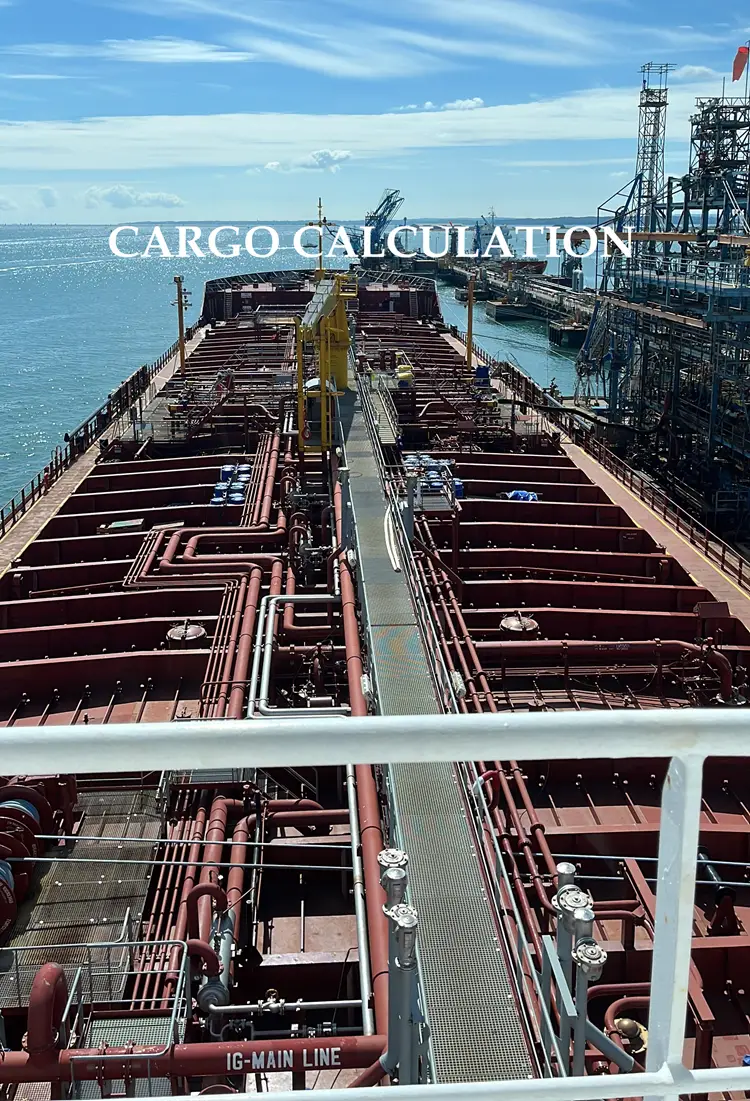
Calculation is the most important part for chief officer however not the hardest one anymore
Oil tankers are designed to carry different types of petroleum products, including gasoline, fuel oil, Jet A-1, diesel, vacuum gasoil (VGO), heavy fuel oil, and many other clean and dirty petroleum products. The cargoes a particular tanker can carry depend on the vessel’s Certificate of Fitness, approved cargo list, and applicable regulations.
Once the voyage order is received, the cargo quantity is generally given in metric tonnes (MT). This is a measurement of mass. However, a tanker also has a limited tank volume, normally expressed in cubic metres (m³). Therefore, before loading, we need to make sure that the required cargo quantity will physically fit inside the available tanks.
This is where density, volume, and temperature become very important.
1. The Relationship Between Mass, Volume, and Density
The basic formula is:
Density = Mass / Volume
Therefore:
Volume = Mass / Density
If we know the cargo mass and density, we can calculate the approximate volume required and compare it with the available tank capacity.
Example: Checking Tank Capacity
Suppose tank 2P has a capacity of 2,675 m³, according to the vessel’s tank plan.
The voyage order requires:
- Cargo quantity: 2,500 MT
- Cargo density: 0.91 t/m³
- Tank capacity: 2,675 m³
First, calculate the required volume:
Volume = Mass / Density
Volume = 2,500 / 0.91
Volume = 2,747 m³
The required volume is approximately 2,747 m³, but the tank capacity is only 2,675 m³.
Therefore, the cargo cannot fit into the tank at this quantity. The quantity must be reduced or additional suitable tank capacity must be used.
Important: This is only a basic calculation. Actual cargo planning must also consider tank restrictions, maximum filling limits, temperature, trim, stability, strength, segregation, free-water content, and the vessel’s approved loading computer/calculation procedures.
2. Why Density and Temperature Are Important
When calculating cargo capacity on an oil tanker, two of the most important factors are:
- Cargo density
- Cargo temperature
These factors directly affect the volume occupied by the cargo.
For example, a high-density product occupies less volume for the same mass than a low-density product.
A simple way to understand this is:
1 MT of a high-density product → relatively small volume
1 MT of a low-density product → relatively large volume
Temperature is also important because petroleum products expand when their temperature increases. This means that a cargo loaded at a relatively low temperature can occupy a larger volume after it is heated during the voyage.
This is one of the reasons why a vessel may have enough deadweight capacity to carry a particular cargo but still not have enough available tank volume.
3. Manual Cargo Calculation — Step by Step
Modern oil tankers normally have an approved loading computer or loading calculation system. The officer can enter the intended cargo quantities, densities, temperatures, and tank allocations, and the system calculates the corresponding volumes and checks various loading conditions.
However, every deck officer involved in cargo operations should understand the basic principles behind these calculations.
Let’s take a simple example.
Step 1 — Receive the Voyage Order
Suppose the voyage order is:
Load 30,000 MT of fuel oil
The vessel’s DWT is approximately:
30,000 MT
At first glance, it may appear that the vessel can load the entire 30,000 MT.
However, the DWT cannot simply be treated as cargo capacity.
Step 2 — Check Bunkers and Fresh Water
Before loading cargo, check whether the vessel will receive or already has bunkers, fresh water, stores, and other weights that need to be considered.
For example:
- Bunkers + fresh water = 500 MT
Therefore:
30,000 − 500 = 29,500 MT
The vessel can theoretically carry approximately 29,500 MT after allowing for these weights, before considering the vessel’s constant and other loading restrictions.
Step 3 — Consider the Ship’s Constant
The ship’s constant represents the difference between the vessel’s calculated lightweight and its actual lightweight and can include items such as accumulated stores, spare parts, equipment, and other variable weights.
Suppose the ship’s constant used for the calculation is:
2,500 MT
Then:
29,500 − 2,500 = 27,000 MT
Therefore, based purely on this simplified weight calculation, the maximum cargo intake would be approximately:
27,000 MT
This example shows why a vessel with a nominal DWT of 30,000 MT cannot necessarily load 30,000 MT of cargo.
The actual cargo intake depends on the vessel’s loading condition and the weights of all other items onboard.
4. Do You Have Enough Tank Volume?
Now we know that the vessel has enough weight capacity for 27,000 MT.
But another question remains:
Do we have enough volume to physically contain the cargo?
This is where cargo density becomes important.
For example, imagine two different materials:
- 1 kg of iron
- 1 kg of cotton
They have the same mass, but the cotton occupies much more space because it has a lower density.
The same principle applies to petroleum products.
Therefore, when preparing the cargo stowage plan, you need the cargo density to convert the ordered cargo quantity from metric tonnes into volume.
For example:
Cargo quantity = 27,000 MT
Cargo density = 1.000 t/m³
Then:
Volume = 27,000 / 1.000 = 27,000 m³
You can then compare this volume with the available cargo tank capacity.
5. The Effect of Temperature
There is another important factor: temperature.
Petroleum products expand as their temperature increases.
For example, a cargo loaded at a relatively low temperature may occupy one volume during loading. If the cargo is subsequently heated, its volume will increase.
This is particularly important for products such as fuel oil, which may require heating during loading, discharge, or the voyage.
To account for the effect of temperature, the industry uses a Volume Correction Factor (VCF).
VCF is used to convert the observed volume of petroleum cargo at its current temperature to a reference temperature, commonly 15°C for metric calculations under the applicable standard.
The appropriate VCF is obtained from the applicable ASTM/API petroleum measurement tables or from the vessel’s approved loading computer.
The exact factor depends on the cargo’s density and temperature, so it should not be guessed.
6. What Happens When the Surveyor Comes Onboard?
Imagine you have prepared your cargo plan and arrive at the loading port.
The terminal and cargo surveyor inform you:
“The vessel will load 25,000 MT.”
Now the calculation becomes more important because the cargo temperature can change during the loading operation.
The cargo may enter the tanks at one temperature and gradually become warmer or cooler during loading.
Therefore, the volume observed in the tank can change even though the actual mass of cargo has not changed.
This is why officers should understand the terminology used by the loading computer and cargo surveyors.
Some of the most important terms are:
- TOV — Total Observed Volume
- GOV — Gross Observed Volume
- GSV — Gross Standard Volume
- VCF — Volume Correction Factor
- VEF — Vessel Experience Factor
- Density in VAC
- Density in AIR
Let’s look at these one by one.
7. What Is TOV?
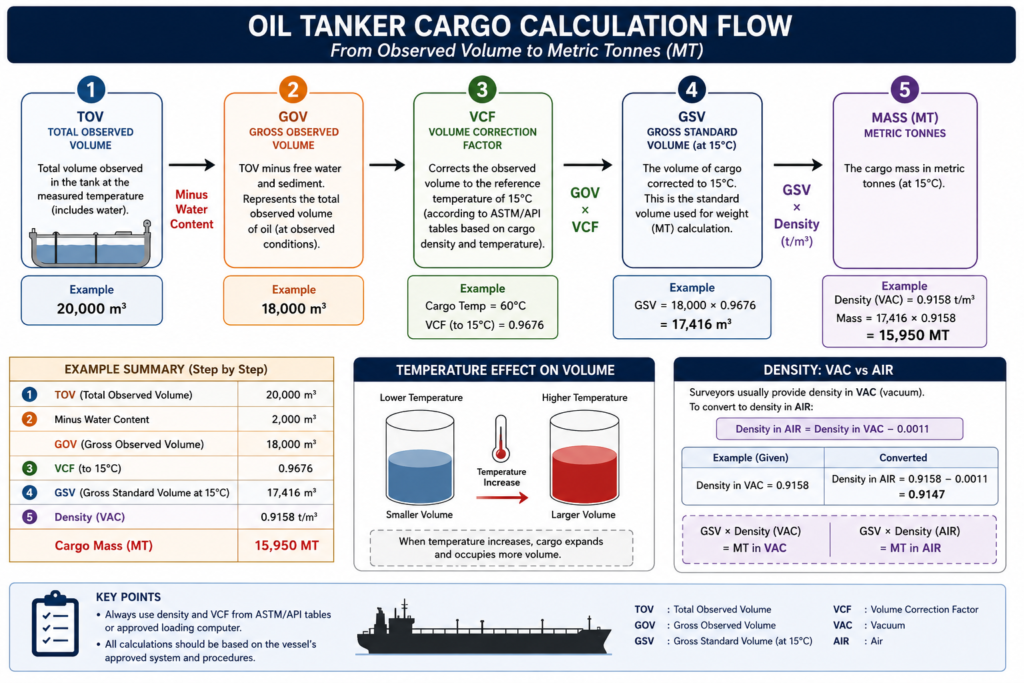
TOV means Total Observed Volume.
It is the total volume observed in the cargo tank at the measured temperature and includes the contents measured in the tank before deductions such as free water.
In simple terms:
TOV = Total volume observed in the tank
TOV is an important figure during cargo operations because tank levels and volumes are monitored during loading and discharge.
For example, if the loading computer shows a certain TOV, the officer can use the information together with the loading rate to monitor the operation and estimate the Estimated Time of Completion (ETC).
8. What Is GOV?
GOV means Gross Observed Volume.
GOV is obtained after deducting the measured free water and sediment, where applicable, from the TOV.
A simplified representation is:
GOV = TOV − Free Water and Sediment
For example:
- TOV = 20,000 m³
- Free water = 2,000 m³
Therefore:
GOV = 20,000 − 2,000
GOV = 18,000 m³
This means that the observed volume attributable to the oil/product is 18,000 m³.
The exact measurement procedure depends on the cargo, terminal, survey method, and applicable petroleum measurement standard.
9. What Is GSV?
GSV means Gross Standard Volume.
Petroleum products have different volumes at different temperatures. Therefore, to compare and calculate cargo quantities consistently, the observed volume is corrected to a standard reference temperature.
For metric petroleum calculations, this is commonly 15°C.
The correction is made using the Volume Correction Factor (VCF).
The basic relationship is:
GSV = GOV × VCF
Let’s use an example.
Suppose:
- GOV = 18,000 m³
- Cargo temperature = 60°C
- VCF = 0.9676
Then:
GSV = 18,000 × 0.9676
GSV = 17,416.8 m³
Therefore, the Gross Standard Volume is approximately:
17,417 m³ at 15°C
The VCF in this example is only for illustration. The actual VCF must be obtained from the applicable ASTM/API tables or the approved loading computer using the correct cargo density and temperature.
10. From GSV to Metric Tonnes
Once we have the GSV, we can calculate the cargo mass.
Suppose the cargo density at the reference condition is:
0.9158 t/m³
Then:
Mass = GSV × Density
Therefore:
Mass = 17,416.8 × 0.9158
Mass ≈ 15,950 MT
So the calculation becomes:
TOV → Deduct Free Water → GOV → Apply VCF → GSV → Apply Density → Metric Tonnes
Using our example:
| Calculation | Result |
| TOV | 20,000 m³ |
| Less free water | 2,000 m³ |
| GOV | 18,000 m³ |
| VCF | 0.9676 |
| GSV | 17,416.8 m³ |
| Density | 0.9158 t/m³ |
| Cargo mass | ≈ 15,950 MT |
This is the basic calculation chain used to convert an observed cargo volume into a standard volume and then into mass.
11. Density in VAC and Density in AIR
Another point that can sometimes cause confusion during cargo operations is the difference between density in vacuum (VAC) and density in air.
Petroleum cargo densities are commonly reported by surveyors at the reference temperature and under a specified basis, often referred to as density in vacuum (VAC).
If a calculation specifically requires density in air, the appropriate conversion should be made according to the applicable measurement standard or the vessel’s approved calculation system.
For a simplified example, if the density is given as:
Density in VAC = 0.9158
and the applicable conversion requires subtracting 0.0011:
Density in AIR = 0.9158 − 0.0011
Density in AIR = 0.9147
Then:
GSV × Density in VAC → Metric tonnes in vacuum
while:
GSV × Density in AIR → Metric tonnes in air
Using our example:
17,416.8 × 0.9158 ≈ 15,950 MT
while:
17,416.8 × 0.9147 ≈ 15,931 MT
However, the exact conversion should always follow the applicable ASTM/API standard and the requirements of the terminal, surveyor, charterer, and bill of lading calculation.
12. What Is VEF?
You may also see VEF, which means Vessel Experience Factor.
VEF is used in petroleum measurement to account for the vessel’s historical measurement performance compared with shore measurements.
It is calculated from qualifying historical vessel and shore figures according to the applicable industry standard.
VEF is therefore not a volume correction factor and should not be confused with VCF.
In simple terms:
- VCF → Corrects volume for temperature and density/reference conditions.
- VEF → Accounts for the vessel’s historical measurement experience when applicable.
13. Why Understanding the Loading Computer Is Important
Modern loading computers make cargo calculations much easier.
Usually, you enter information such as:
- Cargo quantity
- Cargo density
- Cargo temperature
- Tank allocation
- Free water, where applicable
- Loading condition
The system can then calculate:
- Tank volume
- Filling percentage
- TOV
- GOV
- GSV
- VCF
- Cargo weight
- Drafts
- Trim
- Stability
- Shear forces
- Bending moments
However, using a loading computer does not mean that the officer should simply trust the numbers without understanding them.
If a surveyor, terminal representative, or loading master asks:
“How did you arrive at this figure?”
you should understand what each number represents.
A good officer should be able to follow the calculation from tank measurement → observed volume → corrected volume → density → cargo mass.
14. The Basic Cargo Calculation Flow
The entire process can be simplified into the following sequence:
1. Receive the cargo order
Determine the required cargo quantity in MT.
↓
2. Check the vessel’s weight capacity
Consider DWT, bunkers, fresh water, stores, constant, ballast, and other weights.
↓
3. Check cargo density
Use the correct density supplied by the terminal, charterer, surveyor, or cargo documentation.
↓
4. Convert mass to volume
Volume = Mass / Density
↓
5. Check tank capacity
Make sure the required volume fits within the available and permitted tank capacity.
↓
6. Consider cargo temperature
Determine how temperature affects the cargo volume.
↓
7. Apply the appropriate VCF
Convert the observed volume to the applicable reference temperature.
↓
8. Determine GSV
GSV = GOV × VCF
↓
9. Calculate cargo mass
Mass = GSV × Density
↓
10. Verify the final figures
Check the loading computer, cargo plan, stability, strength, tank limits, terminal requirements, and surveyor’s calculations before finalizing the cargo quantity.
To Sum Up
Cargo calculation on an oil tanker is much more than simply dividing metric tonnes by density.
A proper cargo calculation requires an understanding of mass, volume, density, temperature, tank capacity, VCF, TOV, GOV, GSV, VEF, and the applicable measurement standards.
The most important concept to remember is that mass and volume are not the same thing.
A vessel may have enough deadweight capacity for a cargo but still be unable to load the full quantity because the cargo occupies too much tank volume.
Similarly, a cargo may fit during loading but require careful temperature and filling-limit considerations if it is heated afterward.
Modern loading computers perform most of these calculations automatically, but the officer responsible for cargo operations should still understand the principles behind the figures.
Ultimately, accurate cargo calculations help prevent overfilling, cargo shortage claims, incorrect documentation, and unsafe loading conditions.
Important: The examples in this article are simplified for educational purposes. Actual cargo calculations should always be performed using the vessel’s approved loading computer, applicable ASTM/API petroleum measurement standards, cargo documentation, terminal requirements, and company procedures. Never rely on an illustrative VCF or density conversion as an operational value.