Your trusted source for professional maritime news, global shipping updates, marine engineering insights, safety regulations, and navigation resources.
Your trusted source for professional maritime news, global shipping updates, marine engineering insights, safety regulations, and navigation resources.
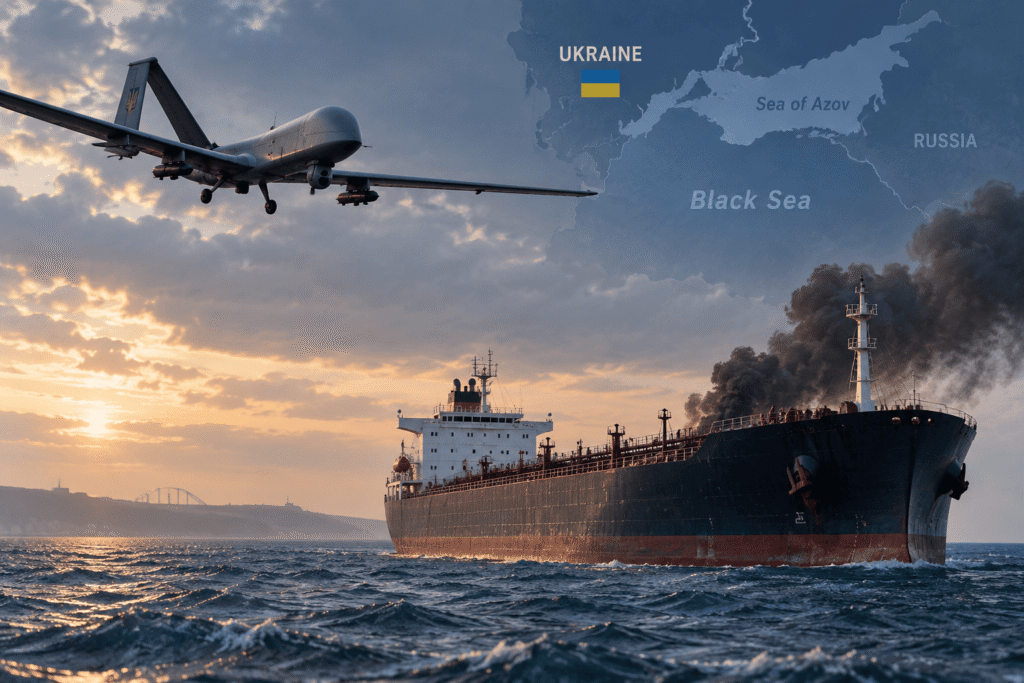
Ukraine says its Unmanned Systems Forces have disabled 300 Russian-linked vessels in the Black Sea and Sea of Azov since the start of a drone campaign in July.
According to Commander Robert “Madyar” Brovdi, the operation began on July 6, 2026, and has targeted vessels described by Ukraine as part of Russia’s shadow fleet.
300 Vessels Reportedly Disabled
Brovdi said Ukrainian drone units have disabled:
134 vessels in the Sea of Azov
166 vessels in the Black Sea
The vessels reportedly include tankers and dry bulk carriers involved in transporting fuel, energy products and other cargo. Ukraine says the operation is intended to disrupt maritime logistics connected with Russia and Crimea.
The figure is a Ukrainian military claim and has not been independently verified for every vessel.
Black Sea Shipping Under Pressure
The reported attacks are adding further pressure on commercial shipping in the region. Russia has also increased attacks on Ukrainian ports and shipping infrastructure, while some operators have changed routes because of the security situation.
The disruption is also affecting grain transportation. Reuters reported that Russian companies are adapting terminals in Baltic and Arctic ports, including Murmansk and Ust-Luga, to handle grain that would normally move through Black Sea routes.
Marine insurers have also expanded the Black Sea high-risk area as attacks involving commercial shipping have increased.
For shipowners, operators and seafarers, the situation highlights the growing security risks of operating in the Black Sea and Sea of Azov.
During recruitment, some tanker seafarers are now being asked a question that would have seemed unusual under normal circumstances:Are you willing to sail to the Strait of Hormuz?
The security situation around the Strait of Hormuz has created a serious dilemma for the maritime industry, particularly for tanker crews. While shipping companies are facing operational, financial and security challenges, seafarers remain the people physically onboard the vessels and therefore face the most direct consequences when a voyage enters a high-risk area.
a simple question about a seafarer’s availability or willingness to work in different trading areas. But for someone looking for employment, the answer may have much bigger consequences.
If a seafarer says “No,” could another candidate who says “Yes” be selected instead?
And if additional financial compensation is offered for entering a high-risk area, how much risk is a seafarer expected to accept for a higher salary?
These questions are becoming increasingly important for tanker crews.
The Question That Can Change a Job Interview
For tanker officers and ratings looking for their next contract, recruitment interviews usually focus on experience, certificates, tanker background, previous vessels and technical knowledge.
However, there is now another question that can enter the conversation:
“Are you willing to go to the Strait of Hormuz?”
But what exactly does the company want to know when asking this question?
Is it simply a survey to understand the availability of its crew?
Or could the answer influence the selection process?
This is where the situation becomes complicated.
I was personally asked this question by a well-known crewing company. My answer was no.
Later, I spoke with a Filipino crew member who had also been asked about his willingness to sail to the region. His answer was very different. He told me that he would say:
“Of course I would go. I would do anything for my company.”
However, he also explained that if the vessel actually entered an extremely dangerous area, he would reconsider his decision because, ultimately, nothing is more important than his life.
This raises an uncomfortable question.
What if that person is selected instead of another candidate simply because he answered “yes” during the interview?
Is that fair?
And what happens to a less experienced seafarer who has fewer employment opportunities and cannot easily choose which vessel or trading area he wants to join?
These are questions that deserve an honest discussion within the maritime industry.
What Happens If a Seafarer Says “No”?
At the moment, it is difficult for seafarers to know exactly what happens behind the recruitment process when one candidate says no and another says yes.
Does the company continue the recruitment process with the person who is willing to enter a high-risk area?
Does the candidate who refuses simply remain on standby?
Or is the question being asked only to understand how many available crew members would potentially accept such an assignment?
Without transparency from companies and crewing agencies, seafarers may naturally question how their answers are being used.
The financial aspect makes the decision even more complicated.
High-risk voyages can involve significant additional compensation, particularly when war-risk premiums and special allowances are included. For some seafarers, the financial difference can be substantial.
For a rating, the additional income could potentially be several times their normal salary, while officers may also receive significantly higher compensation depending on the vessel, company and specific voyage.
For someone with a mortgage, debts, family expenses or other financial responsibilities, turning down a highly paid contract is not necessarily an easy decision.
A seafarer may understand the risks but still think:
“I need the money.”
This is where employment pressure and personal safety begin to collide.
Saying Yes vs. Saying No
There are two obvious choices for a seafarer.
Option 1 — Say Yes
Saying yes could provide several potential advantages:
You may remain eligible for the position.
You may have access to more employment opportunities.
You demonstrate flexibility to the company.
You may qualify for additional compensation if the vessel enters a designated high-risk area.
However, there are also disadvantages:
You are potentially accepting additional personal risk.
The security situation can deteriorate rapidly.
The actual circumstances of a voyage may be different from what was expected during recruitment.
You may later decide that you are no longer comfortable entering the area.
Option 2 — Say No
Saying no can also have clear advantages:
You are being honest about your personal safety limits.
You avoid a voyage that you consider unacceptable.
You may have greater peace of mind about the contract you are accepting.
But there is an obvious concern:
What if another candidate who says yes becomes more attractive to the employer?
That is the part seafarers cannot easily know.
And this leads to perhaps the most important question in this entire discussion:
Can a seafarer’s decision really be considered completely voluntary if saying “no” could potentially affect his employment?
What Should the Company Be Responsible For?
This does not mean that shipping companies should simply ignore the willingness of their crew.
Companies have legitimate operational requirements. A tanker company needs qualified crew members who can operate vessels across different trading areas, including regions where security risks may exist.
However, there should also be transparency.
If a company asks a seafarer whether they are willing to sail to the Strait of Hormuz, the seafarer should ideally understand what that answer actually means.
Is the question asking:
“Would you work for our company if our vessels trade in this region?”
Or:
“Would you personally accept a voyage into a high-risk area under the current security conditions?”
These are two completely different questions.
A seafarer might be willing to work for a tanker company without being willing to enter every high-risk area under every possible security condition.
For example, a seafarer could reasonably say:
“If the current security situation improves and the area is considered sufficiently safe for commercial shipping, I have no problem sailing there. However, under the current circumstances, I would prefer not to enter the area.”
That is very different from simply refusing to work for the company.
Can Safety Be Guaranteed?
This is perhaps the most difficult question.
Can a company guarantee that a seafarer will return home safely?
Realistically, no company can guarantee that.
Shipping has always involved risk. Weather, mechanical failures, piracy, collisions and other unexpected events can occur.
But a conflict zone creates a different level of uncertainty.
A seafarer could therefore reasonably ask the company:
What is the current security assessment?
What measures are being taken to protect the crew?
Is the voyage covered by appropriate war-risk arrangements?
What additional compensation is being offered?
What happens if the security situation deteriorates?
What happens if the crew member no longer considers the voyage acceptable?
Are these conditions clearly reflected in the employment agreement?
These questions are not signs of weakness.
They are reasonable questions from someone whose physical safety depends on the decisions being made ashore.
The Same Problem Can Affect Other High-Risk Areas
The Strait of Hormuz is not the only region where this issue can arise.
The Black Sea has also demonstrated how quickly commercial shipping can become exposed to military and geopolitical risks.
For seafarers, the problem is not limited to one specific geographical location.
The larger question is:
How should the maritime industry deal with crew employment when commercial vessels are operating close to active conflict zones?
A company may have a legitimate commercial reason to operate in a particular region. A seafarer may have a legitimate personal reason to refuse.
Both sides have interests that need to be considered.
More Money Does Not Automatically Mean Less Risk
Higher salaries and additional war-risk compensation can make a dangerous voyage financially attractive.
For some seafarers, the difference may be enough to significantly improve their family’s financial situation.
But money cannot remove the physical risk.
A seafarer can calculate a salary.
He cannot calculate the value of returning home safely to his family.
This does not mean that every seafarer should refuse to sail into a high-risk area. Different people have different risk tolerances, financial circumstances and professional decisions.
The important point is that the decision should be informed and genuinely voluntary.
What Should Seafarers Ask Before Accepting a High-Risk Voyage?
Before accepting a tanker position involving potentially high-risk trading areas, seafarers should consider asking the company for clear information about the voyage and the applicable conditions.
Questions could include:
Will the vessel actually enter the Strait of Hormuz or another designated high-risk area?
What is the current security assessment?
What additional compensation is provided?
Are war-risk arrangements clearly defined?
What security measures are available onboard?
What happens if the security situation suddenly deteriorates?
Are the relevant conditions included in the employment agreement?
The objective is not to create conflict between seafarers and companies.
It is to make sure that both sides understand what they are agreeing to.
The Real Strait of Hormuz Dilemma
The question is ultimately bigger than whether a seafarer says yes or no during a job interview.
It is about the pressure behind that answer.
A seafarer looking for employment may need the salary. A company may need crew members willing to operate its vessels in challenging areas. At the same time, the seafarer is the person who will physically be onboard if the security situation deteriorates.
That creates a difficult balance between employment, income and personal safety.
Perhaps the maritime industry should therefore move beyond simply asking:
“Are you willing to go to the Strait of Hormuz?”
A better question might be:
“Under what conditions would you be willing to go, and what information and protections do you need to make that decision?”
Seafarers are not simply another operational resource. They are the people who ultimately carry the physical consequences of decisions made both onboard and ashore.
And while higher compensation can recognize additional risk, it cannot eliminate that risk.
For every seafarer facing this question, the decision remains deeply personal:
How much is your safety worth, and should your employment depend on the answer?
The Oil Discharge Monitoring and Control System (ODME) is fitted on oil and chemical tankers for the purpose of monitoring and controlling the discharge of water mixed with oil. One of the main purposes of the system is to allow the controlled discharge of oily water and reduce the amount of slop remaining onboard.
MARPOL Requirements
According to Regulation 31 of MARPOL Annex I, all oil tankers of 150 gross tonnage and above must be fitted with an approved ODME system.
Chemical tankers carrying oil or oil-like substances covered under MARPOL Annex I are also subject to the same operational discharge and monitoring requirements.
The ODME system automatically monitors, records, and controls the discharge of oily water or ballast from cargo tank areas.
The main components of an ODME system are:
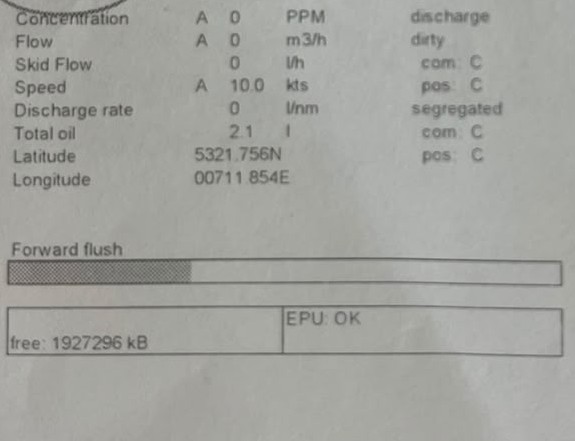
Oil Content Meter (OCM): Measures the oil concentration in the discharged water in parts per million (ppm).
Flow Meter: Measures the discharge flow rate.
Computing / Processing Unit: Calculates the instantaneous rate of discharge, records the necessary information, and uses data such as ship speed and position to control the system.
Overboard Control System: Controls the overboard and slop tank valves. If the discharge conditions are outside the permitted limits, the system automatically stops the overboard discharge and diverts the flow back to the slop tank.
Discharge Limits Outside Special Areas
An oil tanker may discharge oily mixtures or ballast from cargo tank areas into the sea outside Special Areas only when all the required conditions are fulfilled.
The main conditions are:
En Route: The tanker must be proceeding on a voyage.
Distance from Land: The tanker must be more than 50 nautical miles from the nearest land.
Instantaneous Rate of Discharge: The instantaneous rate of oil discharge must not exceed 30 litres of oil per nautical mile.
Total Quantity Limit: The total quantity of oil discharged into the sea must not exceed 1/30,000 of the total quantity of the particular cargo of which the residue formed a part, for tankers delivered after 31 December 1979.
Operational ODME: The vessel must have a fully operational ODME system and the required slop tank arrangement.
Special Areas
Discharge of oil or oily mixtures from cargo areas is generally prohibited within MARPOL Special Areas, such as the Antarctic, Mediterranean, Baltic and Red Seas, regardless of whether an ODME system is installed.
There are only limited exceptions, such as certain clean or segregated ballast conditions, depending on the applicable MARPOL requirements.
Data Recording and Retention
The ODME system must have a dedicated recording device that continuously records important information related to the discharge operation.
The recorded information includes:
Discharge rate in litres per nautical mile
Total quantity of oil discharged
Date and time
Geographical position
Printed or digitally stored records must be retained onboard for at least three years.
ODME Testing and Functional Checks
Like other important equipment onboard, the ODME system also requires regular testing and condition checks.This test procedure should be done under chief officer responsibilities.
Monthly functional tests should be carried out for the valves, system operation, and different alarm or operating conditions. The tests and relevant results should be recorded in the Oil Record Book Part II as required.
So, what exactly should be tested and what procedure should be followed?
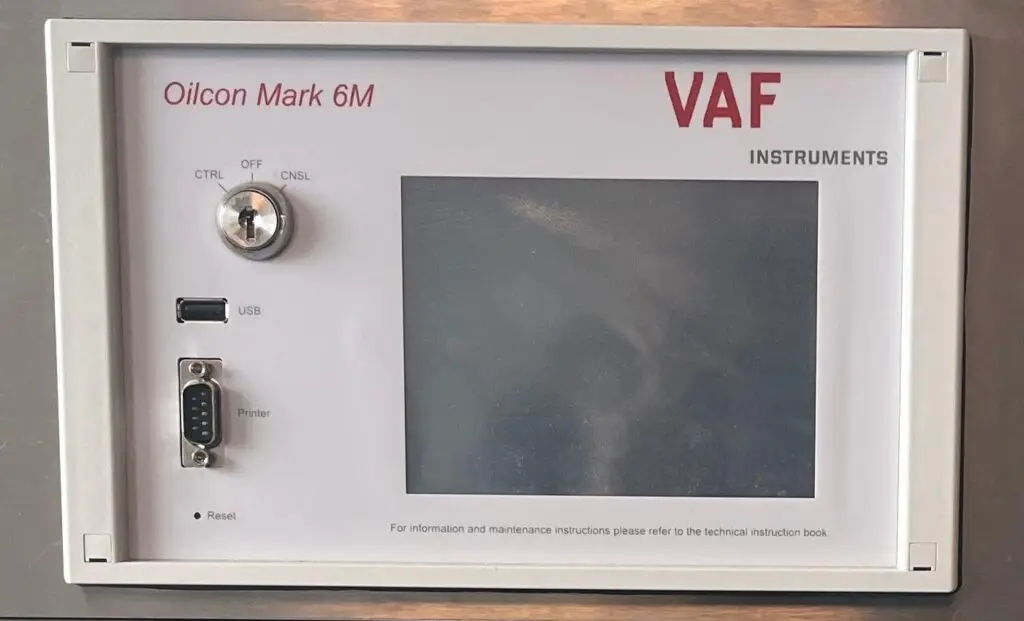
On my vessel, we have an OILCON Mark 6M VAF ODME system, and in this article we will look at the test procedure for this particular equipment according to the manufacturer’s instructions.
Important: The following procedure is based on the equipment manufacturer’s instructions. Always follow the actual manufacturer’s manual and the vessel’s approved procedures when carrying out an ODME test.
Test and Check-Out Procedure
Before starting the test, there is one very important point.
Under no circumstances should the pump run without liquid.
The pump housing must first be filled with liquid. Otherwise, the pump can seize and become damaged.
Before carrying out a test, the person in charge should be familiar with the operation of the system and make sure that the following conditions are fulfilled:
Control air supply is ON.
Fresh water supply is ON.
Electrical supplies are ON.
Main Control Unit (MCU) is switched ON.
Electro-pneumatic unit is switched ON.
Starter box is switched ON.
All manual valves in the system are open.
Cargo pump is on standby.
Generally, if the vessel is operating in an area where the temperature does not normally fall below approximately 5°C, the air and fresh water supplies can normally be left open after joining the vessel. This avoids problems caused by frozen water in the lines or loss of air supply.
Once these supplies are closed, problems can occur later when the system is required to operate again, so it is better to keep them available when the vessel’s operating conditions allow it.
Functional Test Procedure
Proceed as follows.
1. Initial Setup
1. Turn the key switch to the CONTROL position.
2. Press the SETUP key to enter the setup mode.
3. Press the CHANGE key and then press the NEXT key until “TOTAL OIL LIMIT” is displayed.
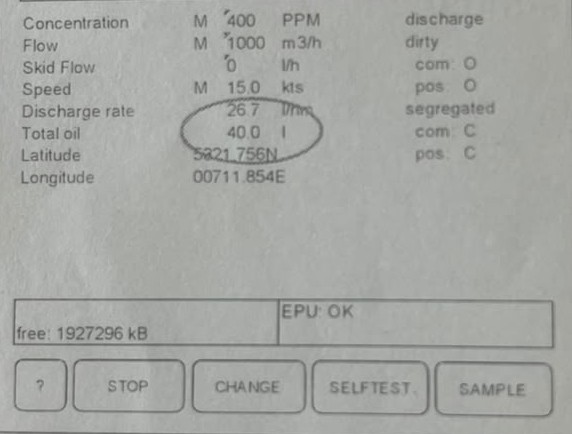
4. Change the TOTAL OIL LIMIT to 40 litres.
5. Press the NEXT key to display “RESET OIL TOTAL”.
6. Change RESET OIL TOTAL to YES.
7. Press the NEXT key until “SHIP SPEED INDICATION” is selected. Use the + and – keys to change the ship speed to 15 knots.
8. Press the NEXT key until “FLOW RATE INPUT” is selected. Use the numeric keys to enter a flow rate of 250 m³/h.
9. Press the NEXT key until “OIL CONCENTRATION INDICATION” is selected. Use the numeric keys to enter an oil concentration of 100 ppm.
10. Press the OK key to enter the setup mode.
11. Press the FLUSH key. The system will not perform the normal flush sequence but will immediately go into IDLE mode.
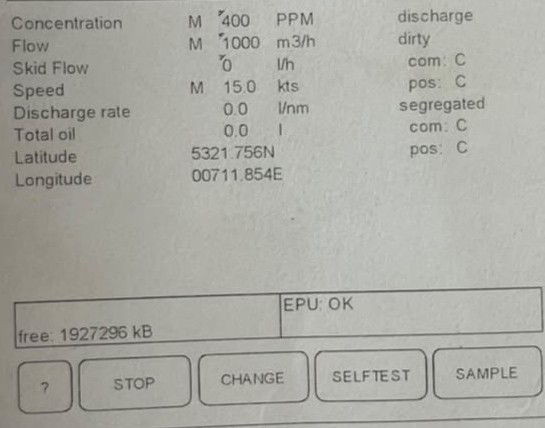
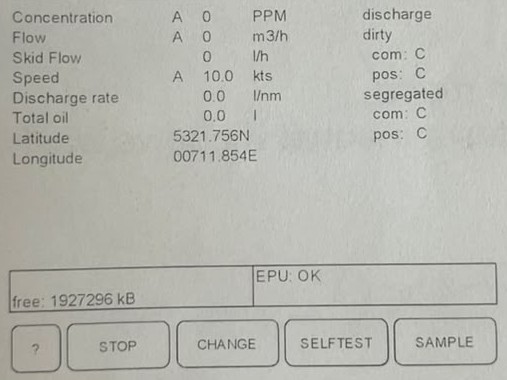
12. Press the SAMPLE key to start the Sample mode.
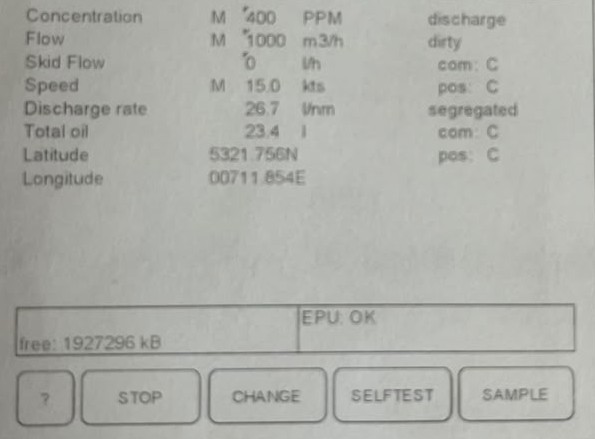
13. Check the display on the MCU and make sure the information shown is correct.
Overboard Valve Operation
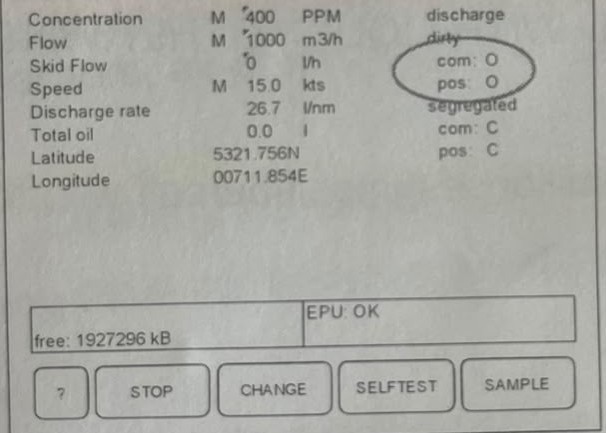
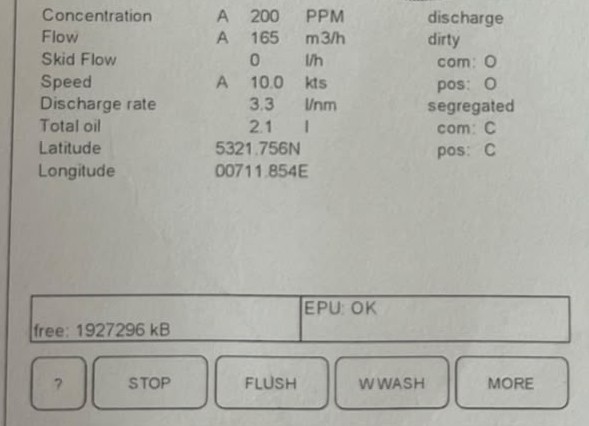
14. After approximately 20 seconds, the signal to open the overboard valve and close the slop tank valve will be given. This will be indicated on the MCU display.
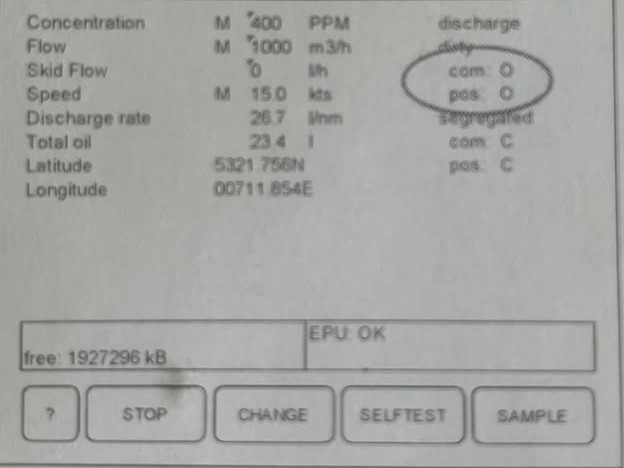
15. Check that the valves have actually operated. On the MCU display, this should be indicated by the valve position changing from C (Closed) to O (Open).
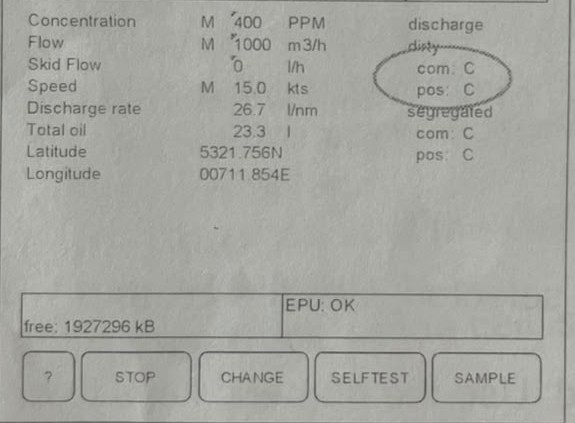
16. Press the STOP key. The system will return to IDLE mode and the signal to close the overboard valve and open the slop tank valve will be given.
17. Check that the valves have actually operated.
High Flow Rate Alarm Test
18. Select the IDLE setup mode by pressing the CHANGE key.
19. Press the NEXT key until “FLOW RATE INPUT” is selected. Use the numeric keys to enter a flow rate of 2,000 m³/h.
20. Press the OK key and then the BACK key to return to IDLE mode.
21. Press the SAMPLE key to start the Sample mode.
22. Check the display on the MCU for correct information.
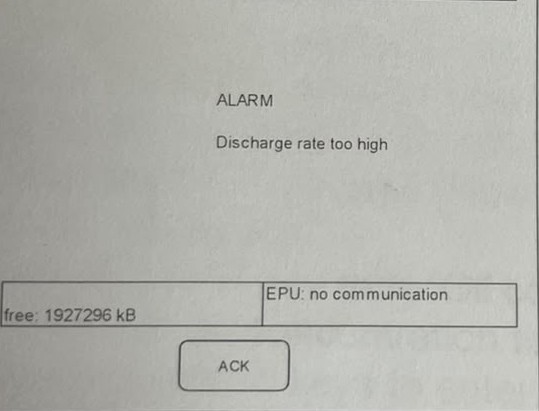
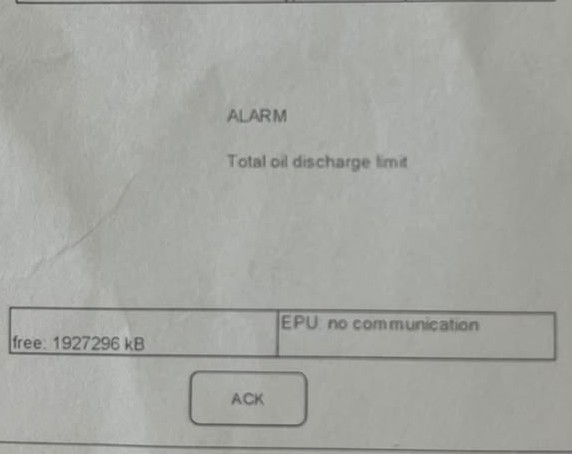
23. Select the Sample mode by pressing the SAMPLE key. Since the discharge rate is now set too high, the system should trigger an alarm.
The overboard discharge valve signal should not change from CLOSED to OPEN.
24. Press the ACK key to stop the alarm buzzer.
25. Press the STOP key to return to IDLE mode.
Total Oil Limit Test
26. Select the IDLE setup mode by pressing the CHANGE key.
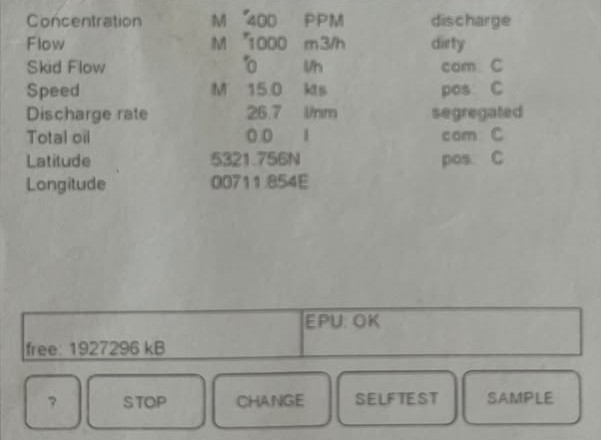
27. Press the NEXT key until “FLOW RATE INPUT” is selected. Use the numeric keys to enter a flow rate of 1,000 m³/h.
28. Press the OK key and then the BACK key to enter IDLE mode.
29. Press the SAMPLE key to start the Sample mode.
30. Check the display on the MCU for correct information.
31. Select the Sample mode by pressing the SAMPLE key.
32. Press the SAMPLE key again to start the Sample mode.
33. Check the display on the MCU for correct information.
34. After approximately 2 minutes, the signal to open the overboard valve and close the slop tank valve will be given. This will be indicated on the display.
35. Check that the valves have actually operated. On the MCU display, the valve position should change from C to O.
36. The discharged oil quantity shown on the display as “TOTAL OIL” will increase.
Allow the simulated oil discharge to continue until it reaches 40 litres. At this point, the system should give the signal to close the overboard valve and open the slop tank valve, and an alarm should be triggered.
Practical Tip
If you do not want to wait for too long during the test, because this simulation can take around 20–25 minutes, you can increase the flow rate to maximum and reduce the ship speed to around 7 knots.
This will increase the calculated oil discharge rate, allowing the total oil limit to be reached faster. With this method, the alarm can normally be observed within a few minutes.
37. Check that the valves have actually operated.
38. Press the ACK key to stop the alarm buzzer.
39. Press the STOP key to return to IDLE mode.
40. Press the STOP key again to select the shutdown mode.
After the shutdown sequence has finished, the system should be in STANDBY mode.
Additional Detailed Test Procedure
The procedure below is taken from the manufacturer’s instruction manual and is more detailed.
For a normal monthly functional test, the procedure above should generally be sufficient for the required operational checks and recording in the Oil Record Book, subject to the vessel’s SMS and applicable requirements.
The more detailed procedure below may be carried out during annual service and maintenance or during other scheduled service intervals, depending on the equipment certificate and manufacturer’s requirements.
Detailed System Test
41. Press the SETUP key to enter the setup mode.
42. Press the CHANGE key and then press the NEXT key until “RESET OIL TOTAL” is displayed.
43. Change RESET OIL TOTAL to YES.
44. Press the NEXT key until “SHIP SPEED INDICATION” is selected. Use the + and – keys to change the ship speed to AUTOMATIC.
45. Press the NEXT key until “FLOW RATE INPUT” is selected. Use the numeric keys to change the flow rate to AUTOMATIC.
46. Press the NEXT key until “OIL CONCENTRATION INDICATION” is selected. Change the oil concentration indication to AUTOMATIC.
47. Use the numeric keys to enter an oil concentration of 400 ppm.
48. Press the OK key to enter the setup mode.
49. Press the FLUSH key. The system will now perform the flush sequence, which takes approximately 7 minutes. After the flush sequence has finished, the system will return to IDLE mode.
50. Check the display on the MCU for correct information.
Sample Pump and Sample Point Test
51. Start the cargo pump.
Note: The MCU will divert the flow into the slop tank.
52. Press the SAMPLE key to start sampling. Check that the ppm indication on the MCU is changing.
53. Press the STOP key to stop sampling and select IDLE mode.
54. Press the CHANGE key to select the IDLE setup mode.
55. Press the CHANGE key to select the SAMPLE POINT. Use the + and – keys to change to the next sample point.
56. Press the OK key and then the BACK key to return to IDLE mode.
57. Press the SAMPLE key to start sampling.
Check the following:
The correct sample point is indicated on the MCU.
The correct sample probe is selected.
58. Repeat steps 52 to 57 for each sample point.
59. Press the STOP key to stop sampling and select IDLE mode.
Oil Type Selection Test
60. Press the CHANGE key to select the IDLE setup mode.
61. Press the CHANGE key and then press the NEXT key until “OIL TYPE” is displayed.
62. Use the + and – keys to select the next oil type.
63. Press the OK key and then the BACK key to return to IDLE mode.
64. Check that the correct oil type is indicated on the MCU.
65. Repeat steps 60 to 63 for each available oil type.
Window Wash Test
66. Press the SAMPLE key to select the Sample mode.
67. Press the W WASH key to select the Window Wash mode.
68. After the W WASH key is pressed, the system will initiate a manual window wash sequence to keep the detector cell in good condition.
The display should indicate WINDOW WASH.
Manual Flush and No Flow Alarm Test
69. Press the SAMPLE key to select the Sample mode.
70. Press the FLUSH key to select the manual flush mode.
Check the following:
Valve V10 opens for approximately 2 minutes.
The oil content indication on the MCU reads zero.
71. Test the NO FLOW alarm by manually closing the sample inlet valve on the skid assembly.
Check that the sample pump stops after approximately 2 minutes.
Re-open the sample inlet valve after the test.
72. Check that ship speed, flow rate, and oil content are all displayed on the MCU.
Wait for the overboard discharge valve to open.
Regulate the cargo pump speed and back pressure to obtain a flow rate equivalent to approximately 50% of the rated capacity of the flowmeter.
Underrange Alarm Test
73. Test the underrange alarm by reducing the flow.
Close the overboard valve. The recirculating valve should open.
Increase the discharge flow and press ALARM RESET.
Then press STOP RESET.
Self-Test
74. Press the SELFTEST key to select the self-test mode.
Follow the instructions shown on the MCU display to perform the self-test.
The following should occur:
The display should indicate 500 ppm.
The audible alarm should sound.
75. Press the BACK key to return to Sample mode.
76. Press the STOP key to select IDLE mode.
Manual Valve Control Test
77. Turn the key switch on the MCU to the CONSOLE position and check the manual control of the overboard discharge valve and slop tank valve from the cargo control console.
78. Turn the key switch on the MCU to the CONTROL position and check that manual control of both the overboard discharge valve and slop tank valve from the cargo control console is not possible.
Shutdown and Flushing Cycle
79. Press the STOP key to select the shutdown mode.
Check the operation of the shutdown flushing cycle as follows:
Valve V10 and valve V11 open.
The sample pump runs.
After approximately 2 minutes, valve V11 should close.
The window wash pump should operate for approximately 12 seconds.
After a further 2 minutes, valve V10 should close and the pump should stop.
The system should now be in STANDBY mode.
80. Finally, inspect the complete system for any evidence of leakage.
During a monthly functional test, the main purpose is to confirm that the ODME system, valves, alarms, sampling system, and automatic stopping/diverting functions are operating correctly.
Always carry out the test according to the manufacturer’s manual, the vessel’s SMS, and the applicable MARPOL requirements.
For the OILCON Mark 6M VAF system, the procedure above gives a practical example of how the system can be checked under different simulated operating conditions, including high flow, total oil limit, sampling, no-flow alarm, underrange alarm, self-test, valve operation, window washing, and shutdown flushing.
Featured Maritime Insights & Industry Knowledge
Explore the latest maritime news, professional guidance, safety practices, engineering insights, navigation tips, and industry trends designed to support seafarers and maritime professionals worldwide. Stay updated with expert knowledge, real-world experiences, and valuable resources from the global maritime community.
Safety is the foundation of successful maritime operations. This episode explores important safety principles followed by professional seafarers, including risk assessment, teamwork, communication, and emergency response procedures.
Industry professionals share their experiences and explain how strong safety awareness helps protect crews, vessels, and the marine environment.
Machinery failures can create serious challenges for ship operations, affecting safety, efficiency, and voyage schedules. Effective maintenance planning is essential to minimize risks and maintain reliable vessel performance.
Regular inspections, condition monitoring, proper lubrication, and timely replacement of worn components help prevent unexpected breakdowns. Modern vessels also use digital monitoring systems and predictive maintenance technologies to identify potential problems early.
Marine engineers play a key role in preventing failures by analyzing equipment performance and following manufacturer guidelines and safety procedures.
By combining skilled engineering practices with modern technology, shipping companies can improve reliability, reduce operational costs, and create safer working environments onboard.
Artificial Intelligence (AI) is becoming one of the most influential technologies shaping the future of the shipping industry. From improving vessel safety to optimizing operational efficiency, AI solutions are helping maritime companies make smarter decisions.
Modern ships are using AI-powered systems to analyze large amounts of operational data, monitor equipment performance, predict maintenance requirements, and improve fuel efficiency. These technologies help reduce downtime and enhance overall vessel reliability.
AI is also supporting advanced navigation systems by assisting crews with route optimization, weather analysis, and collision avoidance. By combining human expertise with intelligent technology, shipping operations can become safer and more efficient.
As the maritime industry continues its digital transformation, artificial intelligence will play an important role in creating smarter, safer, and more sustainable shipping solutions.
Becoming a deck officer is a rewarding career choice for individuals interested in navigation, leadership, and life at sea. Deck officers play a vital role in vessel operations, ensuring safe navigation, cargo management, and compliance with international maritime regulations.
The journey typically begins with maritime education and training at an approved maritime academy. Aspiring officers must develop knowledge in navigation, ship handling, safety procedures, communication systems, and marine regulations.
After completing academic training, cadets gain practical experience through onboard sea service. This hands-on experience helps them understand real-world ship operations and prepare for professional certification examinations.
A successful deck officer requires strong decision-making abilities, teamwork, leadership skills, and commitment to continuous learning. With experience and further qualifications, officers can progress to senior positions such as Chief Officer and Master Mariner.
Access comprehensive reports covering ship accidents, groundings, collisions, engine failures, fires, pollution incidents, and rescue operations from around the world. Each article provides factual information, official investigation updates, safety lessons, and industry analysis to help maritime professionals understand the causes of incidents and improve operational safety at sea.
Stay informed with the latest developments from the global shipping industry. Explore breaking news on container shipping, bulk carriers, tanker operations, ports, logistics, freight markets, vessel technology, and international trade. Our coverage helps seafarers, ship managers, maritime professionals, and industry enthusiasts understand the events shaping commercial shipping across the world’s oceans.
Trusted Maritime Insights Worldwide
Explore reliable maritime information powered by global coverage, expert analysis, and daily industry updates designed for seafarers, professionals, and maritime enthusiasts.
Maritime News Articles
Latest updates covering shipping, ports, marine technology, and industry developments.
Industry Reports
Professional reports, analysis, and resources for maritime professionals.
Countries Covered
Global maritime news and insights from major shipping regions worldwide.
Continuous Updates
Stay informed with regular maritime updates and breaking industry news.
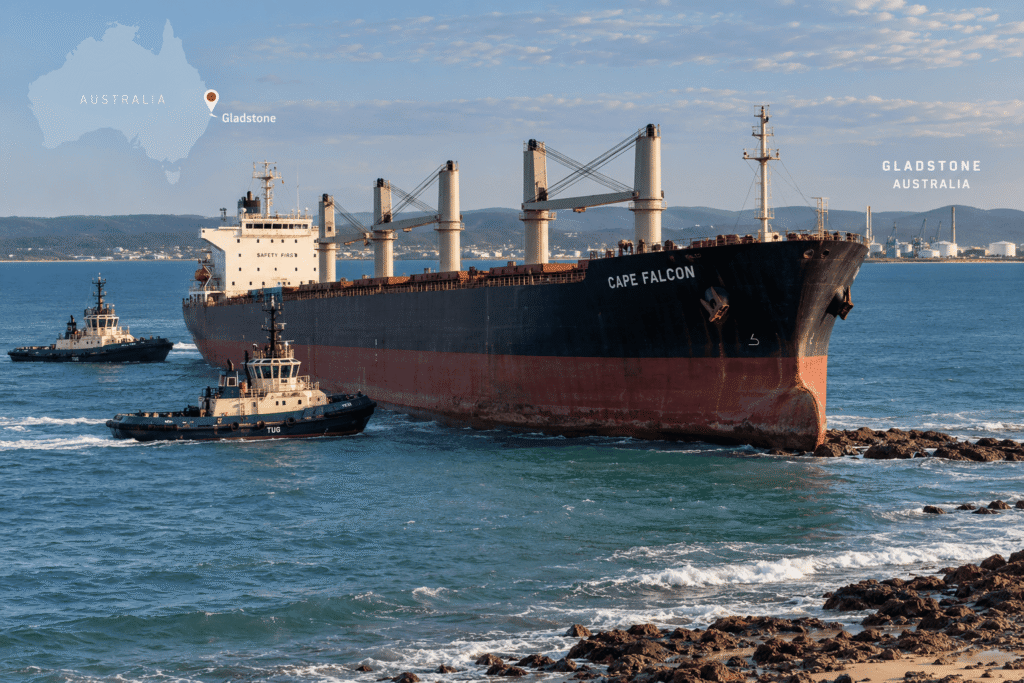
The Liberian-flagged bulk carrier Cape Falcon has remained aground off Gladstone, Queensland, Australia, for five days after two attempts to refloat the vessel failed.
The 292-meter bulk carrier grounded on September 18 while attempting to anchor approximately six nautical miles east of the Port of Gladstone.
According to Queensland’s Department of Transport and Main Roads, Maritime Safety Queensland continues to coordinate the response and recovery operation. Tugboats have already assisted with two unsuccessful refloating attempts.
No Injuries or Pollution Reported
All crew members aboard the Cape Falcon are reported to be safe, and there have been no reports of injuries.
Authorities have also reported no pollution or hull breach following the grounding.
The vessel is not blocking the main shipping channel, meaning other vessels can continue to use the channel. However, port operations in the area remain affected while authorities and salvage teams work on the recovery operation.
Recovery Efforts Continue
The unsuccessful refloating attempts mean further work is required before the bulk carrier can be moved from the grounding location.
Maritime Safety Queensland is continuing to monitor the situation, while the authorities assess the safest way to refloat the vessel.
The grounding occurred while the vessel was attempting to anchor, and investigators are now working to establish exactly what happened during the operation.
ATSB Investigates Cape Falcon Grounding
The Australian Transport Safety Bureau (ATSB) has launched an investigation into the incident.
Investigators are expected to interview crew members and collect evidence to determine the circumstances surrounding the grounding.
The vessel will also be detained after it is refloated. Before the Cape Falcon is allowed to resume its voyage, authorities will conduct a seaworthiness inspection to check whether the vessel and its systems are safe for further operation.
At this stage, there are no reports of injuries, pollution, or a breach of the vessel’s hull.
The focus remains on safely refloating the bulk carrier and completing the investigation into the incident.
Vessel: Cape Falcon
Type: Bulk carrier
Flag: Liberia
Length: 292 meters
Location: Approximately 6 nautical miles east of Gladstone, Queensland
Incident date: September 18, 2026
Crew: Safe, with no injuries reported
Pollution: None reported
Refloating attempts: Two unsuccessful attempts
Investigation: Australian Transport Safety Bureau
Current status: Remains aground while recovery efforts continue
Why do seafarers have to extend their contracts? Explore crew change problems, missing relievers, poor planning and the impact on seafarers and their families.
Why Do Seafarers Still Have to Extend Their Contracts?
I have been working on ships for more than 10 years and have completed more than 20 contracts. Out of all those contracts, I was able to sign off on time only once or twice.
But why?
Why can’t we join or leave ships on time?
Why do we have to extend our sea service contracts and stay onboard longer than agreed?
And why do almost all seafarers suffer from this problem?
Some seafarers cannot even attend their own weddings, see the birth of their children, or be with their families when a close relative passes away—even when companies are informed about these important events well in advance.
But what about seafarers from developed countries?
Well, to be honest, after many years of working on different types of ships with people from different nationalities, I definitely believe there is a form of discrimination in the shipping industry.
Unfortunately, this is similar to what happens in many other parts of the world. If you do not have enough power to defend yourself or demand your rights, some people will use that weakness until the very last second.
There are many reasons for this situation, but I believe incompetent shore-based management and crewing agencies are among the biggest ones.
Seafarers have a very strange working system.
Normally, we work under a contract. When that contract ends, our salary also stops until we find another ship and start working again.
When we are ashore, we need enough savings to cover our expenses. At the same time, however, we cannot stay ashore for too long because our savings will eventually disappear.
So we have to maintain a very difficult balance.
If you save $10,000 and decide to stay ashore for three months, you might already start looking for your next job after one and a half months.
After two and a half months, you may start looking much more actively.
During this period, you might receive an offer from a good company. But if you accept it, your three-month vacation may suddenly become only two months.
If you reject the opportunity and do not find another job by the end of the third month, a dangerous period begins.
You start desperately looking for a ship.
And sometimes, you may even accept a lower salary or a position that you would normally reject simply because you need to start earning again.
Are all seafarers like this?
No.
I will come back to this point later because I believe there is also a form of discrimination in the shipping industry based on nationality.
The Dream We Had at the Beginning
At the beginning of our careers, almost everyone has the same dream.
“I will work for 10 months, save enough money, build some wealth, and leave the sea within five years.”
But here we are.
Many of us are still trapped onboard.
Even when inflation increases, salaries often do not increase at the same rate. Meanwhile, seafarers continue to face dangerous working conditions, vessel attacks, accidents and, in the worst cases, the deaths of crew members.
So for a moment, compare yourself with someone working ashore.
What if you were an Uber driver in Europe, a delivery driver in the UK, or an Amazon warehouse worker in the United States?
To be honest, until you reach Chief Officer level, a seafarer’s income is not always dramatically higher than some shore-based jobs. In some cases, ratings and junior officers may earn similar amounts—or even less—than workers in certain developed countries.
We are the people who keep global trade moving, yet we often struggle to receive even the basic things we ask for.
We stay far away from our loved ones.
We work through rough weather.
We accept responsibility for millions of dollars of cargo and equipment.
And when our contract finally comes to an end, we sometimes hear:
“Sorry, there is no reliever available.”
Or:
“The crew change has been postponed.”
How many of you have received a joining offer only 24 hours before you were expected to board a ship?
I have rejected two such offers myself.
They called me only 24 hours before joining.
Can you imagine being told today that you have to join a ship tomorrow, knowing that you may be away from your family for months?
Why Do Crew Changes Get Delayed?
There are many reasons.
Sometimes the port does not allow a crew change. This can happen in some ports, although it is not always a valid reason.
Sometimes the seafarer does not have the required visa.
Sometimes nobody thought about the visa requirement until the last minute.
Sometimes the reliever becomes sick.
Sometimes the reliever has a family emergency.
Sometimes the company wants to change several crew members at the same time to reduce costs.
And sometimes the company simply wants to wait for a cheaper port.
These are some of the most common reasons why seafarers are forced to extend their contracts.
But do you know what I believe is one of the biggest reasons?
During my career, I have rarely seen a crewing operation that I would describe as truly professional and well-organized.
Think about your previous crewing agencies.
Do you really trust them?
Do you really believe every email they send regarding your contract extension?
Why do so many seafarers onboard automatically become suspicious when they receive an email saying that their contract needs to be extended?
Because, unfortunately, there have been too many situations involving poor communication, excuses, disorganization and, sometimes, simple lies.
Imagine the responsibilities onboard.
As a Captain, you cannot simply say:
“I couldn’t prepare the pre-arrival forms on time.”
As a Chief Engineer, you cannot say:
“I couldn’t complete the fuel oil changeover.”
As a rating, you cannot say:
“I couldn’t prepare the pilot ladder on time.”
If these jobs are not completed, there can be serious consequences.
But when it comes to the office side, crew changes sometimes seem much easier to postpone.
There is a lack of professionalism in some parts of this process.
And there are two sides to the story.
If the head of a crewing department has a strong seafaring background, they usually understand what contract extensions mean to people onboard. They know how difficult it can be for a seafarer to remain onboard for another two or three weeks.
But someone without a seafaring background may see the situation differently.
Crew Changes Are Also About Money
If you run a vessel, you know approximately how much fuel the ship will consume at a certain speed.
You calculate your voyage based on those figures.
You cannot simply tell the Chief Engineer:
“From now on, use half the fuel.”
Fuel is a necessary operating cost.
Crew changes are also a cost.
But unlike fuel consumption, there is sometimes a certain flexibility with crew-change dates.
Now imagine a company with a fleet of 20 vessels.
If every crew change is extended by an average of 15 days, the company may potentially save a significant amount of money over the course of a year.
That saving goes directly into the owner’s pocket.
And for a crewing agency, it can become an opportunity to show the owner:
“Look how much money we saved on crew changes.”
But what happens when a crew member stays onboard too long?
Motivation decreases.
Mental fatigue increases.
Patience becomes shorter.
People become angry and frustrated.
And eventually, the risk of human error increases.
A single mistake caused by an exhausted or demotivated seafarer can cost millions of dollars.
In the worst case, it can even result in the loss of a vessel or human life.
Companies usually prepare financially for bad-case scenarios. They have insurance, emergency procedures and contingency plans.
But somehow, the consequences of prolonged contract extensions are often underestimated.
The “Office Worker” Mentality
Unfortunately, some crewing agencies are a very good example of what I would call the “office worker mentality.”
On paper, everything looks perfect.
The documents are complete.
The schedules look organized.
The spreadsheets are updated.
But sometimes the people managing the process are not fully aware of what is actually happening onboard.
They wait until the last moment.They start making calls,discover that a visa is required,realize that a certificate has expired,discover that the reliever is not available.
And suddenly, the easiest solution is:
“Let’s extend the crew onboard.”
I believe that a large percentage of contract extensions are caused by poor planning, incompetent management or a lack of organization within the crewing process.
Imagine a crewing department with a fixed monthly budget for crew changes.
Suppose they have planned 10 crew changes.
If they find a cheaper port or cheaper crew-change option, they may wait for that opportunity because the company will be happier with the lower cost.
Unfortunately, cheaper does not always mean better.
In some countries, crewing agencies may also have closer relationships with government authorities or other institutions. This can sometimes make it more difficult for seafarers to complain or demand their rights.
A seafarer may simply be expected to say:
“Yes, sir.”
And this is how shipowners can gradually create an environment where they have a large pool of workers who are willing to accept almost anything.
When Personal Connections Matter
I have also seen situations where personal connections make a big difference.
For example, I once knew an officer who had a close friend working in a crewing agency.
Because of that connection, he could arrange certain visas or documentation much more easily than other seafarers.
This creates another problem.
If some people can solve their problems through personal connections while others have to wait weeks or months, the system is clearly not equal.
The people working in the office may benefit from these relationships, while the seafarer’s personal life and mental health become secondary considerations.
And if you have a Captain onboard who always says “yes” to the office, never challenges the crewing department and is willing to accept every extension request, that Captain may become very valuable to the company.
But is that good for the vessel?
I don’t think so.
Most Crew Changes Can Be Planned in Advance
Let’s imagine that a crewing agent calls you today and says:
“You will join a vessel within 10 days. The vessel is going to the United States.”
The first questions should be simple:
Do you have a US visa?
Are all your STCW certificates valid?
Is your medical certificate valid?
Is your seaman’s book valid?
Is your passport valid?
If everything is confirmed, the company already knows that you are ready.
The only uncertainty may be the exact crew-change location, such as whether the vessel will be at anchor or alongside.
The same applies to Europe.
If you have a valid Schengen visa and the vessel is expected to call at a European port within the next 10 days, the company can plan accordingly.
If the vessel is going to Singapore and everyone knows that crew changes are planned there, why wait until the last day to call the seafarer?
The Captain sends the ETA months in advance.
The information is available.
The documents can be checked.
The flights can be arranged.
The reliever can be prepared.
So why does everything sometimes happen at the last minute?
Poor organization on the shore side creates unnecessary problems for everyone.
What About Seafarers From Developed Countries?
Now let’s look at another important question.
What happens to seafarers from developed countries?
Are they facing exactly the same problems?
In many cases, their situation can be very different.
If you are a citizen of a developed country, you generally have stronger legal protections and access to government systems that can help protect your employment rights.
You may pay a lot of taxes, but you can also expect a certain level of protection from the system.
For example, imagine a US citizen working under short-term contracts.
A contract extension may not be treated as something that can simply continue indefinitely. The company may have to plan the employment period much more carefully.
Even if the seafarer is not working in US waters, the company may arrange the contract around the vessel’s schedule so that the seafarer can finish the agreed period and leave the vessel at a suitable port.
Some contracts can be only four to eight weeks long.
The vessel may leave China, cross the Pacific and eventually reach the United States, where the seafarer signs off.
The same can be true for German seafarers working on German-flagged vessels.
Depending on the employment arrangement, some may have long-term contracts similar to shore-based employment, with schedules such as two months onboard and two months off, or other rotational systems.
They may continue receiving a salary throughout the year.
Imagine finishing two months onboard, travelling home, spending your time with your family, and already knowing when and where your next assignment will begin.
You know your joining date.
You know your sign-off date.
You can plan your life.
For many seafarers from other countries, this level of certainty is still a dream.
We Accepted the Job—but Did We Accept Everything?
Contract extensions are a headache.
Missing relievers are a headache.
Cancelled flights are a headache.
Cancelled family holidays are a headache.
Missing weddings, birthdays and important family events can be heartbreaking.
And losing the opportunity to be with your family when someone passes away is something you can never get back.
Some people will say:
“That’s part of the job.”
Maybe it is.
We chose this profession,accepted that we would spend months away from our families challange rough weather,difficult working conditions high responsibility.
But did we accept being treated as if our personal lives do not matter?
Did we accept unlimited contract extensions?
Did we accept poor planning?
Did we accept being informed at the last minute?
I don’t think so.
We accepted the responsibility of being seafarers.
We did not give up our right to be treated professionally.
Until we become financially independent, many of us will continue to depend on this industry.
And sometimes, that means accepting things we should not have to accept.
Maybe the only thing we can do for now is remind ourselves:
Our time matters too.
Because behind every contract extension is not just a name on a crew list.
There is a husband.
A wife.
A father.
A mother.
A son.
A daughter.
A family waiting at home.
And they are waiting for their seafarer to come back.
The Chief Officer, also known as the Chief Mate, is the senior deck officer and second-in-command on a merchant ship.
While the Master has overall command and ultimate responsibility for the safety and security of the vessel, the Chief Officer is heavily involved in the ship’s day-to-day deck operations. Cargo handling, deck maintenance, crew supervision, training, safety, inspections and many aspects of shipboard planning fall within the Chief Officer’s area of responsibility.
On tankers, the role becomes even more demanding because cargo operations involve dangerous and sometimes highly toxic products, complex tank systems, inert gas, cargo pumps, tank cleaning, gas monitoring and strict safety procedures.
The international STCW framework defines the Chief Mate role at the management level and requires competence in areas including navigation, cargo handling and stowage, ship operations, maintenance and repair. It also requires a Chief Mate to be capable of assuming the Master’s responsibilities when necessary.
But what does a Chief Officer actually do during a normal day onboard?
The answer is much more than simply supervising the deck crew.
Who Is the Chief Officer?
The Chief Officer is the senior deck officer immediately below the Master in the ship’s command structure.
A simple way to understand the position is this:
The Master has overall command of the ship, while the Chief Officer manages a major part of the vessel’s daily deck, cargo, maintenance and safety operations.
The Chief Officer normally coordinates the deck department and works closely with the Master, Second Officer, Third Officer, Bosun, Able Seafarers and other crew members.
The position also carries significant responsibility for cargo operations. Under the STCW management-level standards, Chief Mates must be competent to plan and ensure safe loading, stowage, securing, care during the voyage and unloading of cargo.
On a tanker, this can involve thousands or tens of thousands of tonnes of petroleum or chemical cargo.
That means a Chief Officer must understand not only how to operate equipment, but also how cargo operations affect:
Ship stability
Hull stress
Trim and draft
Tank pressure
Cargo temperature
Cargo segregation
Pollution prevention
Personnel safety
Terminal requirements
Loading and discharge rates
What Does a Chief Officer Do?
The exact responsibilities vary according to the ship type, company procedures, Safety Management System (SMS), flag-state requirements and the vessel’s equipment.
However, the Chief Officer commonly has responsibility for the following areas.
1. Cargo Operations
Cargo operations are among the most important responsibilities of a Chief Officer.
Depending on the vessel, this can include:
Cargo planning
Loading and discharge
Ballasting and deballasting
Cargo tank monitoring
Cargo pump operations
Tank cleaning
Cargo line and valve management
Cargo temperature monitoring
Cargo documentation
Communication with terminals
Coordination with cargo surveyors
Cargo calculations
Stability and stress considerations
On tankers, cargo planning must also consider segregation requirements, cargo compatibility, tank condition, inert gas requirements and the vessel’s maximum permissible loading conditions.
The STCW Code specifically requires management-level competence in planning and executing cargo operations safely and in accordance with applicable regulations and procedures.
2. Deck Maintenance
The Chief Officer is normally responsible for planning and supervising maintenance of the vessel’s hull, deck machinery, cargo equipment and associated systems.
This doesn’t mean the Chief Officer personally repairs every piece of equipment.
Instead, the Chief Officer plans the work, assigns responsibilities, supervises the crew, checks the condition of equipment and ensures that maintenance is properly recorded in the vessel’s Planned Maintenance System (PMS).
A routine maintenance program may include inspections of:
Pilot ladders
Mooring ropes
Mooring winches
Windlasses
Anchors and cables
Cargo cranes
Cargo hoses and connections
Cargo pipelines
Cargo valves
Tank cleaning systems
Cargo pumps
Tank monitoring equipment
Tank coatings
Ballast tanks
Deck fittings
Safety equipment
3. Crew Management and Training
A Chief Officer is also a manager.
The deck crew needs clear instructions about what has to be done, how it should be done and what safety precautions are required.
The Chief Officer may organize:
Daily deck work
Maintenance teams
Cargo operation teams
Mooring operations
Tank cleaning teams
Safety drills
Familiarization
Training for junior officers and ratings
Toolbox meetings
Risk assessments and work permits
Good leadership is extremely important.
A Chief Officer who knows everything technically but cannot communicate clearly with the crew can still create serious operational problems.
4. Safety and Accident Prevention
Safety is integrated into almost everything a Chief Officer does.
The Chief Officer may be involved in:
Risk assessments
Permit-to-work systems
Enclosed-space entry
Hot work
Working aloft
Mooring safety
Cargo safety
Tank cleaning safety
Gas testing
Emergency preparedness
Near-miss reporting
Accident investigation
Corrective actions
The Chief Officer also needs to keep the Master informed about important operational issues, deficiencies, accidents, near misses, cargo problems and safety concerns.
5. Ship Security
On many merchant ships, the Chief Officer may also be designated as the Ship Security Officer (SSO), depending on the company’s organization and the vessel’s approved security arrangements.
The ISPS Code requires ships to have appropriate security officers and personnel, but the appointment of the SSO is a company/flag-state matter rather than a universal requirement that the Chief Officer must hold the position. The Master retains ultimate responsibility for ship safety and security.
Security-related duties can include:
Controlling access to the vessel
Monitoring visitors
Checking identification
Stowaway prevention
Security rounds
Security drills
Searches when required
Implementing the Ship Security Plan
Reporting security incidents
What Does a Chief Officer Do on an Oil or Chemical Tanker?
The tanker environment makes the Chief Officer’s job particularly technical.
An oil or chemical tanker can have sophisticated cargo systems that need continuous monitoring and maintenance.
Here are some examples of the equipment and systems a Chief Officer may be responsible for supervising.
Pilot Ladder Inspection
Pilot ladders are critical equipment because pilots may use them when boarding or leaving the vessel.
They are exposed to seawater, weather and mechanical wear, so their condition must be regularly inspected according to applicable requirements and company procedures.
The Chief Officer may check:
Steps
Side ropes
Spreader arrangements
Fastenings
Chafing
General deterioration
A damaged pilot ladder is not something that can simply be ignored until the next port.
Cargo Cranes
Many tankers have deck cranes for handling cargo hoses, provisions, stores, equipment and other heavy items.
The Chief Officer may supervise inspections of:
Hydraulic systems
Oil leakage
Wire ropes
Limit switches
Hooks
Greasing
Brakes
General structural condition
The exact equipment varies between vessels, so the inspection requirements should follow the manufacturer’s instructions, PMS and company procedures.
PV Breaker and Tank Pressure Systems
On oil tankers, pressure/vacuum protection is a critical part of safe cargo operations.
The Chief Officer needs to ensure that relevant pressure/vacuum protection systems are maintained and operational according to the vessel’s procedures.
Depending on the vessel’s design, this may involve monitoring liquid levels in a PV breaker and checking associated valves and systems.
These systems are particularly important because cargo tanks must be protected from excessive pressure or vacuum during loading, discharge and other operations.
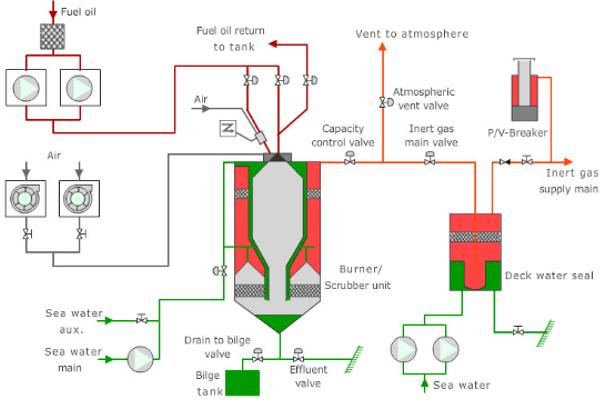
Inert Gas System
Many oil tankers use an inert gas system to reduce oxygen concentration and prevent the formation of a flammable atmosphere inside cargo tanks.
The Chief Officer is closely involved in monitoring the system during cargo operations.
This can include:
Inert gas pressure
Oxygen content
Tank pressure
Deck water seal or equivalent protection
Non-return arrangements
Inert gas main valves
Alarms and shutdowns
The exact system configuration depends on the vessel.
Cargo Tank Monitoring Systems
Modern tankers normally use fixed tank monitoring equipment to measure cargo levels and other parameters.
The Chief Officer relies on this information during:
Loading
Discharging
Cargo calculations
Stability calculations
Cargo monitoring
Tank inspections
The fixed equipment may be supplemented by portable instruments, such as an approved UTI, depending on the vessel and terminal requirements.
Emergency Bilge or Suction Arrangements
On vessels fitted with a pump room, emergency suction arrangements can be an important part of the ship’s emergency preparedness.
These systems need to be maintained and tested according to the ship’s PMS and procedures.
The Chief Officer needs to know where these systems are located, how they operate and how they would be used during an emergency.
Tank Cleaning
Tank cleaning is another major responsibility on tankers.
A fixed tank cleaning system can use seawater or fresh water supplied through a pump and delivered to tank cleaning machines.
Depending on the cargo and cleaning procedure, hot water may be required.
Some vessels therefore have tank cleaning heaters that use steam from the ship’s boiler system to heat the cleaning water before it reaches the tank cleaning machines.
The Chief Officer has to consider:
Previous cargo
Next cargo
Tank coating compatibility
Cleaning temperature
Cleaning chemicals
Washing duration
Sludge generation
Ventilation
Gas measurements
MARPOL requirements
Crew safety
Tank cleaning is not simply a matter of spraying water into a tank. It is a carefully planned operation involving cargo compatibility, safety and environmental considerations.
Gas Detection and Calibration
Gas detection is particularly important on oil and chemical tankers.
Portable and fixed gas detection equipment may be used to monitor parameters such as:
Oxygen
Hydrocarbon gases
Carbon monoxide
Carbon dioxide
Other toxic gases, depending on the cargo and equipment fitted
The Chief Officer may be responsible for ensuring that portable gas meters are properly maintained, tested and calibrated according to the manufacturer’s instructions and company procedures.
Fixed gas detection systems also need to be maintained and tested.
This equipment can literally determine whether an atmosphere is safe to enter or work in.
Cargo Tank and Ballast Tank Inspections
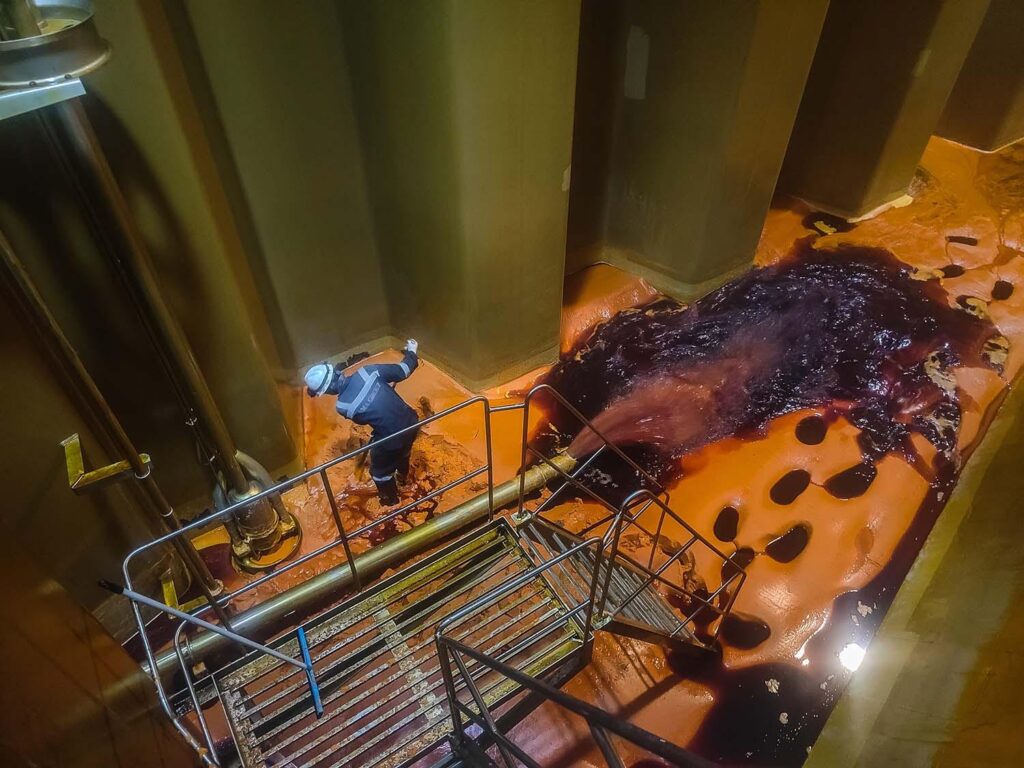
Cargo tanks need regular inspection to identify problems such as:
Coating damage
Corrosion
Cracks
Deformation
Structural deterioration
Leakage
Damaged fittings
Tank coatings can be extremely expensive to repair or replace, particularly on older tankers.
For this reason, early identification of coating damage and corrosion is important.
Ballast tanks also require inspection because they are exposed to seawater and can experience corrosion and structural deterioration over time.
The exact inspection frequency and scope depend on the vessel’s PMS, class requirements, company procedures and applicable regulations.
Cargo Pipelines, Valves and Pumps
Cargo must travel through the vessel’s cargo piping system during loading, discharge and internal transfer operations.
The Chief Officer therefore needs to ensure that cargo lines, valves and related equipment are maintained and free from unacceptable leakage or defects.
Cargo pumps also need regular monitoring and maintenance.
On some vessels, the Chief Officer works closely with the engine department because cargo pumps may be hydraulically driven or otherwise connected to systems maintained by the engineering team.
Mooring Ropes, Winches and Windlasses
Mooring equipment is another important part of the Chief Officer’s responsibilities.
A merchant ship can carry numerous heavy mooring lines, each of which can be expensive and subject to considerable loads during berthing.
The Chief Officer and deck crew need to monitor:
Rope condition
Chafing
Broken strands
Deformation
Mooring winches
Hydraulic systems
Brakes
Fairleads
Rollers
Windlass condition
Anchoring equipment also requires proper maintenance.
The important point is that the Chief Officer does not simply “check the ropes.” The Chief Officer must understand how the entire mooring system behaves under load and ensure that the crew operates it safely.
Does the Chief Officer Stand a Navigation Watch?
Yes.
Although the Chief Officer’s management responsibilities are extensive, the position remains part of the deck officer structure.
On many merchant ships, the Chief Officer stands a 0400–0800 and 1600–2000 navigation watch, although watch schedules can vary according to the vessel’s manning arrangement and company procedures.
During a navigation watch, the Chief Officer is responsible for carrying out the duties of the Officer of the Watch in accordance with the Master’s standing orders, the vessel’s procedures and applicable regulations.
This means that the Chief Officer can move from cargo planning and deck maintenance during the day to navigating a vessel during the night.
That combination is one reason the job is so demanding.
A Realistic Example: A Chief Officer Loading Diesel and Gasoline
Let’s imagine you are the Chief Officer of an oil/chemical tanker proceeding to Hamburg to load approximately 30,000 metric tonnes of cargo, consisting of diesel and gasoline.
The cargoes require proper segregation and a carefully prepared loading plan.
Before Arrival
Before arriving at the terminal, the Chief Officer needs to prepare the cargo plan.
This involves checking:
Cargo quantities
Tank allocation
Cargo segregation
Stability
Trim
Hull stress
Loading sequence
Ballast sequence
Maximum permissible loading rates
Tank capacities
Cargo compatibility
The terminal may request vessel information such as manifold dimensions, manifold height, vessel length, parallel body length and inert gas arrangements.
Before cargo operations begin, the Chief Officer also needs to ensure that the relevant cargo equipment is ready.
This can include:
High-level alarms
High-high-level alarms
Tank radar systems
Cargo valves
Ballast valves
Cargo pipelines
Scuppers
Manifold arrangements
Gas detection equipment
Inert gas systems
At the Loading Terminal
After berthing, the Chief Officer and deck team inspect the vessel and prepare for cargo operations.
The Chief Officer normally meets the terminal representative or loading master.
Together, they establish an operational agreement covering matters such as:
Loading rate
Maximum manifold pressure
Communication procedures
Emergency shutdown arrangements
Cargo sequence
Expected completion time
Special terminal requirements
The vessel’s Notice of Readiness and other documentation are also handled as required.
A cargo surveyor may then board the vessel.
Depending on the cargo operation, the surveyor may check tank condition and documentation and request information such as:
Vessel particulars
Previous cargoes
Vessel Experience Factor (VEF)
Tank calibration tables
UTI information
Cargo documents
Previous dry-dock information
Slop quantities
Once the vessel and terminal are ready, loading can begin.
Starting Cargo Loading
Loading normally begins at an agreed initial rate.
There is a good reason for starting slowly.
At the beginning of a cargo operation, the ship and terminal need to confirm that:
The correct valve is open
The correct tank is receiving cargo
There are no unexpected leaks
Communication is working
Pressure is within limits
Cargo is flowing as planned
Once everything is confirmed, the loading rate may be increased according to the agreed operational limits.
At the same time, the Chief Officer manages the ballast operation according to the loading plan.
This is where cargo planning becomes a real operational task.
The ship is gaining weight in some tanks while losing ballast from others, and stability, trim and hull stresses must remain within safe limits.
Measuring the Cargo
After loading is completed, the ship’s tanks are measured.
Although fixed tank monitoring systems can provide highly useful readings, cargo surveyors may also use portable equipment such as a UTI according to their procedures.
The ship and terminal figures are compared.
Once the cargo quantities and documentation are agreed, paperwork may include:
Bill of Lading
Cargo Manifest
Quantity Certificate
Analysis Certificate
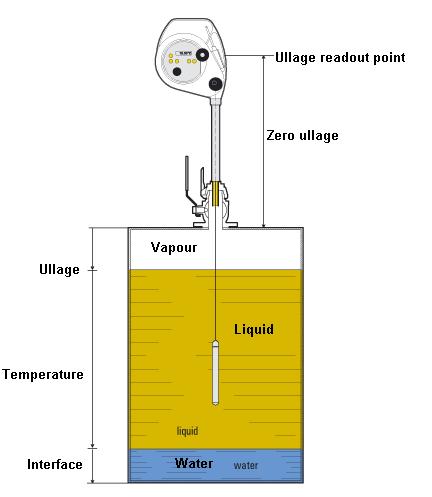
Ullage Report
Time Sheet
Other terminal and cargo documents
If there is an operational disagreement, such as a significant quantity discrepancy, unexpected delay or operational restriction, the Master may issue an appropriate protest or reservation.
The exact documentation depends on the cargo, terminal, charterer and contractual arrangements.
Sailing to the Discharge Port
Once loading is completed and all departure requirements are satisfied, the vessel sails toward the discharge port.
But the Chief Officer’s work does not stop.
Before arrival at the next terminal, cargo equipment is checked again.
The Chief Officer may verify:
Cargo pumps
Cargo valves
Cargo lines
Overfill alarms
Tank monitoring systems
Inert gas arrangements
Ballast systems
Manifold condition
The vessel then arrives at the discharge port.
Discharging the Cargo
At the discharge terminal, the Chief Officer again meets the terminal representative or loading master.
The ship and terminal agree on operational parameters such as:
Maximum discharge rate
Maximum manifold pressure
Communication methods
Emergency contacts
Cargo sequence
Ballast requirements
After the relevant checks and measurements are completed, discharge begins.
Cargo is discharged while ballast operations may take place simultaneously, depending on the vessel’s cargo plan and stability requirements.
The Chief Officer continuously monitors the operation.
Stripping the Cargo Tanks
One of the final parts of a tanker discharge operation is stripping.
The objective is to remove as much remaining cargo as reasonably possible from the tanks and cargo system.
Some vessels are fitted with highly effective stripping systems that can recover very small quantities of remaining cargo.
On other vessels, cargo may need to be stripped toward a designated tank and then discharged through the cargo system.
This is particularly important on tankers because the remaining cargo can affect:
Cargo quantity
Tank cleanliness
Next cargo compatibility
Tank inspection
Environmental compliance
Commercial claims
Once discharge is complete, the surveyor may inspect the tanks and issue the relevant documentation confirming their condition.
The Chief Officer then prepares the vessel for the next operation.
And eventually, after hours of cargo operations, inspections, documentation and supervision, it is time to return to the bridge or finally get some rest.
Chief Officer Salary in 2026
Chief Officer salaries vary considerably depending on the vessel type, company, flag, nationality, experience, trading area and contract conditions.
There is no single global Chief Officer salary.
However, current 2026 job advertisements provide a useful indication of the market.
Recent listings include:
Vessel / Position
Average Monthly Salary
Chemical tanker Chief Officer
$10,800–$11,550
Oil/Chemical tanker, 38,000 DWT
$7,000–$12,000
Crude oil tanker, 120,000 DWT
$10,500–$11,000
Crude oil tanker fleet
Around $12,000
Chemical tanker vacancy
Around $11,300
These are examples from current 2026 vacancies rather than a universal industry salary scale.
A 2026 salary analysis from Maritime Zone reports an average Chief Officer salary of approximately $10,204 per month for June 2026 in its dataset, while also showing that some tanker and gas-sector positions can reach significantly higher levels.
For an experienced Chief Officer on an international tanker, a practical 2026 expectation is therefore often around $10,000–$14,000+ per month, with some specialized vessels and markets paying more.
For example, a current vacancy for a Chief Officer on a 110,000–150,000 DWT crude tanker advertises $12,000 per month, while another current oil/chemical tanker vacancy for a 38,000 DWT vessel advertises $11,000–$12,000 per month.
However, salary alone does not tell the complete story.
A seafarer should also check:
Contract duration
Paid leave
Leave pay
Bonus
Tank cleaning allowance
Overtime
Insurance
Pension
Repatriation
Travel arrangements
Tax obligations
Whether salary is paid only while onboard or continuously
Two Chief Officers earning the same monthly amount can therefore have very different overall compensation packages.
Chief Officer Working Hours
One of the biggest misconceptions about the job is that a Chief Officer simply works a normal “office day” onboard.
In reality, the working day can change dramatically depending on the operation.
During a quiet sea passage, the Chief Officer may have a predictable navigation watch combined with planned maintenance, inspections, paperwork and crew management.
During cargo operations, however, the situation can be completely different.
A Chief Officer may be dealing with:
Pre-arrival preparation
Cargo calculations
Terminal meetings
Loading or discharge
Ballasting
Tank inspections
Cargo surveys
Documentation
Maintenance problems
Crew supervision
Safety meetings
Emergency situations
Port operations can therefore create very long and demanding days.
The Chief Officer also needs to manage rest carefully because international watchkeeping and hours-of-rest requirements apply to seafarers.
Chief Officer vs Captain
The Chief Officer and Master have different responsibilities, although they work closely together.
Master
The Master has overall command and ultimate responsibility for the safety and security of the vessel, crew, cargo and the protection of the marine environment. The STCW framework explicitly recognizes the Master’s ultimate responsibility while requiring the Chief Mate to be able to assume that responsibility when necessary.
Chief Officer
The Chief Officer is the senior deck officer and generally manages a large part of the ship’s daily deck and cargo operations.
In simplified terms:
Master = overall command
Chief Officer = senior deck management and cargo operations
But the Chief Officer is not simply “the person who does everything after the Captain.”
The role is management-focused.
The Chief Officer plans, supervises, coordinates, checks and makes decisions within the area of responsibility while keeping the Master properly informed.
How Do You Become a Chief Officer?
The exact career path depends on the country and flag administration, but the general merchant-navy pathway is:
Deck Cadet → Third Officer → Second Officer → Chief Officer → Master
A mariner normally needs:
Approved sea service
Appropriate Certificate of Competency
Required STCW training
Medical fitness certification
Required examinations
Relevant tanker or ship-type training where applicable
Experience appropriate to the certificate
The STCW Convention establishes international minimum standards for training, certification and watchkeeping, while individual administrations determine how those requirements are implemented nationally.
Becoming a Chief Officer is therefore not simply a matter of accumulating sea time.
The officer must demonstrate competence at management level.
Is Being a Chief Officer Difficult?
Yes—but the difficulty isn’t only physical.
The biggest challenge is responsibility.
Imagine being responsible for a cargo operation involving tens of thousands of tonnes of petroleum product.
A Chief Officer needs technical knowledge, practical experience, leadership, communication skills and the ability to make decisions under pressure.
The Chief Officer Does Not Work Alone
Despite everything described in this article, there is one important point that should never be forgotten:
The Chief Officer does not perform all of these jobs alone.
There is a deck team behind the Chief Officer.
The officers, Bosun, Able Seafarers and other crew members perform maintenance, inspections, mooring, cargo operations, cleaning and many other tasks.
The Chief Officer’s job is not to personally do every piece of work.
It is to plan the work, organize the team, supervise the operation, identify risks and make sure the job is completed safely and correctly.
That is what makes the Chief Officer a management-level position.
Final Thoughts
The Chief Officer is one of the most demanding positions in the merchant navy.
From the outside, a large tanker may look like nothing more than a huge steel structure carrying cargo across the ocean.
From the Chief Officer’s perspective, however, every part of the ship requires attention.
Cargo tanks need to be inspected.
Pumps need to work.
Valves need to operate.
Mooring ropes need to be maintained.
Tank cleaning systems need to be ready.
Gas detection equipment needs to be reliable.
Ballast needs to be controlled.
Cargo needs to be planned.
The crew needs to be trained.
And when the ship arrives at the terminal, the Chief Officer may be responsible for coordinating an operation involving thousands of tonnes of dangerous cargo.
That is why the Chief Officer’s job is much more than a title.
It is a combination of cargo manager, deck manager, safety leader, supervisor, planner, navigator and decision-maker—all while working as part of a team under the overall command of the Master.
For anyone considering a career at sea, becoming a Chief Officer can be one of the biggest milestones in a deck officer’s career.
And for those already working onboard, they know the reality:
The ship may belong to the company, the cargo may belong to the charterer, but when the operation starts, the Chief Officer has a lot of responsibility on his shoulders.
Mooring operations are one of the most important activities performed during a vessel’s arrival and departure from port. Proper mooring ensures the ship remains safely secured while preventing damage to the vessel, port facilities, and surrounding areas.
Successful mooring requires careful planning, effective communication between bridge and deck teams, and proper handling of mooring equipment. Crew members must understand the condition of ropes, winches, bollards, and other mooring systems before starting operations.
Safety procedures are essential during every stage of mooring. Following established practices, maintaining awareness, and using correct techniques help reduce risks and create a safer working environment for all crew members.
Professional seamanship and teamwork play a key role in ensuring smooth and efficient mooring operations.
Marine diesel engines are the primary power source for many commercial vessels around the world. These powerful machines provide the energy required to move ships efficiently across oceans while supporting essential onboard systems.
Understanding the basics of marine diesel engines helps engineers and maritime professionals recognize how propulsion systems operate. Key components include cylinders, pistons, fuel injection systems, turbochargers, cooling systems, and lubrication systems.
Marine engineers are responsible for monitoring engine performance, conducting maintenance, troubleshooting problems, and ensuring reliable operation during voyages.
With modern advancements in fuel efficiency, automation, and environmental technology, marine diesel engines continue to evolve to meet the changing needs of the global shipping industry.
Safety is the foundation of successful maritime operations. This episode explores important safety principles followed by professional seafarers, including risk assessment, teamwork, communication, and emergency response procedures.
Industry professionals share their experiences and explain how strong safety awareness helps protect crews, vessels, and the marine environment.
Stay connected with seafarers worldwide. Get maritime news, professional updates, industry insights, and project announcements directly in your inbox.
This website uses cookies
We use cookies to personalize content, provide social media features, and analyze our traffic. We also share information about your use of our site with our analytics partners. You can change your preferences at any time.