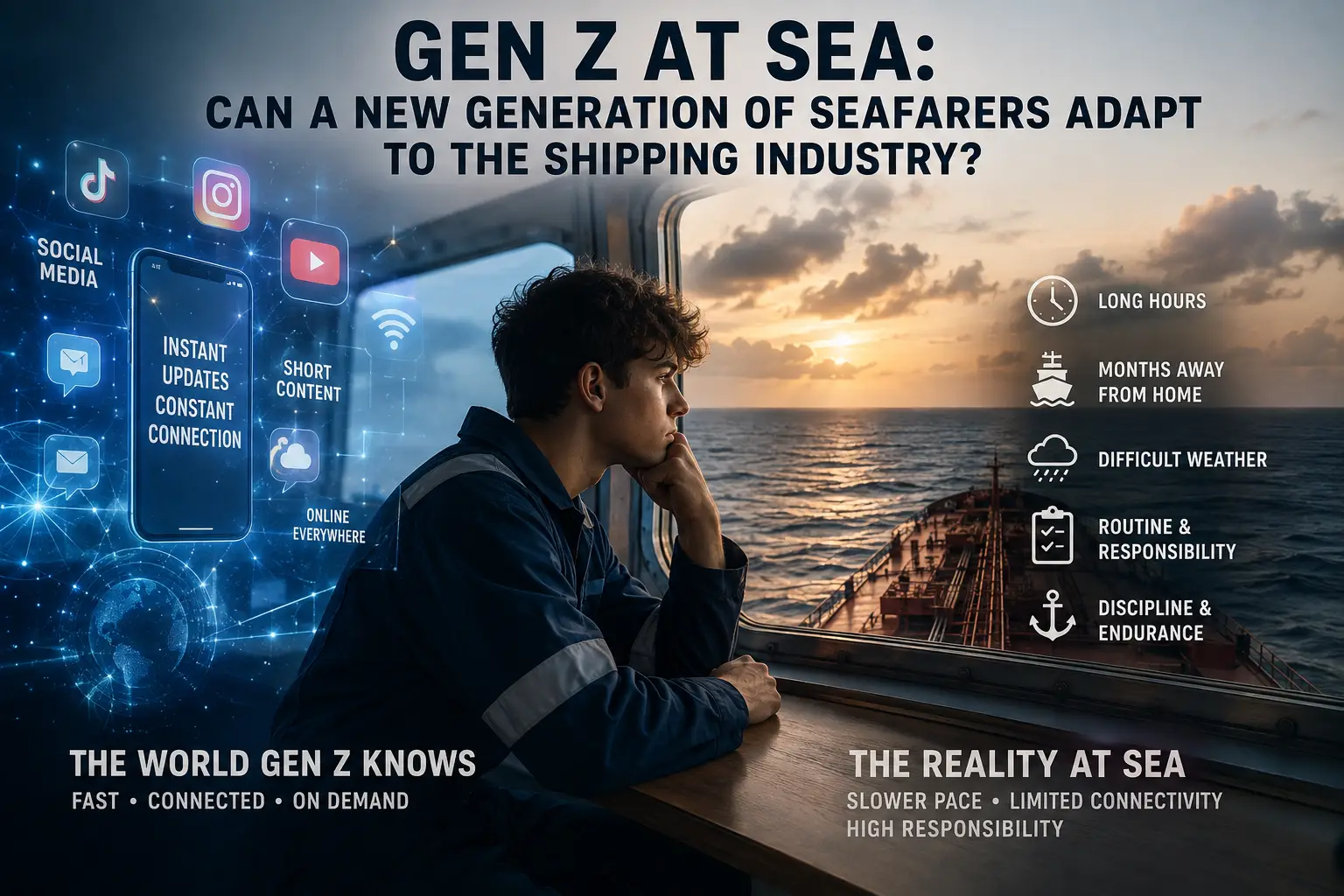
The maritime industry has always been built around discipline, patience and endurance. Seafarers are expected to work long hours, deal with difficult weather, spend months away from home and remain professional under pressure.
But a new generation is entering the industry.
Generation Z, generally referring to people born between the late 1990s and early 2010s, is now becoming part of the modern maritime workforce. Compared with previous generations, Gen Z has grown up with smartphones, social media, instant communication and rapid technological development.
This raises an important question for shipping companies:
Can traditional shipboard working culture adapt to the expectations of a new generation of seafarers?
The answer could have a major impact on the future of the maritime industry.
Gen Z Has Never Known a World Without Instant Communication
One of the biggest differences between Gen Z and previous generations is their relationship with technology.
For many young people today, information is available within seconds. A smartphone can provide entertainment, communication, news, education and social interaction almost anywhere in the world.
Short-form content such as TikTok, Instagram Reels and YouTube Shorts has also changed the way people consume information. Content is fast, visual and constantly changing.
Life at sea is almost the complete opposite.
A vessel may travel at around 15–20 knots and still require weeks or even months to complete a voyage. There may be long periods when nothing significant happens. A seafarer can spend days watching the horizon, maintaining equipment, completing paperwork or waiting for the next port.
For someone who has grown up with constant stimulation, this lifestyle can be a significant adjustment.
Imagine asking a 20-year-old cadet to spend several months on a ship, away from friends and family, with limited entertainment and a completely different daily routine.
The challenge is not necessarily that Gen Z is unwilling to work.
The challenge may be that the psychological environment they grew up in is very different from the environment found on board a ship.
Is Gen Z Really Less Patient?
There is a common argument that younger generations have shorter attention spans and less patience because of social media.
There may be some truth behind this perception, but the situation is more complicated.
Gen Z has also grown up in a period of rapid technological change. They are generally comfortable learning new digital tools, communicating online and adapting to new technology.
This could actually become a major advantage for the maritime industry.
Shipping is becoming increasingly digital. Electronic navigation, automation, remote monitoring, digital reporting, advanced cargo systems, artificial intelligence and other technologies are changing the way ships operate.
A generation that is already comfortable with technology may therefore be particularly well positioned to adapt to the digitalisation of shipping.
The problem may not be their ability to work.
The problem may be how we teach them to work.
The Traditional Shipboard Culture
Anyone who has worked on ships knows that life at sea is not easy.
Seafarers can be required to work long hours, operate machinery in difficult conditions, deal with heavy weather and remain alert during emergencies.
There are also night watches, cargo operations, port manoeuvres, drills and unexpected situations that can interrupt sleep and personal time.
Consider a winter manoeuvring operation.
It is the middle of the night. The temperature is -10°C. The vessel is preparing to manoeuvre, and a young crew member is required on deck.
For an experienced seafarer, this may simply be part of the job.
For a young person who has never experienced this type of environment, it can be a completely different psychological experience.
They may not immediately think:
“This experience will make me stronger.”
They may think:
“Why am I doing this?”
And if the answer is never properly explained, they may eventually decide that they do not want the job.
This is where maritime leadership becomes extremely important.
“We Suffered, So You Should Too” Is Not the Answer
One of the biggest problems in a multi-generational workplace is the belief that younger seafarers should experience exactly what previous generations experienced.
Older seafarers often had extremely difficult careers. Many worked without modern communication systems, had limited access to the internet, spent long periods away from their families and experienced working conditions that would be unacceptable today.
Their experience deserves respect.
But that does not necessarily mean the industry should reproduce every difficulty they experienced.
There is a dangerous mentality in some workplaces:
“We suffered, so you should suffer too.”
This approach may create unnecessary conflict between generations.
A better approach would be:
“We experienced these difficulties. Let us explain why they happened, what we learned from them and how we can make the next generation better prepared.”
Gen Z does not necessarily need a softer maritime industry.
It may need a better-managed maritime industry.
Training Gen Z Requires a Different Approach
Traditional shipboard training can sometimes be based on observation, repetition and direct instruction.
These methods remain important, particularly for safety-critical operations.
However, younger seafarers may respond better when the purpose behind a task is clearly explained.
Instead of simply saying:
“Do this because I told you to.”
A senior officer could explain:
“This is why we are doing it this way. This is the risk we are controlling, and this is what could happen if we do it incorrectly.”
That small difference can have a major effect.
Young seafarers often want to understand the reason behind a procedure rather than simply follow an instruction without context.
This does not mean that a ship should become a democracy.
The Master remains the Master. Officers remain responsible for their duties, and safety procedures must be followed.
But authority and explanation can exist together.
Mentoring Could Become More Important
One of the most effective ways to help younger seafarers adapt could be a stronger mentoring culture.
A cadet or junior officer may be afraid to ask a senior officer what they consider to be a basic question.
If they receive a negative reaction, they may stop asking.
That can create a serious problem.
A good senior officer should be able to say:
“You don’t know it yet. That’s why you are here to learn.”
A simple mentor system could help young seafarers understand not only what they are doing, but also why they are doing it.
This could include:
- Regular discussions between senior and junior crew members
- Clear training objectives
- Short practical learning sessions
- Constructive feedback
- Opportunities to ask questions without embarrassment
- Clear explanations of career progression
- Greater involvement in practical operations
For a young seafarer, having one experienced person on board who is willing to teach rather than simply criticise can make a significant difference.
Connectivity Is No Longer a Luxury
There is another major difference between generations: communication with the outside world.
Previous generations could spend weeks or months at sea with very limited communication with their families.
Today, connectivity has become an important part of life at sea.
Video calls, messaging applications and social media allow seafarers to remain connected with their families and friends.
For Gen Z in particular, constant digital communication is normal.
Therefore, reliable internet access should increasingly be considered part of crew welfare rather than simply an entertainment benefit.
A seafarer who can speak to their family after a difficult day may be psychologically better prepared to continue working.
This is particularly important for young crew members experiencing their first contract.
Gen Z May Actually Help Maritime Technology
There is an interesting contradiction here.
The same generation that some people describe as impatient may also be one of the most technologically adaptable generations entering shipping.
Modern ships are becoming more dependent on digital systems.
Electronic navigation systems, automated machinery, digital documentation, remote monitoring and data-driven operations are becoming increasingly common.
Young seafarers who have grown up using smartphones and computers may adapt quickly to these systems.
The industry therefore needs to avoid viewing Gen Z only as a challenge.
They could also become one of shipping’s biggest technological advantages.
The key is to connect their technological skills with traditional maritime knowledge.
A young officer who understands both traditional seamanship and modern digital systems could become extremely valuable to the future shipping industry.
But Gen Z Is Not the Same Everywhere
It is also important not to treat Gen Z as one single group.
A 20-year-old from a wealthy country and a 20-year-old from a developing country may have completely different expectations about work.
For some young people, leaving a ship after a difficult contract may be a realistic option.
For others, the salary from a maritime job may be essential for supporting their family.
Economic conditions therefore influence how young people perceive difficult working environments.
This is one reason why general statements such as “Gen Z does not want to work hard” are misleading.
Some young people may leave a difficult job because they have other opportunities.
Others may continue working because they have no alternative.
The maritime industry is global, and its workforce comes from very different social and economic backgrounds.
The Real Threat: Losing Young Seafarers
The biggest concern should not be whether Gen Z likes ships.
The real question is whether the maritime industry can retain enough young people to replace the experienced seafarers who will eventually leave the workforce.
Shipping already depends heavily on a global workforce.
Experienced captains, chief engineers, chief officers and other senior crew members cannot be replaced overnight.
Training a competent seafarer takes years.
If large numbers of young people enter the industry but leave after one or two contracts, shipping companies could face a serious manpower problem in the future.
This makes retention just as important as recruitment.
Hiring young people is not enough.
The industry needs to give them a reason to stay.
Shipping Does Not Need to Become Easy
There is an important distinction between making shipping more attractive and making shipping easier.
Ships will always require discipline.
Cargo operations will remain dangerous.
Bad weather will still exist.
Emergency situations will still require people to work under pressure.
A vessel will still need crew members who are willing to wake up at 3 a.m. for manoeuvring operations in freezing weather.
These realities cannot simply disappear because a new generation has different expectations.
But the way those realities are communicated can change.
Young seafarers need to understand that difficult situations are sometimes unavoidable.
At the same time, senior management should ask whether every difficult practice on board is actually necessary.
Hard work is part of shipping. Unnecessary hardship does not have to be.
The Future Captain May Need to Be a Better Mentor
The maritime officer of the future may need more than technical knowledge.
Leadership, communication and mentoring could become equally important.
A captain or chief officer managing a multinational crew already needs strong interpersonal skills. With several generations working together, these skills will become even more important.
The future leader may need to know when to be strict, when to explain, when to listen and when to support.
That does not mean lowering standards.
In fact, good communication can make standards stronger.
A young seafarer who understands why a safety procedure matters may be more likely to follow it correctly than someone who follows it only because they are afraid of punishment.
Can Gen Z Adapt to Life at Sea?
Yes.
But the maritime industry must also adapt.
Every generation enters the workforce with different expectations.
Previous generations adapted to the ships of their time. Gen Z will need to adapt to the realities of maritime life as well.
However, shipping companies cannot expect the next generation to behave exactly like the previous one.
The industry is changing.
Ships are becoming more technologically advanced. Communication is improving. Automation is increasing. Crew welfare is receiving greater attention.
The people operating these ships are changing too.
Perhaps the future of shipping does not depend on forcing Gen Z to become exactly like previous generations.
Perhaps it depends on combining the resilience and practical experience of older seafarers with the technological ability and new perspectives of younger ones.
The sea will always be difficult.
The question is whether we can build a maritime industry where young people are prepared to face those difficulties — rather than simply being expected to tolerate them.
Shipping needs strong seafarers. But strength does not always mean suffering in silence. Sometimes, real strength comes from learning how to adapt.