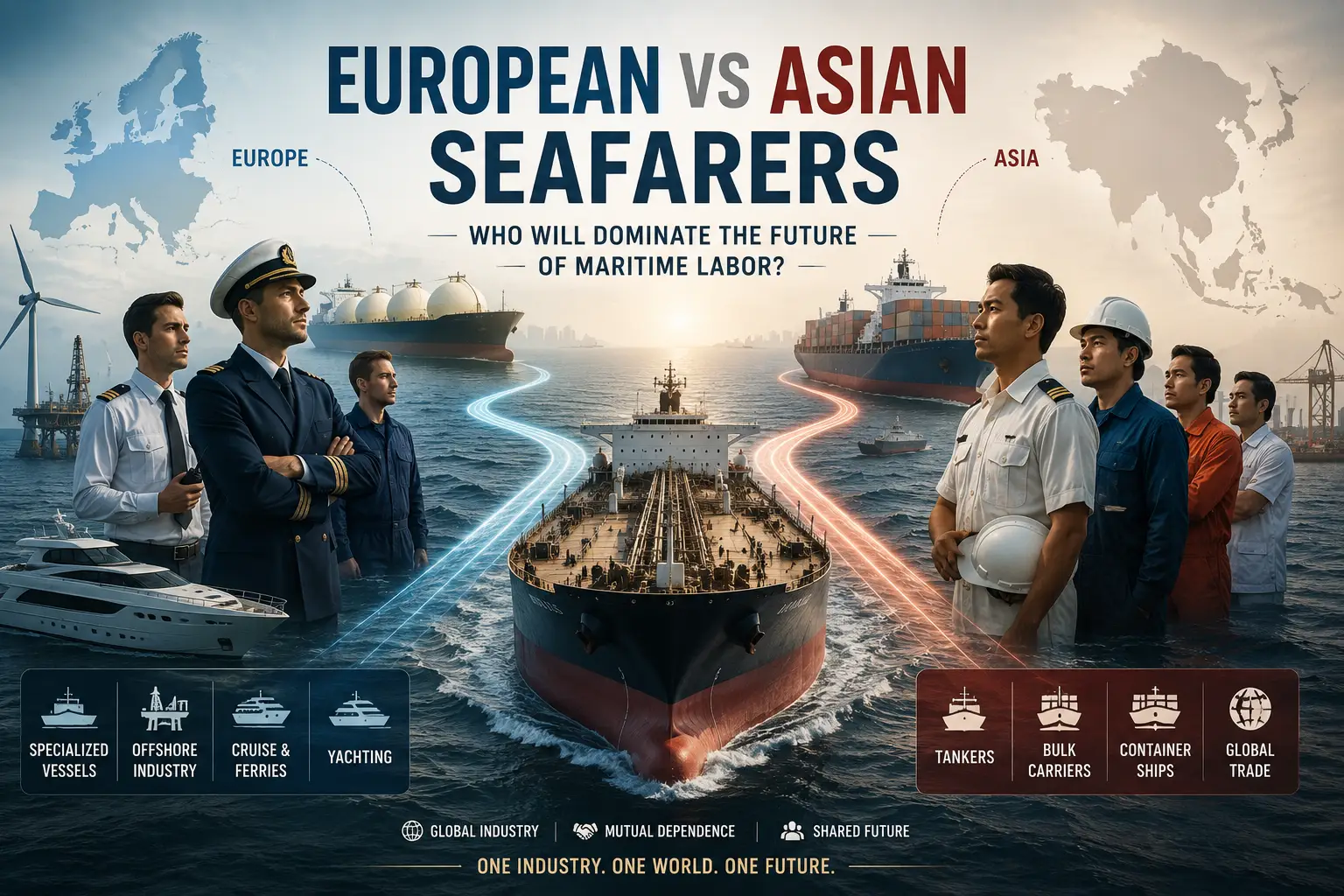
European vs Asian seafarers: why shipowners often rely on Asian maritime labor, what this means for European officers, and how the industry may evolve.
The maritime industry has always been international. Ships operate across borders, and crews are often made up of people from many different countries.
But there is an interesting question that is becoming increasingly relevant:
What will happen to European officers as shipowners increasingly rely on Asian seafarers?
If you are interested in how Filipinos become biggest workforce of the shipping industry , you can read the article
Is the future of the maritime industry going to be dominated by lower-cost Asian labor, while European officers move toward specialized vessels and shore-based positions?
To understand this, we need to look at several different factors, including nationality restrictions, crew costs, contract duration, established maritime labor markets, and the changing expectations of seafarers.
Are Seafarers Allowed to Work on Ships of Any Nationality?
In theory, shipping is a global industry.
An officer with a valid Certificate of Competency (CoC), the necessary endorsements, and the required qualifications can potentially work for a foreign company or on a foreign-flagged vessel.
However, in reality, nationality restrictions still exist in several countries.
The United States is one of the best-known examples.
The Jones Act, formally Section 27 of the Merchant Marine Act of 1920, regulates transportation of goods between U.S. ports and includes requirements relating to U.S.-built, U.S.-flagged, and U.S.-owned vessels. In certain domestic trades, additional requirements regarding U.S. citizens and workers also apply.
But the United States is not the only country where national regulations can influence crew nationality.
Countries such as Australia, Canada, Norway, Turkiye, the United Kingdom,Spain and Germany have various forms of national or regulatory requirements affecting maritime employment, depending on the vessel, trade, flag, position, and applicable agreements.
The important point is that these regulations are not always absolute.
When There Are Not Enough Local Seafarers
This is where the situation becomes more interesting.
I currently work on a German-flagged tanker, and I have seen how the shortage of national officers can create practical problems for shipowners.
German regulations have traditionally included nationality requirements for certain senior positions, while other crew members may work with the appropriate endorsements.
However, when there are not enough qualified German officers available, flexibility or exemptions can become necessary.
The reason is simple:
A ship cannot continue operating if there are not enough qualified officers available to crew it.
I have also seen a Turkish-owned vessel trading in Spanish cabotage waters where the vessel operated under the Spanish flag. The captain was Spanish, while the remaining crew members were Turkish.
Stories like these make us ask an important question:
If shipping companies can increasingly recruit internationally, what does the future look like for officers from developed countries?
Why Do Shipowners Often Prefer Asian Seafarers?
There is no single answer.
It is tempting to say that Asian seafarers are preferred simply because they are cheaper, but the reality is more complicated.
Several factors influence a shipowner’s decision.
These include:
- Lower overall crew costs
- Longer contract durations
- Established Asian maritime labor markets
- Large and experienced crewing agencies
- Availability of qualified seafarers
- Familiarity with multinational crews
- Operational flexibility
Let’s look at these factors one by one.
1. Lower Overall Crew Costs
Shipping is a business, and crew costs are an important part of operating a vessel.
International organizations and collective agreements establish minimum wage scales for seafarers, but actual salaries can be considerably higher depending on the vessel, position, company, nationality, experience, and employment agreement.
In general, salary expectations in some Asian maritime labor markets can be lower than those expected by officers from Western European countries.
This does not necessarily mean that Asian seafarers are less qualified.
Rather, the labor market itself is different.
For a shipowner operating several vessels, even a relatively small difference in monthly crew costs can become significant when multiplied across an entire fleet.
This is one reason why shipowners may look toward established Asian maritime labor markets.
2. Contract Duration
Contract duration is another important factor.
Imagine a vessel with approximately 20 crew members.
If crew members have relatively short contracts, the company may need to arrange crew changes several times a year.
Every crew change involves costs such as:
- Flights
- Port agents
- Immigration procedures
- Transportation
- Hotels when necessary
- Documentation
- Medical arrangements
- Launch or boat services in some ports
Even if the direct cost of one crew change is relatively modest, the total can become significant over an entire fleet.
Now consider a crew structure where ratings remain onboard for around eight months and officers for around six months.
The number of crew changes can be reduced considerably.
For shipowners, fewer crew changes mean lower logistical costs and less administrative work.
Therefore, longer contract durations can be an important advantage when selecting a particular labor market.
3. Established Asian Maritime Labor Markets
Another major advantage is the established maritime labor infrastructure in countries such as the Philippines.
The Philippines has developed a huge maritime workforce and a large network of manning and crewing agencies.
This creates an ecosystem where shipowners do not necessarily have to search for individual seafarers themselves.
Instead, a company can contact a crewing agency, provide the vessel details and required positions, and request qualified candidates.
The agency may already have a large database of officers and ratings with different levels of experience.
This makes the recruitment process much easier for shipowners.
For a company operating a large fleet, this can be extremely valuable.
Instead of spending significant time searching for individual crew members, the company can rely on an established recruitment network.
4. Experience and Reliability
There is another factor that is often discussed onboard: the quality of the crew.
In practice, shipowners do not simply want the cheapest possible crew.
A cheap crew can become extremely expensive if poor performance results in:
- Equipment damage
- Cargo contamination
- Delays
- Accidents
- Maintenance problems
- Human-error-related incidents
Therefore, experienced shipowners often look for a balance between salary and competence.
In other words:
The cheapest seafarer is not necessarily the cheapest option for the shipowner.
A more experienced officer or rating may cost more but can potentially reduce operational risks and maintenance problems.
This is why large crewing markets can offer different levels of experience and salary expectations, allowing companies to select crews according to their operational requirements and budget.
5. Language and Multinational Crews
Modern ships are often multinational workplaces.
A single vessel can have crew members from the Philippines, India, Turkiye, Romania, Ukraine, Russia, Greece, Croatia, and several other countries.
English is generally the working language onboard international ships.
Therefore, the ability to communicate effectively in English and work within a multinational team is often more important than nationality itself.
This is another reason why countries with large and established maritime labor markets have become important suppliers of seafarers.
What About European Seafarers?
At this point, it may sound like European seafarers are simply disappearing from the industry.
I don’t think that is necessarily the case.
European seafarers still have important advantages, especially in specialized sectors.
They can be found in areas such as:
- Northern European shipping
- Offshore operations
- Specialized vessels
- LNG and LPG shipping
- Cruise ships
- Ferries
- Government-related shipping
- Inland European shipping
- Yachting
- Companies operating under strong national labor agreements
The situation is therefore more complicated than simply saying:
“Asian seafarers will replace European seafarers.”
A more realistic possibility is that the two labor markets may gradually become more specialized.
European Officers May Move Toward Specialized Jobs
European officers often have access to opportunities that may be less attractive or less available to lower-cost international labor markets.
Contract duration is also an important consideration.
Many European seafarers prefer shorter contracts and longer periods of leave.
This can make them more expensive from a shipowner’s perspective, but it can also make certain European officers attractive for specialized operations where experience, communication, local regulations, and customer expectations are particularly important.
The yachting industry is another interesting example.
For high-end yacht owners, employing officers from countries with strong maritime traditions can sometimes be seen as a sign of professionalism and prestige.
The cruise industry also continues to employ officers from Europe and North America, particularly in senior positions.
The Future May Be About Specialization, Not Disappearance
So, what will happen to European officers?
I don’t believe European officers will simply disappear from the maritime industry.
Instead, the industry may become increasingly divided into different labor markets.
Asian seafarers may continue to dominate many conventional commercial shipping positions because of the combination of availability, established crewing networks, competitive salaries, and longer contracts.
European officers, meanwhile, may increasingly concentrate on specialized vessels, offshore operations, cruise ships, ferries, yachting, inland shipping, and shore-based maritime careers.
This does not necessarily mean that one group is better than the other.
It simply means that the global maritime labor market is adapting to economic realities.
So, Is It All About Money?
Not entirely.
If it were only about salary, the cheapest possible crew would always win.
But shipping companies also care about:
- Competence
- Reliability
- Experience
- Safety
- Crew stability
- Communication
- Vessel type
- Operational requirements
- Regulatory compliance
A shipowner may save money by employing cheaper crew members, but if the crew creates more operational problems, those savings can disappear very quickly.
This is why experienced shipowners often look for the best balance between cost and performance, rather than simply the lowest salary.
The Real Question: Who Will Work at Sea?
The maritime industry is often discussing a future shortage of qualified officers.
There may indeed be a shortage of seafarers in certain positions and regions.
But the more interesting question is:
Which seafarers will fill those positions?
The global maritime labor market has created strong incentives for people from developing countries to enter the profession.
In countries where maritime employment provides significantly better income than many shore-based alternatives, becoming a seafarer can be an attractive career.
This creates a continuous supply of new seafarers.
At the same time, people from developed European countries may have more attractive shore-based alternatives.
They may have stronger labor protections, shorter working hours, better social security systems, and more opportunities to build a career without spending months away from home.
This creates a completely different incentive structure.
A Changing Maritime Workforce
The maritime industry has changed over the last few decades.
In some countries, governments and educational institutions actively encouraged people to enter the maritime profession when shipping companies faced officer shortages.
As maritime academies and private training institutions expanded, the number of potential officers increased.
Today, the situation in some countries is almost the opposite.
Shipping companies can have access to large pools of qualified applicants and can select candidates according to their requirements.
This is a major change in the maritime labor market.
The industry is no longer asking only:
“Where can we find an officer?”
It is increasingly asking:
“Which officer gives us the best combination of competence, availability and cost?”
What Does This Mean for European Officers?
European officers still have a future at sea.
However, the traditional model of having large numbers of European seafarers working on every type of commercial vessel may continue to decline.
Instead, European maritime professionals may increasingly move toward positions where their experience, qualifications and local knowledge provide additional value.
This could include:
- Offshore
- LNG and LPG
- Cruise
- Yachting
- Specialized vessels
- Maritime administration
- Pilotage
- Ship management
- Marine surveying
- Port operations
- Shore-based management
In countries such as Germany, the Netherlands, Greece, Italy, France, Norway and Denmark, the maritime industry remains extremely important.
Many globally recognized shipping companies are based in Europe.
Therefore, European maritime professionals are unlikely to disappear.
But their role in the global seafarer labor market may change.
Conclusion
The future of European and Asian seafarers is not simply a competition between two groups.
It is a result of economics, regulations, labor markets, demographics and the changing expectations of people who work at sea.
Asian seafarers are likely to remain a major part of the global commercial shipping workforce because of established maritime labor markets, large crewing networks, competitive employment costs and longer contract structures.
European officers, meanwhile, may increasingly focus on specialized sectors and positions where experience, qualifications, local knowledge and working conditions justify higher employment costs.
The global shipping industry needs both.
The real question is not:
“Will Asian seafarers replace European seafarers?”
The better question is:
“How will the global maritime labor market divide and specialize in the future?”
And from what we can see today, that process has already started.