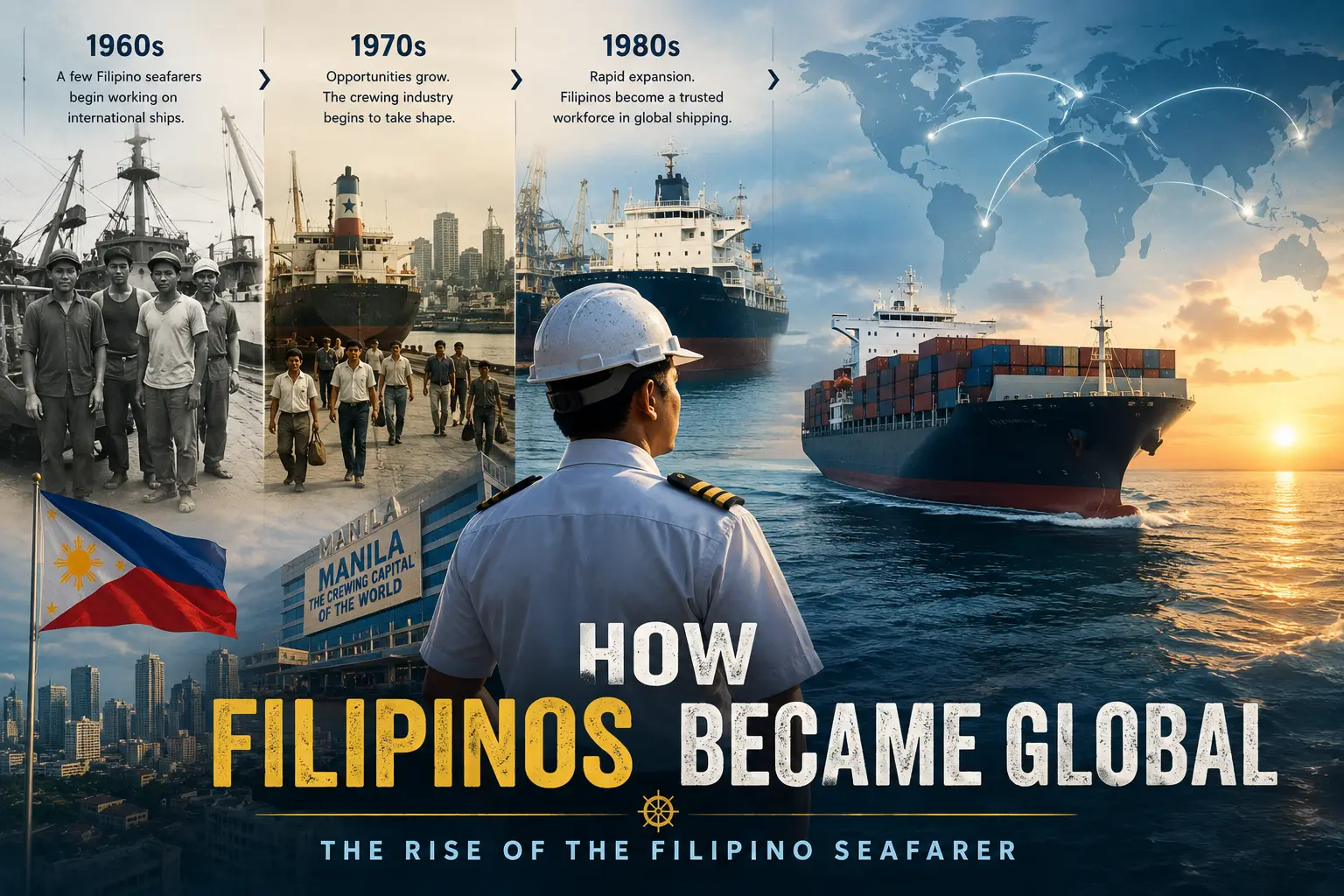
Survival of a nation from zero to hero of the shipping industry…
According to the latest BIMCO report, there are currently around 2,565,580 seafarers working in the global maritime industry. The distribution of seafarers by nationality shows one country standing clearly above the rest: the Philippines.
But how did this happen?
When did the Philippines become one of the world’s largest suppliers of seafarers? Why have Filipino seafarers remained so important to the international shipping industry for decades? And what are the real reasons behind this success?
To understand the answer, we need to go back several decades.
The Early Years of Filipino Seafarers
In the 1960s, it was estimated that only around 2,000 Filipino seafarers were working on international ships.
By 1975, this number had increased to approximately 23,534, and the number continued to grow during the following years (McKay, 2007).
The growth became particularly significant during the 1980s. By the end of that decade, the number of Filipino seafarers had increased dramatically, and the Philippines had established itself as one of the world’s most important sources of maritime labour.
Since around 1987, the Philippines has remained at or near the top of the global rankings for supplying seafarers.
So how did a country that had only a few thousand seafarers working internationally in the 1960s become a global maritime labour powerhouse?
The answer is not simply cheap labour.
It was the combination of English-language skills, overseas employment, government policy, maritime education, private crewing companies, international standards, and the growing demand for lower-cost seafarers.
Why Did the Philippines Have the Right Conditions?
The rise of Filipino seafarers cannot be separated from the country’s history.
The Philippines spent centuries under Spanish rule before coming under American control. The American period had a particularly important long-term effect on the country because English became deeply established in the education system and wider society.
This later became one of the Philippines’ biggest advantages in the international maritime labour market.
At the same time, the Philippines was a developing country with limited domestic employment opportunities. Working overseas therefore became an increasingly attractive option for many Filipinos.
For many families, overseas employment offered something that was difficult to find at home: higher wages and the ability to send money back to their families.
This created a strong culture of overseas employment.
Filipinos began working in many different sectors around the world, and maritime employment became one of the most important of them.
The combination was powerful:
English-speaking workforce + overseas employment culture + relatively low labour costs + growing maritime experience
The Philippines had the foundations of a global maritime labour market.
The Oil Crisis Changed the Shipping Industry
The 1970s were a turning point for the global shipping industry.
The oil crisis dramatically increased operating costs and created serious financial pressure for shipowners. Labour costs became an increasingly important issue, particularly for shipping companies operating large fleets.
Shipowners therefore began looking for ways to reduce operating expenses while still maintaining safe and efficient operations.
This created an opportunity for countries that could provide trained seafarers at competitive costs.
The Philippines recognized this opportunity.
Instead of treating overseas maritime employment simply as individual migration, the country increasingly developed it into an organized industry.
The government supported the development of maritime education, training institutions and manning agencies, while private companies became increasingly involved in recruiting and supplying Filipino seafarers to international shipowners.
This was one of the most important developments in the history of Filipino seafarers.
From Individual Workers to an Organized Crewing Industry
During the early stages, Filipino seafarers were gradually introduced into international ship crews.
According to accounts from seafarers and historical discussions of the period, Filipino workers were initially employed heavily in ratings positions. As shipowners became more familiar with Filipino crews and gained confidence in their performance, their presence expanded to other positions onboard.
This created an important feedback loop.
More Filipino seafarers gained experience.
More shipowners became familiar with Filipino crews.
More manning agencies were established.
More Filipino workers entered the industry.
And the cycle continued.
This can be described as a classic network effect:
More shipowners
→ More manning agencies
→ More Filipino seafarers
→ More experience
→ More international trust
→ More shipowners
Once this cycle started, the industry became increasingly difficult for competitors to catch.
The Birth of the Philippine Crewing Industry
The development of the manning industry was another major turning point.
During the early 1970s, manning companies in Manila began to organize themselves more formally. By the middle of the decade, industry associations were being established to represent companies involved in the employment of Filipino seafarers.
This helped transform Manila into one of the most important centres of international maritime recruitment.
The growth of private crewing companies was particularly important because the industry was closely connected to the needs of foreign shipowners.
Instead of simply producing maritime graduates, the Philippines was developing a system designed to connect those workers directly with the international shipping market.
This distinction is extremely important.
The Philippines was not only producing seafarers.
It was building a maritime labour export industry.
Maritime Education Became a Major Part of the Strategy
Training was another critical part of the process.
As the demand for Filipino seafarers increased, the country needed institutions capable of producing larger numbers of qualified maritime professionals.
Maritime schools, training centres and other educational institutions expanded.
One important development was the establishment of the National Maritime Polytechnic in 1978, which later became an important institution for maritime training and research in the Philippines.
The objective was increasingly clear:
Produce seafarers who could meet international standards and work effectively on foreign-owned ships.
This became even more important as international maritime regulations developed.
International Standards Gave the Philippines Another Advantage
Cheap labour alone cannot explain the long-term success of the Philippines.
A shipowner cannot simply hire inexpensive workers. Seafarers must also have the necessary qualifications, training and certification.
This is where compliance with international maritime standards became extremely important.
The Philippines worked toward aligning its maritime education and training system with international requirements, including the standards associated with the STCW Convention.
This allowed Filipino seafarers to become increasingly integrated into the global maritime labour market.
The strategy was therefore based on two major objectives:
- Make the Philippines attractive to international shipowners and maritime employers.
- Maintain the country’s position as a reliable supplier of internationally qualified seafarers.
The second objective was just as important as the first.
If Filipino seafarers had been inexpensive but poorly trained, the industry would not have survived for decades.
The Philippines needed to become both competitive and reliable.
But India Had Already Started Building a Maritime Labour System
At this point, an interesting question appears.
If the oil crisis and maritime labour demand created such a major opportunity in the 1970s, why did the Philippines eventually become more dominant than India?
India had already developed organized maritime employment institutions much earlier.
For example:
1954 → Mumbai Seamen’s Employment Office
1955 → Calcutta Seamen’s Employment Office
India also had a huge population and a long history of maritime employment.
Today, India remains one of the world’s largest suppliers of seafarers.
So why did the Philippines manage to build such a strong position despite having a much smaller population?
Philippines vs. India: Why Did the Philippines Gain the Advantage?
There is no single answer.
Several factors appear to have worked together.
1. English Language
One of the Philippines’ biggest advantages was English proficiency.
Because of the historical influence of the United States and the use of English throughout the education system, Filipino workers were relatively well positioned to communicate with international employers.
English is extremely important onboard ships.
The captain, officers, ratings and shore management may come from completely different countries.
A common working language is therefore essential.
The Philippines already had a large population of workers who could operate in an English-speaking environment.
2. Strong Overseas Employment Networks
Another important advantage was the development of an established overseas employment system.
Once thousands of Filipinos began working abroad, networks developed around them.
Families became familiar with overseas employment.
Recruitment agencies developed experience.
Training centres expanded.
Shipowners became familiar with Filipino crews.
And experienced seafarers could recommend the industry to younger generations.
This created a self-reinforcing system.
3. Private Manning Companies
The growth of private crewing companies was perhaps one of the most important differences.
The Philippine maritime labour industry became strongly connected to international shipowners through private manning agencies.
These companies had a direct commercial incentive to understand what foreign shipowners wanted.
If a shipowner wanted properly trained seafarers, the agencies had to provide them.
If a shipowner wanted lower costs, the agencies had to remain competitive.
If a shipowner wanted reliable crews, the agencies had to build a reputation for reliability.
In other words, the market itself created pressure to meet the requirements of international shipowners.
Why Shipowners Kept Coming Back
This is where the Filipino seafarer story becomes particularly interesting.
Shipping is an extremely international industry.
A vessel may be owned by a company in one country, managed from another, registered under a third country’s flag and operated by a crew consisting of people from five or six different nationalities.
For shipowners, therefore, reliability and predictability are extremely valuable.
A shipowner does not only consider salary when selecting a nationality.
They also consider:
- Training quality
- English communication
- Availability of crew
- Certification
- Experience
- Cultural compatibility
- Contract flexibility
- Labour costs
- Reliability
- Existing relationships with manning companies
The Philippines gradually developed strengths across many of these areas.
Once a shipowner had a positive experience with Filipino crews, there was a strong incentive to continue using the same labour source.
That created another powerful cycle:
Good experience
→ More trust
→ More Filipino crew contracts
→ More experienced Filipino seafarers
→ More experienced officers
→ More trust
This is one of the main reasons the Philippines was able to maintain its position for such a long period.
The Government’s Role
The government played an important role, but the story was not simply about government control.
The Philippine model increasingly combined government regulation and support with private-sector participation.
The government could establish regulations, education standards and international compliance requirements.
Private companies could then connect Filipino workers with foreign shipowners.
This combination created an environment where the maritime labour market could grow rapidly.
The strategy was relatively simple:
Train the workers → certify the workers → connect them with foreign employers → gain international experience → build trust → expand the industry.
Over time, this became one of the Philippines’ most important economic advantages.
Why Filipino Seafarers Became Global
The rise of Filipino seafarers was therefore not caused by one event.
It was the result of several factors coming together at exactly the right time.
The Philippines had:
- A large working-age population
- Relatively low labour costs
- Strong English-language skills
- A growing culture of overseas employment
- Maritime education and training institutions
- Private crewing companies
- Government support and regulation
- International maritime certification
- Increasing experience with foreign shipowners
- A growing global reputation
The oil crisis created the opportunity.
The government helped build the framework.
Private manning companies connected the workers with international shipping companies.
Maritime schools produced the workforce.
And shipowners provided the demand. Once these elements came together, the industry created its own momentum.
If you wonder future of shipping compare to Asian and European officer and rating issues , read this article