Iran’s Islamic Revolutionary Guard Corps (IRGC) Navy has warned tanker crews near ports and anchorages in Kuwait and Bahrain to leave their vessels immediately, saying the ships could be targeted.
The warning comes as tensions between Iran and the United States continue to escalate across the Gulf following U.S. strikes on several Iranian oil tankers.
IRGC Warns Tanker Crews to Leave Ships
According to Iranian state media, the IRGC Navy issued the warning on September 8, telling crews aboard oil tankers in the vicinity of Kuwaiti and Bahraini ports to abandon their vessels.
The warning reportedly applies to tankers both at anchor and alongside berths.
Iran accused Kuwait and Bahrain of hosting U.S. military forces and supporting American operations against Iran. The IRGC said tankers in the area could become targets as the conflict continues.
The warning represents a serious escalation for commercial shipping because it specifically includes vessels that are stationary in port or at anchor.
U.S. Strikes Destroy Five Iranian Oil Tankers
The Iranian warning followed U.S. military strikes against five Iranian oil tankers on September 8.
According to the U.S. military, the vessels were Kivik, Charminar, Horizon 1, Riesco and Derya. U.S. Central Command said crews were warned to abandon the ships before the strikes.
The strikes came after Iranian forces attempted to attack a U.S. Navy warship with ballistic missiles. The U.S. said the warship avoided the attacks without casualties.
Iran subsequently threatened further retaliation against U.S. military positions and warned tanker crews in Kuwait and Bahrain.
Growing Risk for Commercial Shipping
The latest warning raises new concerns for merchant ships operating in the Persian Gulf, Strait of Hormuz and surrounding waters.
The situation is particularly concerning for tanker crews because the latest threats are not limited to ships underway. Vessels at anchor or alongside a berth could also face risks.
The Institute for the Study of War reported that Iran appears to be increasingly focusing on stationary commercial vessels as part of its response to U.S. attacks on Iranian tankers. It reported that several commercial vessels were attacked or potentially targeted in the region during the latest escalation.
A separate maritime report from SeaTrade Maritime also confirmed that the IRGC Navy’s warning specifically threatened tanker crews in Bahraini and Kuwaiti ports following the U.S. strikes.
What This Means for Seafarers
For seafarers, the latest development highlights the increasing risks of working in a conflict-affected maritime region.
Tankers operating around Kuwait, Bahrain and the Strait of Hormuz may face additional security concerns, including military activity, attacks on commercial vessels and restrictions on navigation.
The situation could also create difficult decisions for shipping companies and crews regarding whether vessels should remain in port, move to safer areas or temporarily suspend operations.
As tensions between Iran and the United States continue, the security situation in the Gulf remains highly uncertain.
For tanker crews, the latest IRGC warning is another reminder that commercial ships can become exposed to military conflicts even when they are not directly involved in the fighting.
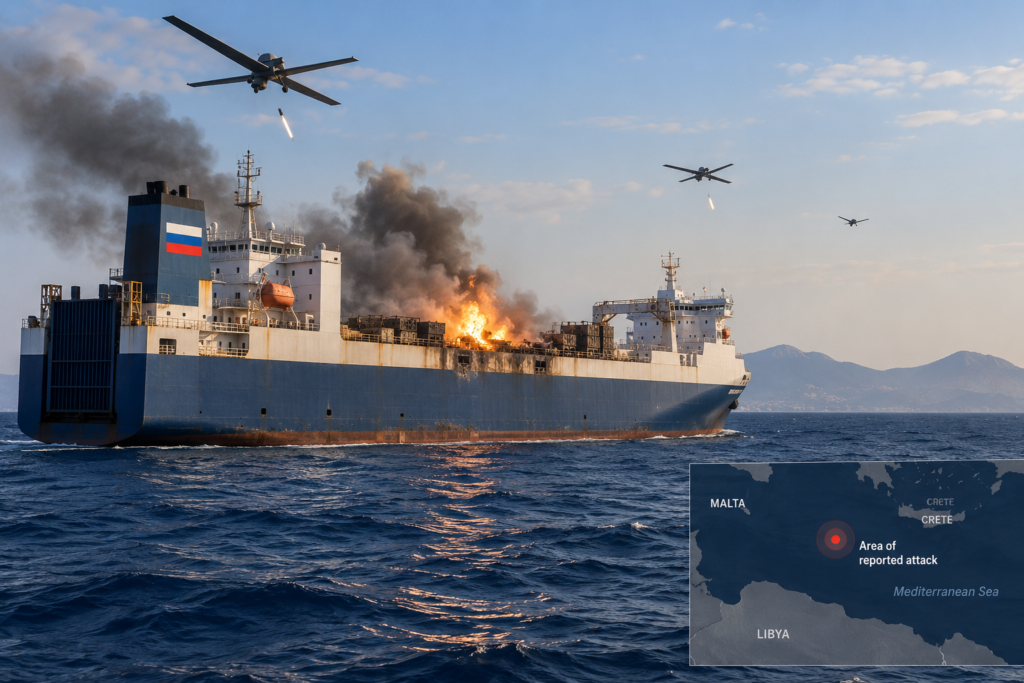
A Russian-flagged roll-on/roll-off (Ro-Ro) cargo vessel was reportedly attacked by multiple aerial drones while sailing in the central Mediterranean Sea in early September.
According to information circulating online, the vessel departed Oran, Algeria, on September 1 and was later tracked sailing east of Malta. The reported attack occurred in the Mediterranean waters between Crete and Libya.
Drone Attack Reportedly Damaged Vessel
Video footage circulating online appears to show several drones approaching the vessel before dropping small munitions onto its deck.
The reported strikes allegedly damaged deck equipment and triggered a small fire onboard. Initial information indicates that the vessel remained afloat following the incident.
However, the full extent of the damage has not been independently verified. There is also no confirmed public information regarding possible injuries or casualties among the crew.
Vessel Linked to Russian Military Logistics
The vessel has previously been associated with the movement of Russian military-related cargo.
Ukrainian military intelligence has previously identified vessels operating within the same Russian maritime logistics network as being involved in the transportation of military and special-purpose cargo.
Despite these previous links, there is currently no independently verified information confirming what cargo the vessel was carrying when the reported attack took place.
Attacker and Motive Remain Unconfirmed
As of September 8, 2026, no publicly available official statement has confirmed responsibility for the reported attack.
Several key details remain unclear, including the origin of the drones, where they may have been launched from, and the precise motive behind the operation.
The incident is therefore still developing, and further information from maritime authorities, the vessel’s operator, or military sources may be required to establish what happened.
What We Know So Far
Vessel: Russian-flagged Ro-Ro cargo vessel
Departure: Oran, Algeria — September 1
Reported location: Central Mediterranean, between Crete and Libya
Weapons: Multiple aerial drones reportedly used
Reported damage: Deck equipment damaged and small fire
Crew condition: Not independently confirmed
Cargo: No independently verified information
Attacker: Not officially identified
Status: Vessel reportedly remained afloat
The reported incident highlights the growing security risks facing commercial and logistics vessels operating in the Mediterranean and surrounding waters, particularly those potentially connected to military supply networks.
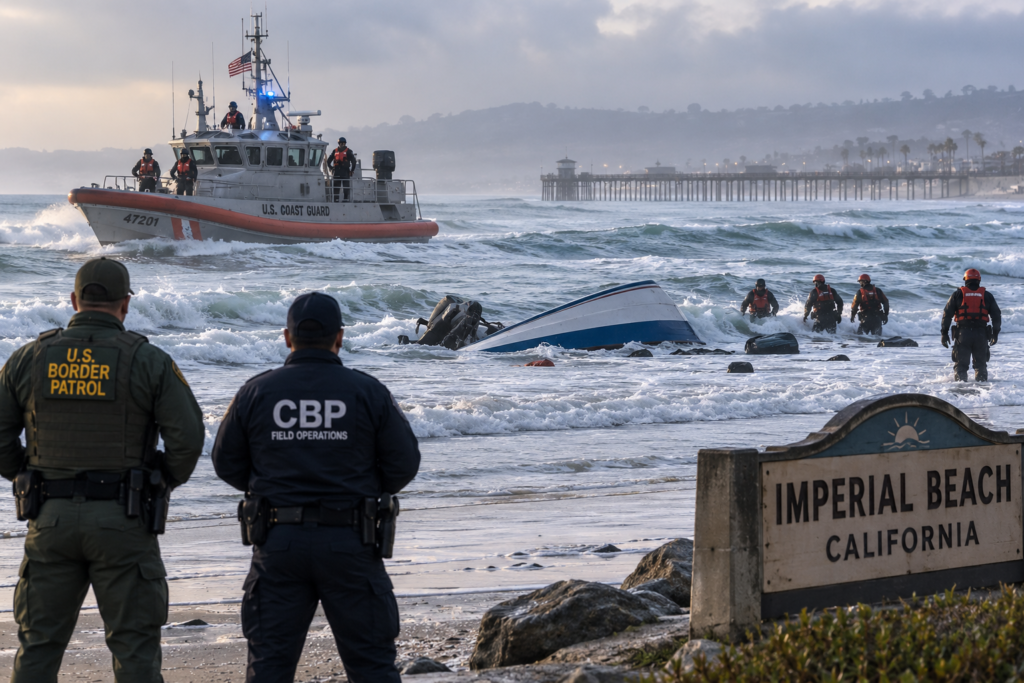
SAN DIEGO, California — A 38-year-old Mexican national has been sentenced to 57 months in federal prison for his role as the pilot of a small smuggling boat that capsized off Imperial Beach, California, resulting in the deaths of five undocumented immigrants.
David Alfonso Barrera Nunes was sentenced after pleading guilty to federal charges related to bringing undocumented immigrants into the United States for financial gain, resulting in death. The sentence was announced by the U.S. Attorney’s Office for the Southern District of California on September 4, 2026.
Boat Capsized in Heavy Surf
The incident occurred on November 14, 2025, after U.S. Border Patrol agents received information about a small vessel traveling north from Mexico toward Imperial Beach.
Dense fog initially prevented authorities from intercepting the boat. The vessel later entered the surf zone and capsized. Authorities recovered four bodies from the water, while a fifth victim was found several days later and identified as the boat’s co-pilot.
According to Nunes’ April 2026 plea agreement, the vessel was carrying nine undocumented passengers and was powered by a single outboard engine that had experienced repeated failures.
Nunes admitted that the boat did not have enough life jackets for everyone on board. As the vessel approached the shoreline, the engine failed again, causing the boat to rotate before capsizing approximately 200 yards from the coast.
Pilot Left Passengers After Capsizing
Federal authorities said Nunes managed to reach shore after the vessel overturned but did not attempt to rescue the passengers who remained in the water.
The case involved multiple federal agencies, including Homeland Security Investigations (HSI), U.S. Border Patrol, U.S. Customs and Border Protection (CBP), and the U.S. Coast Guard.
The fatal incident highlights the dangers associated with unseaworthy vessels used for maritime smuggling, particularly when boats operate without adequate safety equipment and with mechanical problems in challenging coastal conditions.
Nunes’ 57-month federal prison sentence follows his guilty plea to charges involving the unlawful transportation of people into the United States for financial gain and resulting in death.
Governments are taking action to protect seafarers from high-risk waters and safeguard their lives and rights. Now, it is time for Black Sea states and other countries to reach agreements on maritime safety.
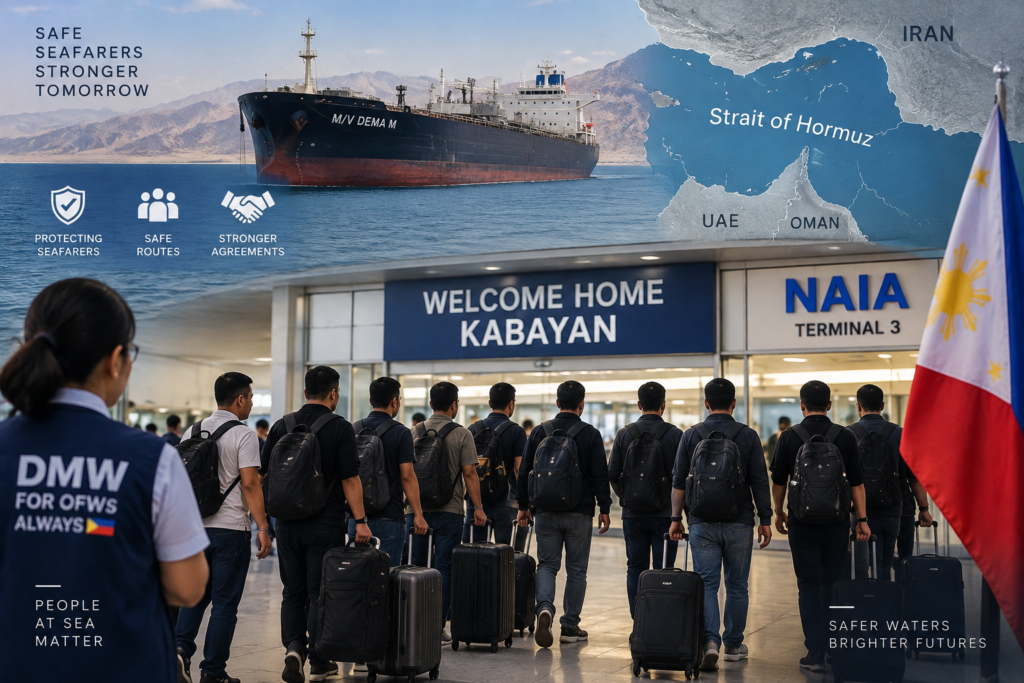
MANILA, Philippines — Ten Filipino seafarers have safely returned to the Philippines after refusing to sail aboard the M/V Dema M toward the Strait of Hormuz due to security concerns along the route.
The seafarers arrived in the Philippines on September 4, 2026, and were assisted by government officials upon their arrival at Ninoy Aquino International Airport (NAIA) Terminal 3.
Department of Migrant Workers (DMW) Assistant Secretary Venecio V. Legaspi, together with representatives from the DMW and the Overseas Workers Welfare Administration (OWWA), welcomed the returning seafarers.
The government agencies provided repatriation assistance and support to facilitate the seafarers’ safe return home.
DMW Supports Seafarers’ Decision
Legaspi said the DMW would continue to protect the rights, employment, and benefits of Filipino seafarers, particularly when they face circumstances that could put their safety at risk.
He also expressed the department’s support for the seafarers’ decision to decline the voyage amid security risks associated with the Strait of Hormuz, one of the world’s most strategically important maritime routes.
The decision comes as security concerns continue to affect commercial shipping operating in and around the region, raising concerns among shipowners, seafarers, and maritime authorities.
Repatriation Under UPLIFT Initiative
According to the DMW, the repatriation was carried out in line with President Ferdinand R. Marcos Jr.’s directive under the UPLIFT initiative.
The Philippine government recognizes the right of overseas Filipino workers, including seafarers, to refuse deployment or sailing assignments involving routes considered highly dangerous.
The policy forms part of the government’s continuing efforts to protect the safety and welfare of Filipino workers and their families, particularly when overseas employment exposes them to significant security risks.
The return of the ten seafarers highlights the growing importance of maritime security assessments and the protection of crew members operating in high-risk areas.
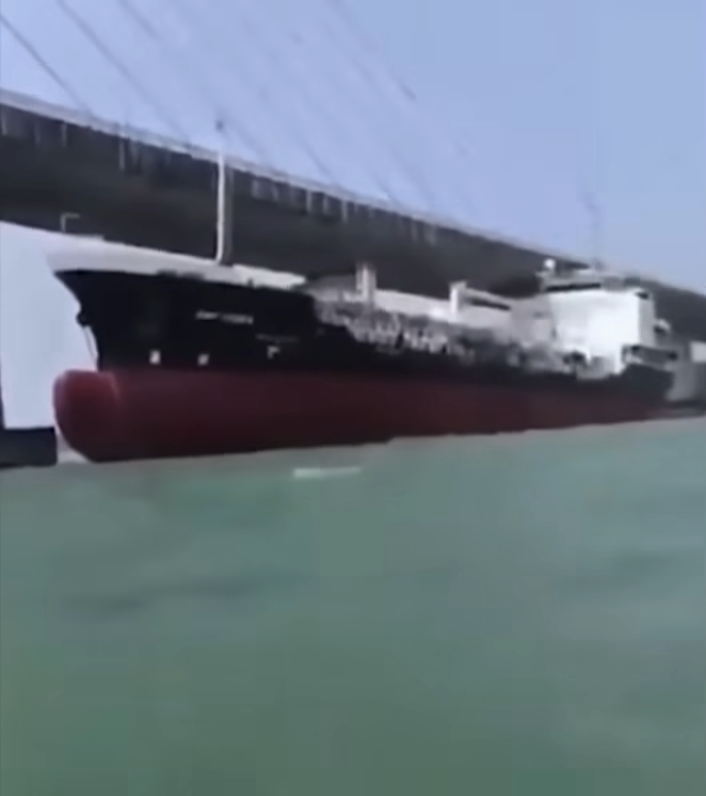
The Malaysian-flagged product tanker SMF IXORA struck the Sungai Johor Bridge in Kota Tinggi, Malaysia, on September 2, 2026, shortly after leaving the nearby Benzmark Marine Shipyard.
Vessel Details – SMF IXORA
Vessel: SMF IXORA
IMO Number: 9414101
Type: Oil Products Tanker
Flag: Malaysia
Year Built: 2007
Length: Approximately 100 m
Beam: Approximately 16 m
Deadweight: 5,643 tonnes
Gross Tonnage: 3,991 GT
The incident occurred at approximately 2:30 p.m. local time, when the tanker reportedly began drifting toward the bridge while being moved with the assistance of a tugboat. According to Malaysia’s Marine Department, strong currents contributed to the loss of control, while the escort tug reportedly did not have sufficient towing capacity to stop or redirect the vessel.
SMF IXORA Drifts Toward Sungai Johor Bridge
The SMF IXORA, an oil products tanker with an IMO number of 9414101, was being relocated from the Benzmark Marine Shipyard when the incident occurred.
The vessel was built in 2007 and measures approximately 100 metres in length, with a beam of around 16 metres and a deadweight of 5,643 tonnes.
During the manoeuvre, strong currents reportedly pushed the tanker away from its intended track and toward the Sungai Johor Bridge.
The tugboat assigned to control the vessel was reportedly unable to generate enough pulling power to prevent the tanker from drifting. As the situation developed, additional tugboats were brought to the area to assist.
Tanker Removed From Bridge
The SMF IXORA eventually came into contact with the bridge structure at around 2:30 p.m.
Two additional tugboats were subsequently deployed to assist with the recovery operation. The tanker was successfully moved away from the bridge at approximately 3:16 p.m. and was later taken to a safe anchorage.
The incident attracted attention from motorists using the bridge, with images and videos of the tanker alongside the bridge quickly circulating online.
Fortunately, no injuries were reported.
Sungai Johor Bridge Remains Open
Following the incident, the bridge was inspected by the relevant authorities.
The Senai-Desaru Expressway operator, Senai-Desaru Expressway Berhad (SDEB), said the inspection found the bridge to be safe for use. The structure reportedly sustained only minor damage and remained open to road traffic.
Reports also indicated that the tanker itself suffered minor damage, including damage to parts of its exhaust system, railing and navigation equipment.
Marine Department Investigates the Incident
Malaysia’s Marine Department has launched a further investigation into the circumstances surrounding the incident.
The preliminary information indicates that the tanker had just been launched into the water from the nearby shipyard before the accident. Authorities are examining the circumstances that led to the vessel drifting toward the bridge, including the effect of strong currents and the towing capability of the assisting tug.
At this stage, the investigation is ongoing, and the exact causes and responsibilities have not been officially established.
A Reminder of the Risks During Shipyard Manoeuvring
Although the incident resulted in no reported injuries and only minor damage, it highlights the risks involved when large vessels are moved in confined waters.
Shipyard departures and relocation manoeuvres can be particularly challenging because a vessel’s movement can be strongly affected by current, wind, available under-keel clearance, tug power and the vessel’s own manoeuvring characteristics.
Once a vessel begins to drift in a restricted waterway, there may be very little time to recover control, especially when a fixed structure such as a bridge is nearby.
The SMF IXORA incident also demonstrates why appropriate tug selection, risk assessment, communication and contingency planning are critical during vessel movements in confined waters.
The Marine Department’s investigation is expected to provide further information about exactly what happened and whether additional factors contributed to the tanker striking the Sungai Johor Bridge.
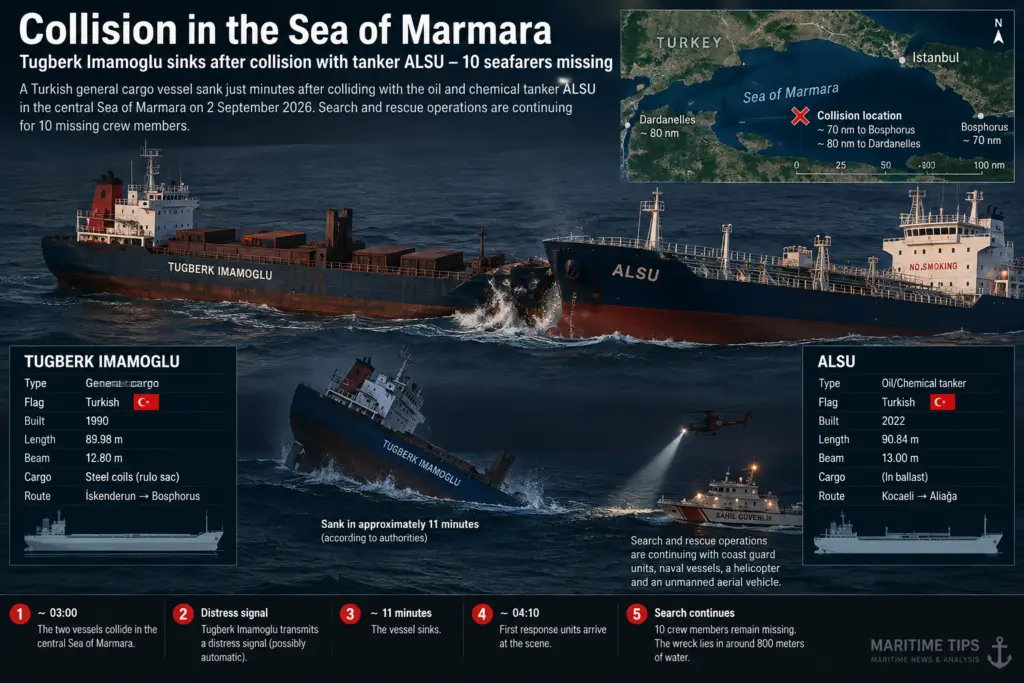
A Turkish general cargo vessel sank just minutes after colliding with the oil and chemical tanker ALSU in the Sea of Marmara early Wednesday morning. Ten crew members remain missing.
A major search and rescue operation is underway in the Sea of Marmara after the Turkish-flagged general cargo vessel Tugberk Imamoglu sank following a collision with the Turkish-flagged oil and chemical tanker ALSU.
The accident occurred at approximately 03:00 local time on September 2, in the central part of the Sea of Marmara, off Silivri. According to information released by Turkish authorities, the Tugberk Imamoglu sank in approximately 11 minutes.
All 10 crew members aboard the general cargo vessel are Turkish citizens, and authorities have so far been unable to establish contact with any of them.
Vessel Details
The sunken vessel, Tugberk Imamoglu, was a Turkish-flagged general cargo ship built in 1990.
Vessel: Tugberk Imamoglu
Type: General Cargo
Year Built: 1990
Flag: Turkey
Length: 89.98 meters
Beam: 12.80 meters
Cargo: Steel coils
The other vessel involved in the accident was ALSU, a Turkish-flagged oil and chemical tanker built in 2022.
Vessel: ALSU
Type: Oil/Chemical Tanker
Year Built: 2022
Flag: Turkey
Length: 90.84 meters
Beam: Approximately 13 meters
According to available vessel-tracking information, the ALSU was sailing from Kocaeli toward Aliağa and was in ballast at the time of the accident.
Where Did the Collision Happen?
The collision occurred in the middle of the Sea of Marmara, approximately 70 nautical miles from the Bosphorus Strait and around 80 nautical miles from the Dardanelles Strait.
The Tugberk Imamoglu had departed İskenderun and was proceeding toward the Bosphorus before the accident. The ALSU was approaching from the opposite direction.
The two vessels collided within the traffic separation scheme in the Sea of Marmara, an area where strict navigation procedures are particularly important because of the high volume of commercial traffic.
What Happened Between the Two Ships?
One of the most important questions in the investigation will be how the two vessels approached each other and which collision-avoidance situation existed immediately before the impact.
According to information from MarineTraffic and the reported VHF communications, the vessels were approaching each other from opposite directions.
Under the COLREGs, the exact responsibilities of each vessel depend on the circumstances and whether the situation was classified as a head-on, crossing or another type of encounter. If the vessels were in a head-on situation, both ships would normally be expected to alter course to starboard.
However, reported VHF communications appear to include repeated calls to the ALSU to alter course to port. The other vessel reportedly responded with an acknowledgement.
These communications could become an important part of the investigation, although VHF conversations alone cannot establish responsibility for the collision.
Authorities will likely examine the vessels’ AIS tracks, radar information, VDR recordings, bridge watchkeeping, helm orders, engine movements and communication records to determine exactly how the situation developed.
Why Did Tugberk Imamoglu Sink So Quickly?
The most striking detail of the accident is the reported sinking time.
Turkey’s Minister of Transport and Infrastructure, Abdulkadir Uraloğlu, said that the Tugberk Imamoglu sank in approximately 11 minutes. The accident site is also reported to have a water depth of around 800 meters, creating a major challenge for underwater search and recovery operations.
The Tugberk Imamoglu was carrying approximately 4,199 tonnes of steel coils.
Based on the vessel’s dimensions and the available information, one possible explanation for the rapid sinking could be extensive flooding following the collision.
If the ALSU struck the Tugberk Imamoglu with significant force, particularly in the starboard side, the impact could have created a large opening in the hull. Once seawater enters a cargo hold, flooding can progress extremely quickly, depending on the size and location of the damage, internal subdivision, cargo arrangement and the condition of the vessel.
The vessel was a relatively small general cargo ship with large cargo spaces. Significant flooding of one cargo hold could rapidly reduce the vessel’s reserve buoyancy and stability.
The presence of heavy steel coils would also be an important factor for investigators when reconstructing the vessel’s condition before the accident.
However, the exact reason for the Tugberk Imamoglu’s rapid sinking has not yet been officially established. The location and extent of the hull damage, the condition of the cargo holds, watertight integrity, loading condition and possible progressive flooding will all need to be examined.
Could the Crew Have Had Time to Abandon Ship?
Another important question is whether the crew had enough time to react after the collision.
The Tugberk Imamoglu reportedly transmitted a distress signal, although authorities noted that the signal may have been automatically activated during the sinking process.
The vessel’s life-saving appliances and free-fall lifeboat were later found in the sea, but no crew members were located inside.
A severe collision during the early morning hours can create an extremely difficult situation for a bridge team and crew. If the impact caused rapid flooding, the crew may have had only a very limited amount of time to assess the damage, raise the alarm, muster and abandon ship.
The investigation will need to establish whether a general alarm was activated, whether the crew received sufficient warning and whether the abandonment equipment could be deployed before the vessel lost stability.
Claims That the Tanker Left the Scene
The owner of the Tugberk Imamoglu, Tahsin Doğruyol, has made serious allegations regarding the accident.
According to his statement, the captain of the Tugberk Imamoglu warned the ALSU twice before the collision. He also claimed that the tanker was not following the expected course and that the vessel left the scene after the collision.
Doğruyol said his company became aware of the accident through its own alarm system and claimed that approximately 31 minutes were lost.
At sea, vessels have obligations to render assistance to persons in distress. Whether the ALSU remained at the scene, how quickly assistance was provided and what happened immediately after the collision will therefore be important parts of the official investigation.
At this stage, however, the circumstances surrounding the ALSU’s movements after the collision remain under investigation.
Search and Rescue Operation Underway
Following the accident, the Turkish Coast Guard and the Directorate General of Coastal Safety launched a large-scale search and rescue operation.
The first emergency response units reached the area at approximately 04:10.
Initially, 14 maritime search and rescue units and one helicopter were deployed to the area.
The Turkish Ministry of National Defence later announced that additional naval assets had been directed toward the accident site.
These included:
TCG Salihreis frigate
TCG Akın rescue and salvage vessel
TCG Osmangazi landing ship
TCG Karayel fast attack craft
One unmanned aerial vehicle supporting the search operation
Despite the discovery of the Tugberk Imamoglu’s life-saving equipment in the sea, none of the 10 missing crew members had been located at the time of the latest official statements.
Investigation Will Focus on the Final Minutes
The accident raises several critical questions for investigators.
Why did the vessels collide despite operating in one of Turkey’s busiest maritime areas? What were their exact courses and speeds before the collision? What did the radar and AIS systems show? Which vessel had the right of way under the applicable COLREGs situation? What orders were given on both bridges? And why did the Tugberk Imamoglu sink in such a short period of time?
Investigators are expected to examine the vessels’ VDR data, AIS tracks, radar recordings, ECDIS information, engine and steering records, VHF communications and bridge watchkeeping procedures.
The condition of the Tugberk Imamoglu’s hull and cargo holds will also be critical in determining why the vessel sank so rapidly.
With the wreck now lying in approximately 800 meters of water, recovering the vessel and obtaining physical evidence could be extremely difficult.
For now, the priority remains finding the 10 missing seafarers.
The investigation into the collision between the Tugberk Imamoglu and ALSU is continuing.
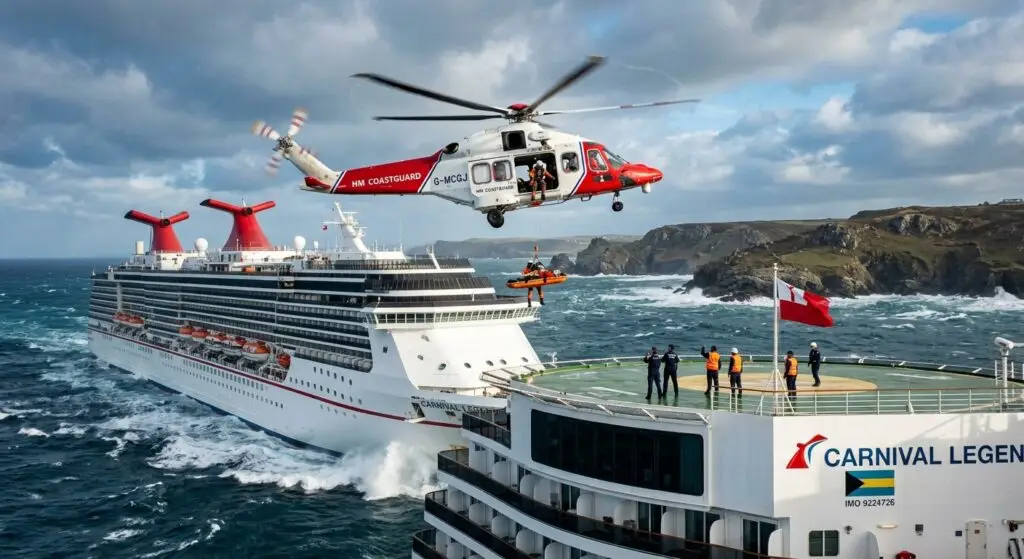
A passenger aboard the Carnival Legend was medically evacuated by helicopter after a medical emergency occurred while the cruise ship was sailing off the southwest coast of England.
Vessel Name : Carnival Legend
Year of Built : 2002
Flag : Bahamas
Vessel type : Cruise / Passenger Ship
Lenght : 292,50 mtr
Beam : 38,80 mtr
Gross Tonnage : 85942
The incident took place on Saturday, August 29, 2026, during the final sea day of the ship’s British Isles itinerary. The passenger was airlifted from the cruise ship by HM Coastguard and transported to Newquay Airport in Cornwall before being transferred to an ambulance for further medical treatment.
Carnival Legend Requests Medical Evacuation
HM Coastguard received a request for assistance at approximately 9:40 a.m. local time after the Carnival Legend reported a medical emergency while sailing off the southwest coast of England.
The cruise ship made a minor course adjustment to support the helicopter evacuation. Once the passenger had been safely removed from the vessel, the Carnival Legend resumed its planned voyage toward Dover.
Authorities have not released the passenger’s name, age, or specific medical condition.
The available information indicates that the evacuation was carried out because the passenger required medical treatment that could not be provided adequately while the ship remained at sea.
Passenger Was Evacuated to Newquay
Following the aerial evacuation, the passenger was flown to Newquay Airport in Cornwall.
An ambulance was waiting at the airport to continue the transfer to a medical facility. This type of coordinated response allows seriously ill or injured passengers to reach shore-based medical care much faster than waiting for a cruise ship to arrive at its next scheduled port.
For cruise ships operating hundreds of miles from major medical facilities, helicopter evacuation can sometimes be the quickest option available.
Carnival Legend Was Completing a British Isles Cruise
The Carnival Legend began its 10-night British Isles voyage on August 20, departing from Dover.
The itinerary included destinations in Ireland, Wales, England, Scotland and the Isle of Man before the ship began its return journey toward Dover.
The medical emergency occurred during the final sea day as the vessel was sailing from Douglas on the Isle of Man toward Dover.
Despite the interruption, the ship continued its voyage after the evacuation was completed.
Why Medical Evacuations Are Necessary on Cruise Ships
Medical emergencies can occur at any time during a cruise, and ships have onboard medical facilities designed to provide initial treatment and stabilization.
However, cruise ship medical centers do not have the same capabilities as major hospitals on shore. Serious conditions may require specialist treatment, advanced diagnostic equipment or surgical facilities that are not available onboard.
Conditions such as heart attacks, strokes, severe injuries and other life-threatening emergencies may therefore require a passenger or crew member to be transferred to a shore-based hospital.
The evacuation method depends on several factors, including the patient’s condition, the ship’s location, weather conditions and the distance to the nearest suitable medical facility.
When a vessel is close enough to land, the ship may divert toward a port. In more urgent situations, a helicopter evacuation can significantly reduce the time needed to reach professional medical care.
Medical Evacuations Are Not Unusual at Sea
Medical evacuations are a regular part of emergency operations in the cruise industry. Cruise ships carry thousands of passengers and crew members, and medical emergencies can happen even when a ship is far from its scheduled port.
In some cases, passengers may also require evacuation while the vessel is alongside in a foreign port. The decision depends on the severity of the condition and the level of medical treatment available locally.
The Carnival Legend incident highlights the importance of emergency coordination between cruise ships and maritime rescue authorities when serious medical situations occur offshore.
What Happened to the Passenger?
At the time of reporting, authorities had not released details about the passenger’s identity, age or medical condition.
It is therefore unclear what caused the medical emergency or what treatment the passenger required after arriving in Cornwall.
The Carnival Legend continued toward Dover following the successful evacuation.
Frequently Asked Questions
What happened aboard Carnival Legend?
A passenger suffered a medical emergency while the Carnival Legend was sailing off the southwest coast of England on August 29, 2026. HM Coastguard was contacted and the passenger was evacuated by helicopter.
Where was the passenger taken?
The passenger was flown to Newquay Airport in Cornwall, where an ambulance was waiting to transport them for further medical treatment.
Did Carnival Legend have to cancel its voyage?
No. The ship made a minor course adjustment during the evacuation and then continued its voyage toward Dover.
Why are cruise passengers medically evacuated?
Passengers may be medically evacuated when they require treatment or medical facilities that cannot be adequately provided onboard the cruise ship. In serious cases, transferring the patient to a shore-based hospital can be the safest and fastest option.
Has the passenger’s condition been released?
No. Authorities have not publicly released the passenger’s identity, age or specific medical condition.
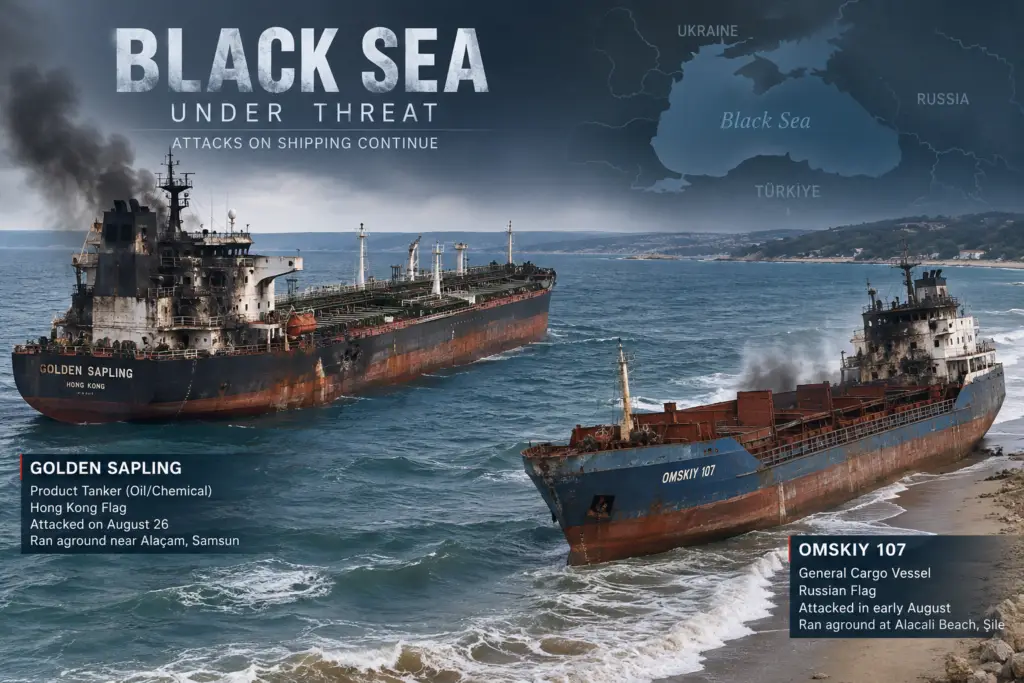
Two vessels damaged in separate attacks in the Black Sea have run aground on Turkey’s coast, adding to growing concerns over the safety of commercial shipping in the region.
Vessel name : Golden Sapling
Built : 1999
Flag: Hong Kong
Vessel Type : Oil chemical Tanker
Lenght : 147,83 mtr
Beam : 24,20 mtr
Deadweight : 19455 tonnes
On August 30, the product tanker Golden Sapling ran aground near Alacam in Samsun Province, Turkey, after drifting without a crew for four days.
The Hong Kong-flagged, Chinese-owned tanker was reportedly struck by a drone on August 26, approximately 90 nautical miles off Sinop, in the Black Sea. The attack caused severe damage to the vessel’s bridge and deckhouse, with fire badly affecting the upper part of the ship.
All 21 crew members were evacuated after the incident. According to reports, the crew was rescued by the Greek-flagged tanker Maran Pythia, leaving Golden Sapling abandoned at sea.
Without a crew onboard, the damaged tanker continued drifting for several days before eventually reaching the Turkish coastline.
Second Damaged Vessel Runs Aground Near Istanbul
Vessel name : Omskiy 107
Built : 1981
Flag: Russia
Vessel Type : General Cargo
Lenght : 108,40 mtr
Beam : 15 mtr
Deadweight : 3248 tonnes
Only hours after the Golden Sapling incident, another damaged vessel was reported aground on Turkey’s Black Sea coast.
The Russian-flagged cargo ship Omskiy 107 ran aground at Alacali Beach in the Şile district of Istanbul. The vessel had also been abandoned by its crew following an earlier attack.
The 108-metre cargo ship, built in Romania in 1981 and operated by Moscow-based Avomar Shipping, had reportedly been drifting across the Black Sea for almost four weeks.
Omskiy 107 was attacked near Novorossiysk in early August. Images from the vessel after reaching the Turkish coast show extensive fire damage around the bridge and accommodation area.
The ship’s prolonged drift highlights the risks created when damaged commercial vessels are left without propulsion or crew in one of the world’s busiest maritime regions.
Turkey Protests Black Sea Shipping Attacks
Following the incidents, Turkey’s Foreign Ministry summoned the Ukrainian ambassador to protest the attacks involving commercial vessels in the Black Sea.
The latest incidents have also raised concerns among shipping companies operating in the region, particularly as attacks on merchant vessels continue to affect commercial maritime traffic.
According to authorities, MSC has suspended its Novorossiysk container service, reflecting the growing security concerns surrounding Black Sea operations.
Growing Risks for Merchant Ships in the Black Sea
The grounding of Golden Sapling and Omskiy 107 demonstrates how an attack on a merchant ship can create risks long after the initial strike.
A vessel that loses propulsion, suffers major fire damage, or has to evacuate its crew can become a drifting hazard. If the ship is not quickly secured or towed, currents and weather can eventually push it toward coastal areas.
For seafarers and shipping companies, the situation remains a serious reminder that the risks associated with the Black Sea conflict extend beyond the immediate attack zone.
As attacks on commercial vessels continue, shipowners and operators may face increasing pressure to reconsider routes, security measures and port calls in the region.
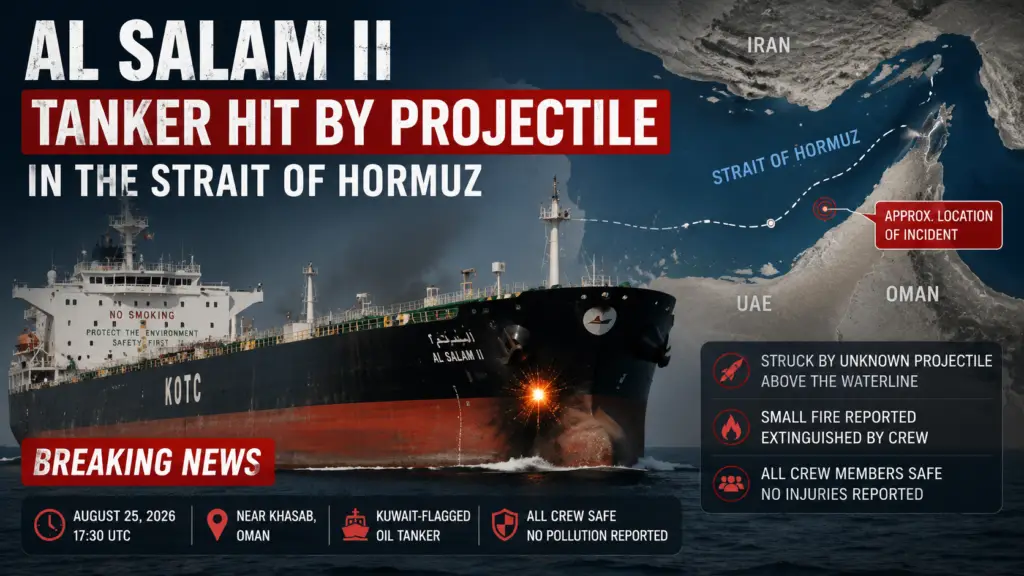
Kuwait-flagged tanker Al Salam II was hit by an unknown projectile in the Strait of Hormuz, causing a small hull breach and fire.
A Kuwait-flagged crude oil tanker Al Salam II was struck by an unknown projectile while transiting the Strait of Hormuz on August 25, 2026, according to maritime security information.
The incident caused a small breach above the vessel’s waterline and a fire onboard. The crew managed to extinguish the fire, and no injuries or oil pollution were reported.
The latest incident adds to growing security concerns for commercial vessels navigating the Strait of Hormuz.
Al Salam II Hit While Sailing Eastbound
According to information reported by the United Kingdom Maritime Trade Operations (UKMTO), the tanker was sailing eastbound through the Strait of Hormuz when it was hit at approximately 17:30 UTC near Khasab, Oman.
The projectile struck the vessel above the waterline, causing a small hole in the hull and a minor fire.
The crew responded to the incident and successfully extinguished the fire.
At the time of the reports, all crew members were safe, and there were no reports of environmental pollution.
The incident is being investigated, while vessels operating in the area have been advised to maintain caution.
Al Salam II Vessel Details
The vessel involved was identified as Al Salam II, a Kuwait-flagged oil tanker.
The tanker was built in 2007 and measures approximately 228 metres in length with a beam of 32.25 metres. Its IMO number is 9328168.
The attack occurred while the vessel was transiting one of the world’s most strategically important shipping routes.
The Strait of Hormuz connects the Persian Gulf with the Gulf of Oman and the Arabian Sea, making it a critical route for international oil transportation.
Another Tanker Was Hit Just One Day Earlier
The incident involving Al Salam II came only one day after another tanker was attacked in the region.
On August 24, the Liberia-flagged crude oil tanker Metro Venetian was struck by an unidentified projectile off Oman.
The projectile reportedly hit the vessel’s engine-room area, causing damage and leaving the tanker without propulsion. The crew was reported safe, and no environmental impact was reported at the time.
The close timing of the two incidents has raised further concerns about the security of commercial shipping around the Strait of Hormuz.
Growing Risk for Commercial Shipping
The latest attacks highlight the continuing risks faced by merchant vessels operating in and around the Strait of Hormuz.
Shipping traffic through the waterway has already fallen significantly compared with normal levels. Reuters reported that AIS-tracked vessel movements were around 90% below pre-conflict levels during the August 15–21 period.
Despite the reduced traffic, some tankers continue to transit the waterway, exposing crews and vessels to significant navigational and security risks.
For shipowners and operators, the situation creates additional challenges involving voyage planning, war-risk insurance, security assessments and crew safety.
What Happens Next?
The circumstances surrounding the attack on Al Salam II remain under investigation, and no responsibility for the projectile attack has been established in the reports reviewed.
For seafarers, however, the incident is another reminder of how quickly the security situation can change in a major commercial shipping route.
As long as tensions remain high around the Strait of Hormuz, vessels transiting the area are likely to face increased security precautions and operational uncertainty.
Two South Korean seafarers have died after a serious fire broke out onboard an oil products tanker off Incheon, South Korea, on the night of August 27, 2026.
The vessel, reportedly named DL Amber, is a 7,333-ton oil products tanker. The ship was sailing from Incheon Port toward Ulsan when the fire broke out in the engine room.
Ship name : DL Amber
Lenght : 127,68 mtr
Width : 19,60 mtr
Tonnage : 7333 tons
Flag: Korean
Built : 2010
Owner : Donglim Tanker
According to reports from South Korean authorities, the fire was reported at around 10:38 p.m. on August 27, while the tanker was approximately 7.4 kilometers north of Jawoldo Island in Incheon.
Two Crew Members Found in Engine Room
There were 18 crew members onboard, including 11 South Korean nationals and seven foreign crew members.
During the firefighting and rescue operation, two South Korean male crew members, one in his 20s and another in his 60s, were found in cardiac arrest inside the engine room.
Both seafarers were taken toward port for emergency medical treatment, but unfortunately they could not be saved and were pronounced dead.
The remaining 16 crew members were successfully rescued by the Korean Coast Guard and were reported to be in stable condition.
Fire Started in Engine Room
Initial information indicates that the fire started inside the engine room.
However, authorities have not yet confirmed the exact cause of the fire. An investigation will be carried out to determine what caused the fire and how it developed.
This is an important point because the engine room contains several potential sources of ignition, including fuel systems, lubricating oil, electrical equipment, generators and high-temperature machinery. At this stage, however, it would be incorrect to say that any particular piece of equipment caused the fire.
The Coast Guard has only confirmed that the fire is believed to have originated in the engine room.
Cargo Tanks Were Not Affected
One of the most serious concerns in any tanker fire is the possibility of the fire spreading from the machinery spaces toward the cargo tanks.
In this case, authorities reported that the fire did not spread to the vessel’s main oil cargo tanks.
This prevented the incident from becoming a much larger tanker emergency and there were no reports of an oil spill resulting from the fire.
The tanker had reportedly departed Incheon Port at around 8:00 p.m. and was heading toward Ulsan when the incident occurred.
Coast Guard Fought Fire For More Than Five Hours
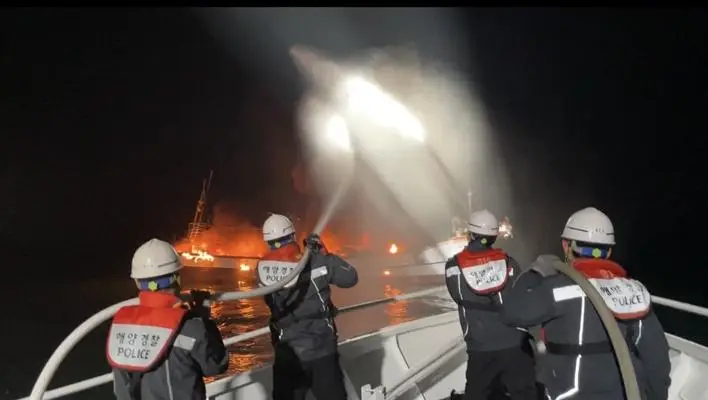
The Korean Coast Guard responded with a large-scale rescue and firefighting operation.
According to reports, 24 Coast Guard vessels, one aircraft and three vessels from related agencies were involved in the operation.
Firefighting continued for more than five hours before the fire was finally extinguished at approximately 4:01 a.m. on August 28, around 5 hours and 32 minutes after the initial report.
The incident could have developed into a much more serious maritime disaster if the fire had reached the cargo area.
Investigation Underway
The exact cause of the fire remains unknown at this stage.
South Korean authorities are now investigating the incident, including the cause of the fire, the extent of damage to the tanker and the circumstances surrounding the deaths of the two crew members.
For seafarers, engine-room fires remain one of the most dangerous emergencies onboard because they can rapidly fill enclosed spaces with smoke and toxic gases while simultaneously affecting the vessel’s power generation and propulsion systems.
Fortunately, the fire onboard DL Amber was contained before reaching the main cargo tanks, while 16 of the 18 crew members were rescued safely.
The investigation will now be important in determining exactly what happened inside the engine room and what caused the fire to develop so rapidly.
This website uses cookies
We use cookies to personalize content, provide social media features, and analyze our traffic. We also share information about your use of our site with our analytics partners. You can change your preferences at any time.