A Turkish general cargo vessel sank just minutes after colliding with the oil and chemical tanker ALSU in the Sea of Marmara early Wednesday morning. Ten crew members remain missing.
A major search and rescue operation is underway in the Sea of Marmara after the Turkish-flagged general cargo vessel Tugberk Imamoglu sank following a collision with the Turkish-flagged oil and chemical tanker ALSU.
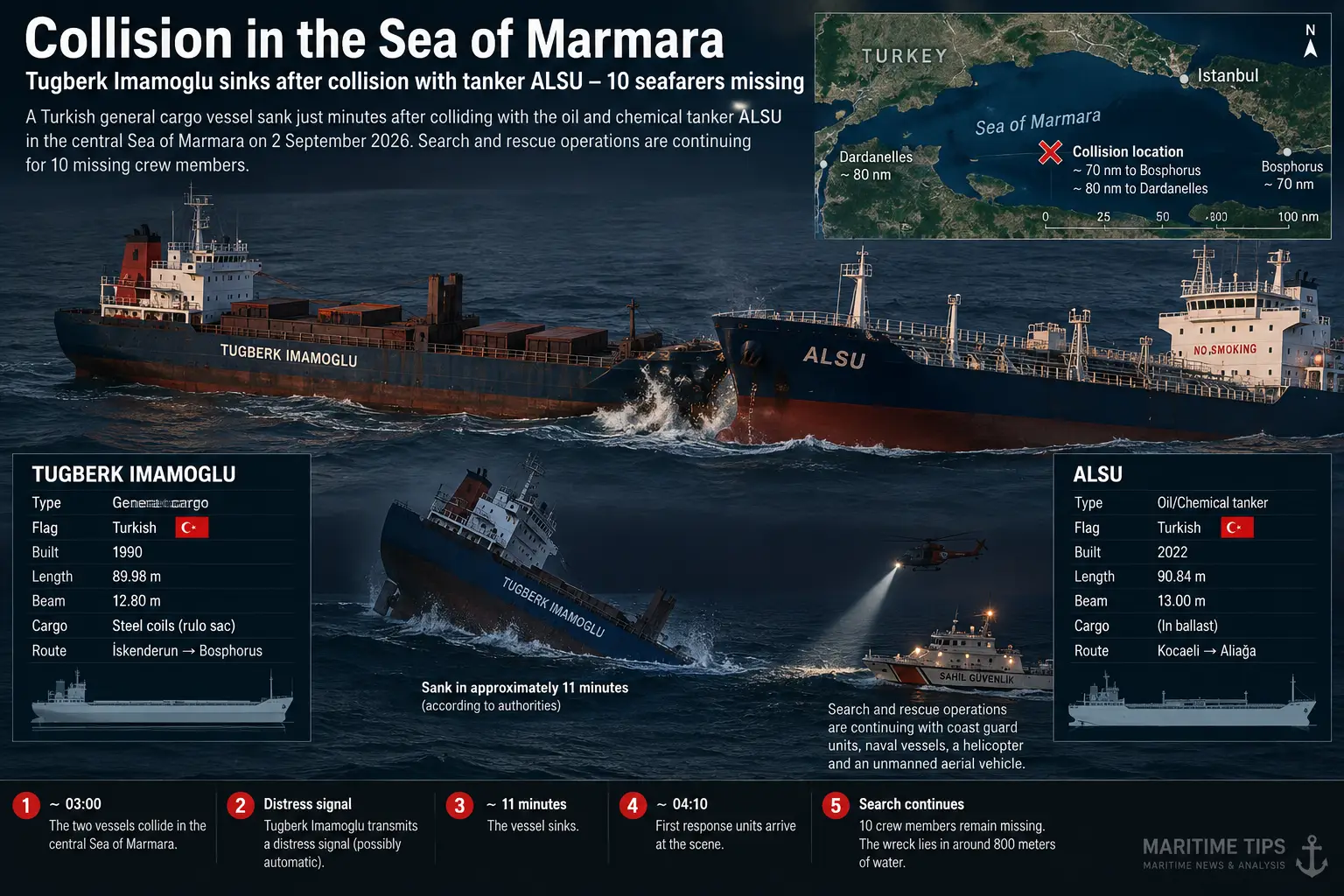
The accident occurred at approximately 03:00 local time on September 2, in the central part of the Sea of Marmara, off Silivri. According to information released by Turkish authorities, the Tugberk Imamoglu sank in approximately 11 minutes.
All 10 crew members aboard the general cargo vessel are Turkish citizens, and authorities have so far been unable to establish contact with any of them.
Vessel Details
The sunken vessel, Tugberk Imamoglu, was a Turkish-flagged general cargo ship built in 1990.
- Vessel: Tugberk Imamoglu
- Type: General Cargo
- Year Built: 1990
- Flag: Turkey
- Length: 89.98 meters
- Beam: 12.80 meters
- Cargo: Steel coils
The other vessel involved in the accident was ALSU, a Turkish-flagged oil and chemical tanker built in 2022.
- Vessel: ALSU
- Type: Oil/Chemical Tanker
- Year Built: 2022
- Flag: Turkey
- Length: 90.84 meters
- Beam: Approximately 13 meters
According to available vessel-tracking information, the ALSU was sailing from Kocaeli toward Aliağa and was in ballast at the time of the accident.
Where Did the Collision Happen?
The collision occurred in the middle of the Sea of Marmara, approximately 70 nautical miles from the Bosphorus Strait and around 80 nautical miles from the Dardanelles Strait.
The Tugberk Imamoglu had departed İskenderun and was proceeding toward the Bosphorus before the accident. The ALSU was approaching from the opposite direction.
The two vessels collided within the traffic separation scheme in the Sea of Marmara, an area where strict navigation procedures are particularly important because of the high volume of commercial traffic.
What Happened Between the Two Ships?
One of the most important questions in the investigation will be how the two vessels approached each other and which collision-avoidance situation existed immediately before the impact.
According to information from MarineTraffic and the reported VHF communications, the vessels were approaching each other from opposite directions.
Under the COLREGs, the exact responsibilities of each vessel depend on the circumstances and whether the situation was classified as a head-on, crossing or another type of encounter. If the vessels were in a head-on situation, both ships would normally be expected to alter course to starboard.
However, reported VHF communications appear to include repeated calls to the ALSU to alter course to port. The other vessel reportedly responded with an acknowledgement.
These communications could become an important part of the investigation, although VHF conversations alone cannot establish responsibility for the collision.
Authorities will likely examine the vessels’ AIS tracks, radar information, VDR recordings, bridge watchkeeping, helm orders, engine movements and communication records to determine exactly how the situation developed.
Why Did Tugberk Imamoglu Sink So Quickly?
The most striking detail of the accident is the reported sinking time.
Turkey’s Minister of Transport and Infrastructure, Abdulkadir Uraloğlu, said that the Tugberk Imamoglu sank in approximately 11 minutes. The accident site is also reported to have a water depth of around 800 meters, creating a major challenge for underwater search and recovery operations.
The Tugberk Imamoglu was carrying approximately 4,199 tonnes of steel coils.
Based on the vessel’s dimensions and the available information, one possible explanation for the rapid sinking could be extensive flooding following the collision.
If the ALSU struck the Tugberk Imamoglu with significant force, particularly in the starboard side, the impact could have created a large opening in the hull. Once seawater enters a cargo hold, flooding can progress extremely quickly, depending on the size and location of the damage, internal subdivision, cargo arrangement and the condition of the vessel.
The vessel was a relatively small general cargo ship with large cargo spaces. Significant flooding of one cargo hold could rapidly reduce the vessel’s reserve buoyancy and stability.
The presence of heavy steel coils would also be an important factor for investigators when reconstructing the vessel’s condition before the accident.
However, the exact reason for the Tugberk Imamoglu’s rapid sinking has not yet been officially established. The location and extent of the hull damage, the condition of the cargo holds, watertight integrity, loading condition and possible progressive flooding will all need to be examined.
Could the Crew Have Had Time to Abandon Ship?
Another important question is whether the crew had enough time to react after the collision.
The Tugberk Imamoglu reportedly transmitted a distress signal, although authorities noted that the signal may have been automatically activated during the sinking process.
The vessel’s life-saving appliances and free-fall lifeboat were later found in the sea, but no crew members were located inside.
A severe collision during the early morning hours can create an extremely difficult situation for a bridge team and crew. If the impact caused rapid flooding, the crew may have had only a very limited amount of time to assess the damage, raise the alarm, muster and abandon ship.
The investigation will need to establish whether a general alarm was activated, whether the crew received sufficient warning and whether the abandonment equipment could be deployed before the vessel lost stability.
Claims That the Tanker Left the Scene
The owner of the Tugberk Imamoglu, Tahsin Doğruyol, has made serious allegations regarding the accident.
According to his statement, the captain of the Tugberk Imamoglu warned the ALSU twice before the collision. He also claimed that the tanker was not following the expected course and that the vessel left the scene after the collision.
Doğruyol said his company became aware of the accident through its own alarm system and claimed that approximately 31 minutes were lost.
At sea, vessels have obligations to render assistance to persons in distress. Whether the ALSU remained at the scene, how quickly assistance was provided and what happened immediately after the collision will therefore be important parts of the official investigation.
At this stage, however, the circumstances surrounding the ALSU’s movements after the collision remain under investigation.
Search and Rescue Operation Underway
Following the accident, the Turkish Coast Guard and the Directorate General of Coastal Safety launched a large-scale search and rescue operation.
The first emergency response units reached the area at approximately 04:10.
Initially, 14 maritime search and rescue units and one helicopter were deployed to the area.
The Turkish Ministry of National Defence later announced that additional naval assets had been directed toward the accident site.
These included:
- TCG Salihreis frigate
- TCG Akın rescue and salvage vessel
- TCG Osmangazi landing ship
- TCG Karayel fast attack craft
- One unmanned aerial vehicle supporting the search operation
Despite the discovery of the Tugberk Imamoglu’s life-saving equipment in the sea, none of the 10 missing crew members had been located at the time of the latest official statements.
Investigation Will Focus on the Final Minutes
The accident raises several critical questions for investigators.
Why did the vessels collide despite operating in one of Turkey’s busiest maritime areas? What were their exact courses and speeds before the collision? What did the radar and AIS systems show? Which vessel had the right of way under the applicable COLREGs situation? What orders were given on both bridges? And why did the Tugberk Imamoglu sink in such a short period of time?
Investigators are expected to examine the vessels’ VDR data, AIS tracks, radar recordings, ECDIS information, engine and steering records, VHF communications and bridge watchkeeping procedures.
The condition of the Tugberk Imamoglu’s hull and cargo holds will also be critical in determining why the vessel sank so rapidly.
With the wreck now lying in approximately 800 meters of water, recovering the vessel and obtaining physical evidence could be extremely difficult.
For now, the priority remains finding the 10 missing seafarers.
The investigation into the collision between the Tugberk Imamoglu and ALSU is continuing.