How many seafarers are there in the world? Explore the latest 2026 BIMCO figures, the largest seafarer-supplying countries, global demand and 2030 forecasts.
The global maritime industry relies on millions of seafarers working on merchant ships around the world. According to the latest BIMCO Seafarer Workforce Report, there are approximately 2.5 million seafarers serving the global merchant fleet.
With almost 85,000 vessels in the global fleet, seafarers remain one of the most important parts of the international shipping industry.
So, which countries supply the largest number of seafarers? And how many officers and ratings are currently working at sea?
Which Countries Have the Most Seafarers?
According to estimates of national contributions to the current global supply of seafarers, the five countries supplying the largest number of seafarers in 2026 are the Philippines, India, China, Russia, and Indonesia.
Together, these five countries account for approximately 56.25% of the global seafarer workforce.
The estimated number of officers and ratings supplied by each country is:
- Philippines: 203,179 officers and 256,968 ratings
- India: 140,718 officers and 171,218 ratings
- China: 110,893 officers and 199,107 ratings
- Russia: 85,816 officers and 153,541 ratings
- Indonesia: 72,304 officers and 110,940 ratings
The figures demonstrate how strongly the global maritime workforce depends on Asian seafarer supply, with the Philippines, India, China, and Indonesia among the world’s most important sources of maritime manpower.
Philippines: The World’s Largest Seafarer Supplier
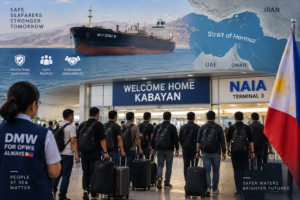
The Philippines has remained the world’s leading seafarer-supplying country for decades, making its maritime workforce one of the most important in the international shipping industry.
The country’s success has developed over many years through maritime education, training institutions, government-supported programs, and strong connections with international shipping companies.
The rise of Filipino seafarers is also an interesting example of how an Asian country became one of the most important suppliers of manpower to the global shipping industry.
Read more: How the Philippines Became a Global Maritime Powerhouse
Female Seafarers Are Increasing
The global seafarer workforce is also becoming more diverse.
The BIMCO report indicates that the number of female seafarers increased significantly in 2026, with much of this growth concentrated in officer positions.
Only one administration reported a decline in the number of female seafarers, and this decrease was recorded among deck ratings. Meanwhile, the majority of respondents reported that the number of female ratings had remained broadly unchanged.
Although women still represent a relatively small proportion of the global seafarer workforce, the continued increase in female officers is a positive development for the maritime industry.
How Many Seafarers Are Needed Worldwide?
The global demand for STCW-certified seafarers is estimated at 2,547,790 seafarers in 2026.
This includes:
- 1,088,080 officers
- 1,459,710 ratings
The demand for STCW-certified seafarers has increased by approximately 35% compared with the previous reports published in 2021 and 2015.
The increase has been particularly significant among ratings. Compared with 2021, global demand for officers has increased by 23.1%, while demand for ratings has increased by 46.3%.
Global Seafarer Demand in 2026
| Seafarer Category | Global Demand |
| Officers | 1,088,080 |
| Ratings | 1,459,710 |
| Total | 2,547,790 |
These figures highlight the continuing challenge faced by the shipping industry: the global merchant fleet requires a large and continuously available pool of qualified seafarers.
Which Ship Types Need the Most Seafarers?
The demand for seafarers is not distributed equally across all sectors of the merchant fleet.
According to the BIMCO report, the three industry segments responsible for the largest shares of global demand for STCW-certified officers are:
- General cargo ships – 21.4%
- Bulk carriers – 18.9%
- Cruise ships – 14.0%
These sectors also account for some of the highest demand for ratings.
For ratings, the largest shares of demand are:
- Cruise ships – 22.5%
- Bulk carriers – 18.4%
- General cargo ships – 18.0%
The cruise industry is particularly interesting for European seafarers, as cruise companies continue to employ officers and ratings from a wide range of European countries.
Read more: How European Seafarers Can Find Jobs in the Cruise Industry
How Many Seafarers Will Be Needed in 2030?
The demand for seafarers is expected to continue increasing over the coming years.
According to the baseline forecast, global demand in 2030 is expected to reach:
- 1,162,716 officers
- 1,558,973 ratings
This represents a continued increase in demand for qualified maritime professionals as the global merchant fleet expands and shipping companies face the need to replace retiring seafarers.
Projected Global Seafarer Demand in 2030
| Seafarer Category | Projected Demand |
| Officers | 1,162,716 |
| Ratings | 1,558,973 |
| Total | 2,721,689 |
The baseline forecast estimates that the shipping industry will need approximately 22,747 additional officers every year to meet projected officer demand in 2030.
This represents roughly a 2% annual increase in the number of officers required.
The report also provides alternative scenarios based on different levels of global fleet growth, including high-growth and low-growth forecasts for officer and rating demand in 2030.
The Future of the Global Seafarer Workforce
The numbers show that seafarers will remain essential to the global shipping industry throughout the coming decade.
The continued growth in demand for STCW-certified officers and ratings could create new opportunities for maritime professionals, particularly in countries that already have strong maritime education and training systems.
At the same time, the shipping industry will need to address several challenges, including the recruitment and retention of qualified officers, the increasing demand for specialized skills, and the need to attract more young people to maritime careers.
Countries such as the Philippines, India, China, Russia, and Indonesia are likely to remain major suppliers of seafarers, while demand for qualified maritime professionals is expected to continue growing as the global fleet develops.
For anyone considering a career at sea, these figures demonstrate that the maritime industry continues to offer opportunities for qualified deck officers, engine officers, and ratings around the world.
Source : BIMCO