Here is the third serie of our article of sea life if you want to start from beginning of the journey here and then for the second blog
Every milestone starts with a single step.
If you do not have the courage to start what you want, how can you ever become what you want to be?
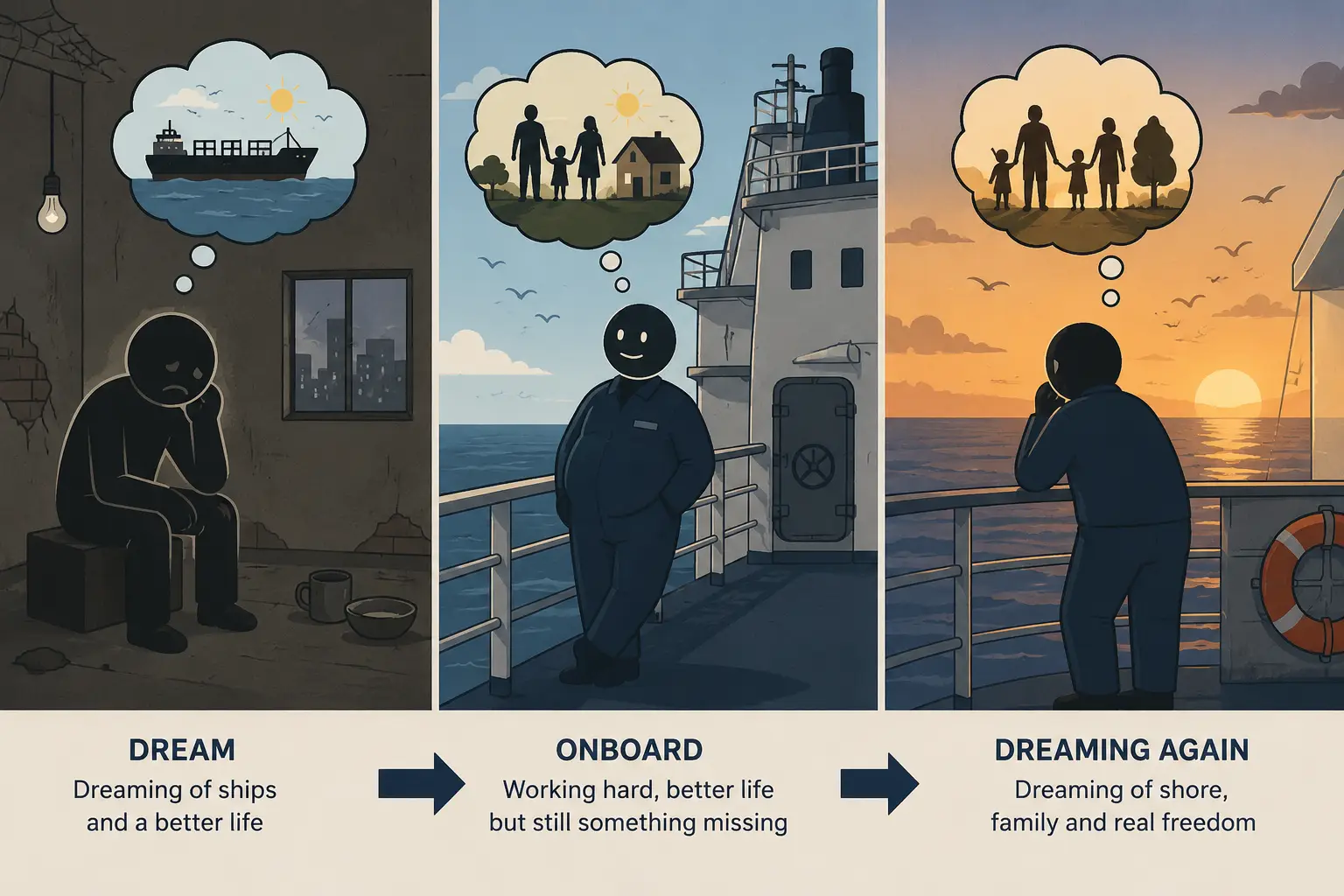
Some of us dream of becoming a seaman. Others want to become an officer. Then, after becoming an officer, the next goal is often to become a captain. The same applies to engineers: starting as a third engineer and eventually becoming a chief engineer.
But when you finally become what you wanted to be, are you actually happy and satisfied?
Have you ever considered what you left behind, what you missed, and what you never got to see?
Is it only difficult for us to leave the people we love behind and go onboard, or are they also suffering silently without us?
There are millions of jobs in the world, so why do we choose to work onboard ships?
Are we weak or strong? Smart or foolish? Rich or poor?
Why Do People Choose a Life at Sea?
Since the beginning of my career, I have rarely seen a truly wealthy person working onboard.
Most of us come from ordinary or difficult backgrounds. We start working at sea because it offers something that many other jobs cannot: the opportunity to earn an above-average income and change our lives.
But what is the final destination?
Eventually, we will all die. Yet during our careers, many of us spend most of our time seeing only the sea and ships.
I recently met a safety officer in Fawley who told me about his life. He had worked at the terminal for more than 30 years. He started at the security gate and eventually became a safety officer before reaching retirement age.
He also told me about his brother-in-law, who built a successful business, sold it for millions, and started travelling around the world in a caravan.
Unfortunately, his brother-in-law has already passed away.
Now, this safety officer is planning to buy his own caravan and travel around the world.
The only difference between them was around ten years.
When you become wealthy, you may achieve your dreams 10 or 15 years earlier.
But eventually, death finds everyone.
What Are We Sacrificing to Work Onboard?
Okay.
If we are all going to die eventually, then why do we stay away from the people we love for so long?
At least 70% of seafarers probably start this career as a temporary 5–10 year project.
The plan is usually simple:
Work hard → earn money → buy a house → secure your future → leave the ships.
But somehow, many of us cannot escape.
Five years become ten.
Ten years become twenty.
During this time, your children grow up. Family members pass away. You miss weddings, birthdays, parties, meetings, and countless small moments that you can never get back.
And what do you earn in return?
Money.
You work hard and sacrifice part of your life for the people you love. You send your children to private schools, buy a nice car, purchase another house, and try to build wealth.
But sometimes you realise that you are collecting wealth instead of memories.
Even if you try to explain your life onboard to people ashore, they often cannot understand what you are talking about.
They do not know what a gangway is.
They do not understand the provision store, chipping and painting, cargo operations, watchkeeping, or what it feels like to spend months surrounded by the same steel walls.
At some point, you simply stop explaining.
You just continue living your life.
Life Onboard Is Not the Same Anymore
I am sure almost every seafarer had a dream before starting this career.
Some wanted to start a business.
Some wanted to build wealth and quit shipping.
Some simply wanted a decent and comfortable life.
But if you decide to become an officer between the ages of 20 and 30, you may spend around six years of your life onboard during your early career.
Six years onboard.
Think about that.
That is a significant part of your youth spent working at sea.
How many times did you actually go ashore?
How many times did you meet new people?
How many people you met during your voyages are you still in contact with today?
Older generations of seafarers were sometimes luckier in this regard.
Ships could stay in ports for weeks or even a month. Seafarers had time to explore the local area, meet people, build friendships, and sometimes even meet their future partners.
Today, the situation is very different.
For tankers and container ships, port stays can sometimes be only one or two days.
In some ports, shore leave is also restricted or difficult.
You may spend more than six months onboard, surrounded by steel, with very limited opportunities to experience the places you are actually travelling to.
So how do you enjoy the world when you barely have the opportunity to see it?
Your Mental Health Matters Onboard
Even if you have strong mental health, there can be a point where the pressure starts affecting you.
Loneliness, isolation, long working hours, separation from family, lack of shore leave, and repetitive routines can slowly become difficult to handle.
So what can keep a seafarer going?
One of the best answers is having a purpose.
Dreaming is good.
But dreaming can also be dangerous.
If you only dream about changing your life but never take action, eventually those dreams can become another source of frustration.
You start thinking:
“What if I had started earlier?”
“What if I had tried?”
“What if I had left the ship?”
That is why having a dream is not enough.
You need a plan.
What Should a Seafarer Do?
First of all, do your job properly.
Never forget that you are the most valuable thing you have.
There is an important principle in first aid: protect yourself first, because if you become unable to help, you cannot help anyone else.
The same principle applies to your career and your life.
Take care of yourself first.
Then write down your dreams.
Do not just keep them in your head.
Write them somewhere and start creating a realistic plan to achieve them.
Build Something Ashore
Since we work onboard, we cannot easily manage a traditional business from the ship.
That is why it is important to find trustworthy people ashore who can help you operate your business while you are onboard.
Try to stay involved, even when you are at sea.
And remember that being a seafarer gives you something very valuable: worldwide experience.
Use it.
For example, if you visit France and discover an amazing type of cake, learn how it is made.
If you want to open a café one day, perhaps you can bring that experience into your own business.
Every country you visit can teach you something.
Every port can give you an idea.
Every person you meet can potentially change your perspective.
Create an Income Outside Shipping
Another important goal for a seafarer can be building an income source outside the ship.
It could be a rental property, a small business, investments, or an online business.
The important thing is to build something that can continue generating income if you eventually decide to leave shipping.
Why?
Because when you leave the ships, your income can suddenly decrease.
And nobody wants to see their quality of life collapse after leaving a career they spent 10, 20, or 30 years building.
Sometimes people start seeing you only as the person who provides money.
Not as a husband.
Not as a brother.
Not as a friend.
Not as a relative.
Just as money.
And this is one of the saddest things that can happen after spending years working for your family.
Turn Your Skills Into a Business
Your experience onboard can also become an advantage ashore.
If you are a bosun, why not consider a hardware or marine equipment business?
If you are a donkeyman or an experienced engine-room worker, why not consider a welding equipment or technical supply business?
If you are an officer, your knowledge of shipping, logistics, safety, navigation, or cargo operations could potentially become the foundation of a business.
Try to connect your skills at sea with opportunities ashore.
You already have knowledge that many people do not have.
You just need to find a way to use it.
You Can Start From the Bottom
I have heard stories about people who started their careers onboard as stewards and eventually became shipowners with fleets of more than 20 vessels.
Whether every story is completely accurate or not, the principle remains the same:
Why not you?
You do not have to start with millions of dollars.
You do not need a perfect plan.
You need to take the first step.
Everything starts with a step.
Do not be afraid.
Do not be ashamed of starting small.
Do not think too small.
We work at sea and sometimes fight against waves that are more than 10 metres high.
If we can handle that, perhaps we can also handle the challenges of building a different life.
Start Small and Stay Consistent
Make your plan using small steps.
Then try to execute those steps safely and consistently.
If you feel that you do not belong on ships, that feeling may not disappear by itself.
I remember my first contract as a cadet.
I told myself:
“This job is not for me.”
Now I am a chief officer, and sometimes I still think the same thing.
The difference is that I never took serious action to change my situation.
I dreamed many times about leaving the ships, but I never really worked toward it.
If you are still young and already know that you do not want to spend your entire life at sea, take action early.
Do something that adds value to your life.
Do not only dream about it.
Wealth Does Not Always Mean Happiness
I have seen many able seamen who had more wealth than some officers and even captains.
Why?
Because when they started working, their families were not living a wealthy lifestyle.
Some came from villages or modest backgrounds.
They focused on saving and buying assets.
Meanwhile, some officers start earning a higher salary and immediately change their lifestyle.
A better car.
A bigger house.
More expensive holidays.
More spending.
Eventually, despite earning more money, they still cannot escape the ships.
Your salary does not make you wealthy.
What you do with your salary does.
What Is the Real Meaning of Life Onboard?
Life onboard a ship is not only about the sea, ships, cargo, watches, salaries, and contracts.
It is also about what you sacrifice to earn that money.
Every seafarer has a different story.
For some, working at sea is the best career they could have chosen.
For others, it is simply a way to reach another destination in life.
The important thing is knowing which one you are.
If you want to stay at sea for 30 years, there is nothing wrong with that.
If you want to become a captain, become the best captain you can be.
But if you want to leave shipping one day, do not spend 20 years only dreaming about it.
Start working toward it.
Because anyone can dream.
But only consistent action can turn a dream into reality.
Consistency is one of the most important things when achieving a dream.
Remember:
You cannot control how long you will live.
But you can control what you do with the time you have.
So take the first step.
And make it count.
Share Your Seafarer Story
Have you ever thought about leaving the ships?
What made you start working at sea?
What have you sacrificed during your seafarer career?
And if you eventually left shipping, what did you do after leaving?
If you have a story or experience you would like to share with other seafarers, send it to us through the contact section below or by email.
Your story might help another seafarer make a decision that changes their life.