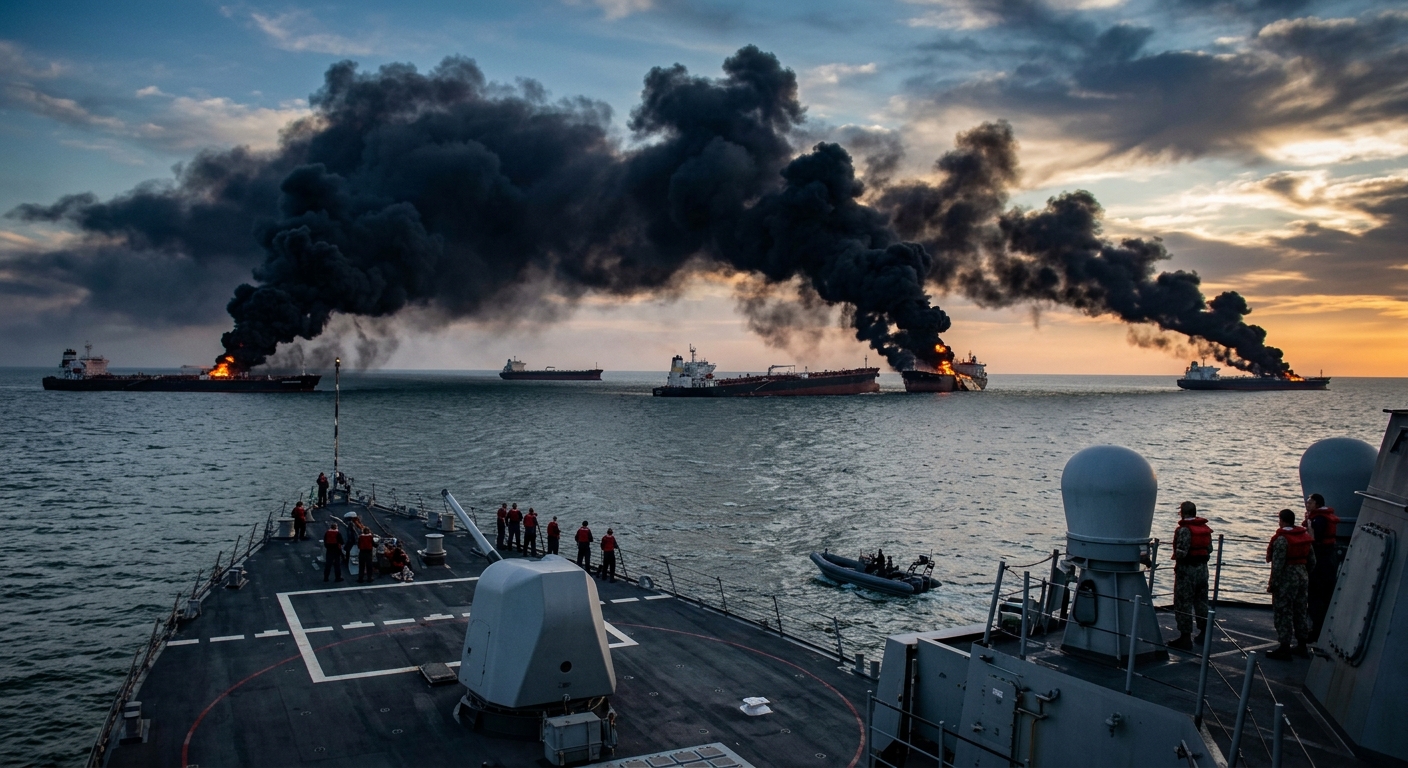
U.S. forces destroyed five Iranian oil tankers on September 8 after Iran’s Islamic Revolutionary Guard Corps (IRGC) attempted to attack a U.S. Navy warship with ballistic missiles, according to U.S. Central Command (CENTCOM).
The American warship reportedly managed to evade both missile attacks, which took place over two days. No U.S. personnel were injured during the incidents.
Five Iranian Oil Tankers Destroyed
According to CENTCOM, the vessels involved were M/T Kaviz, M/T Charminar, M/T Horizon 1, M/T Riesco and M/T Derya.
The Kaviz, Charminar, Horizon 1 and Riesco were struck in the Gulf of Oman, while Derya was targeted near Kharg Island.
CENTCOM said the crews of the vessels were instructed to abandon their ships before the U.S. forces carried out the strikes. Following the attacks, the five tankers were reportedly rendered inoperable.
The U.S. military said the vessels were connected to an Iranian oil network that supports the IRGC.
Tensions Continue Around the Strait of Hormuz
The latest attacks come as military activity continues to increase across the Persian Gulf, Gulf of Oman and waters surrounding the Strait of Hormuz.
The situation has raised further concerns for commercial shipping operating in one of the world’s most important maritime regions.
The Strait of Hormuz is a major route for global energy transportation, with large numbers of oil tankers and other merchant vessels normally passing through the area.
Any further military escalation could create additional risks for ships, cargoes and seafarers operating in the region.
Growing Security Concerns for Seafarers
Separate incidents involving merchant vessels have also been reported in the region, increasing security concerns for crews operating close to areas affected by the ongoing U.S.-Iran conflict.
For seafarers currently operating in or scheduled to transit the area, maintaining a high level of situational awareness is extremely important.
Masters, Company Security Officers, flag states and relevant maritime authorities should be closely followed, while crews should continue monitoring official maritime security advisories and voyage updates.
Particular attention should be given to vessels operating around the Strait of Hormuz, Persian Gulf and Gulf of Oman, where the security situation can change rapidly.
As tensions continue, shipping companies and crews will need to carefully assess the risks before and during voyages through the region.
The good part is nobody injured and they all safe.