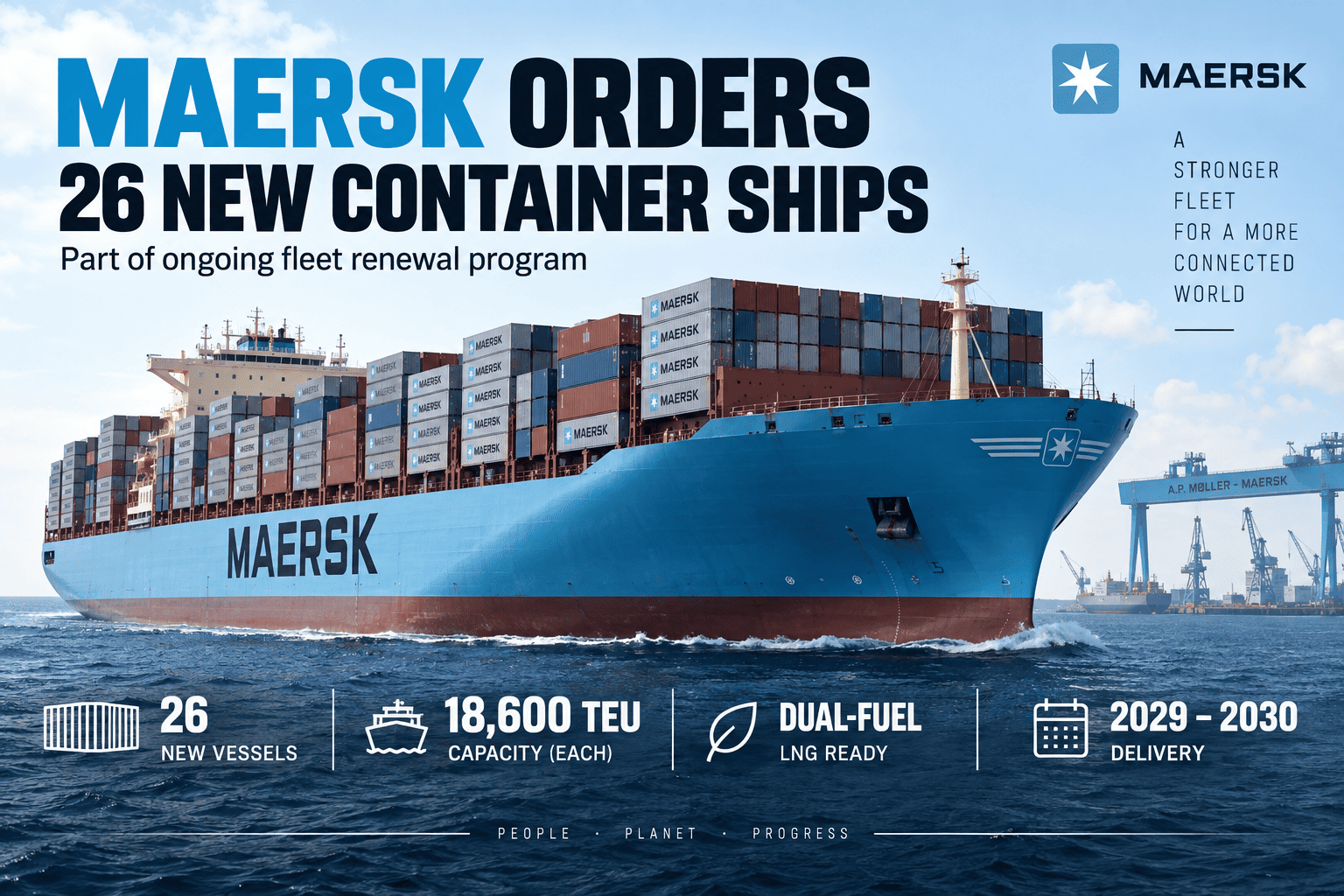
Maersk has confirmed an order for 26 new large container ships as part of its ongoing fleet renewal program. The vessels will each have a capacity of 18,600 TEU and are expected to be delivered between 2029 and 2030.
The order had been the subject of industry speculation for several days. Maersk has now confirmed that the company is moving ahead with the new ships, although some details of the shipbuilding program have not yet been publicly disclosed.
Maersk Confirms 26 New Container Ships
According to Maersk, the company has ordered 26 large container vessels as part of its fleet renewal strategy.
Each ship will have a capacity of approximately 18,600 TEU, making the new vessels some of the largest ships in the Maersk fleet.
The vessels will also be fitted with dual-fuel engines capable of operating on conventional bunker fuel and liquefied gas. This gives Maersk greater flexibility in how the ships are operated as fuel and environmental requirements continue to change.
The ships are scheduled for delivery in 2029 and 2030.
New Ships Will Be Built for Flexibility
Maersk previously announced an order for eight 18,600 TEU vessels from New Times Shipbuilding in China in February 2026.
The eight ships are scheduled for delivery in 2029 and 2030 and are part of a new series designed to provide greater deployment flexibility across Maersk’s network.
Maersk said the ships will be approximately 366 metres long and 58.6 metres wide. They are smaller than the largest container ships currently being built, which can reach around 400 metres in length.
The latest confirmation means the 18,600 TEU design will form a much larger part of Maersk’s future fleet.
Why Is Maersk Ordering More Ships?
Maersk has described its newbuilding program primarily as part of fleet renewal, but the container shipping market has changed significantly in recent years.
Competition between the world’s largest container shipping companies has increased, with carriers continuing to invest in new and more efficient vessels.
Maersk has also been dealing with changing trade routes and operational requirements. The disruption to shipping through the Red Sea and Suez Canal has shown how quickly global container networks can change.
More recently, Maersk and Hapag-Lloyd have started making targeted changes to some services through the Suez Canal while continuing to monitor the security situation in the region.
For Maersk, having newer ships with flexible deployment options could help the company adjust its network as trade routes and market conditions change.
Maersk Has Previously Focused on Fleet Renewal
Maersk has been renewing its fleet for several years rather than simply increasing its total capacity.
In February 2026, the company announced its eight-vessel order with New Times Shipbuilding. Maersk said the ships were part of its ongoing fleet renewal program and would help maintain the company’s competitiveness.
The company also stated that the vessels were designed to offer more deployment options than the largest container ships in the industry.
Maersk’s previous fleet strategy included replacing older vessels while keeping the overall fleet size relatively stable.
However, the latest 26-ship order has attracted attention because of its size and comes at a time when the major container shipping lines are investing heavily in their fleets.
Will Maersk Order 24,000 TEU Ships?
Before Maersk confirmed the 26-vessel order, several shipping industry analysts had reported that the company could be considering even larger container ships.
Reports from Linerlytica and Alphaliner had suggested that Maersk was looking at different vessel sizes, including ships around 19,000 TEU and 24,000 TEU.
Some reports had even suggested that Maersk’s next shipbuilding program could eventually involve more than 40 vessels and have a value of several billion dollars.
However, these additional reports should be treated separately from the confirmed order. Maersk has confirmed the 26 vessels with 18,600 TEU capacity, while reports about additional 24,000 TEU vessels remain part of the wider industry speculation.
What Does This Mean for the Container Shipping Industry?
The new Maersk order comes as the global container shipping fleet continues to grow.
Large container vessels allow carriers to move significant amounts of cargo on major trade routes, while dual-fuel technology gives operators more flexibility as the shipping industry moves toward lower-emission fuels.
At the same time, fleet expansion can increase available container capacity across the market. This is important because shipping companies must balance investment in new vessels with the risk of having more capacity than the market needs.
Maersk has previously acknowledged the importance of flexibility because of changing market conditions and geopolitical disruptions.
Maersk’s New Ships Will Enter Service From 2029
The 26 new vessels are expected to enter the Maersk fleet during 2029 and 2030.
With a capacity of 18,600 TEU each, the total nominal capacity represented by the 26 ships is approximately 483,600 TEU if all vessels are counted at their stated design capacity.
The ships will use dual-fuel propulsion and are expected to become an important part of Maersk’s future container fleet.
For seafarers and the wider shipping industry, the order also highlights how quickly the next generation of large container ships is being developed.
Conclusion
Maersk has confirmed one of the industry’s major recent container ship orders, with 26 new 18,600 TEU vessels planned for delivery in 2029 and 2030.
The ships will feature dual-fuel engines and form part of Maersk’s continuing fleet renewal strategy. While reports of possible 24,000 TEU vessels remain unconfirmed, the latest order shows that Maersk is continuing to invest heavily in large, flexible and newer-generation container ships.
As competition between the major container carriers continues, Maersk’s fleet strategy will be an important development to watch over the next few years.