Mark Zuckerberg’s 118-meter superyacht Launchpad was reportedly closer to a small boat that ran out of fuel in Alaska, while the much smaller Wilderness Legacy cruise vessel responded and towed the boat to safety. But did Launchpad actually break maritime regulations?
Did Zuckerberg’s Yacht Ignore a Stranded Boat? A Mariner’s Look at the Alaska Rescue
The incident has attracted significant attention online after a 21-foot skiff ran out of fuel in Southeast Alaska and requested assistance from the U.S. Coast Guard.
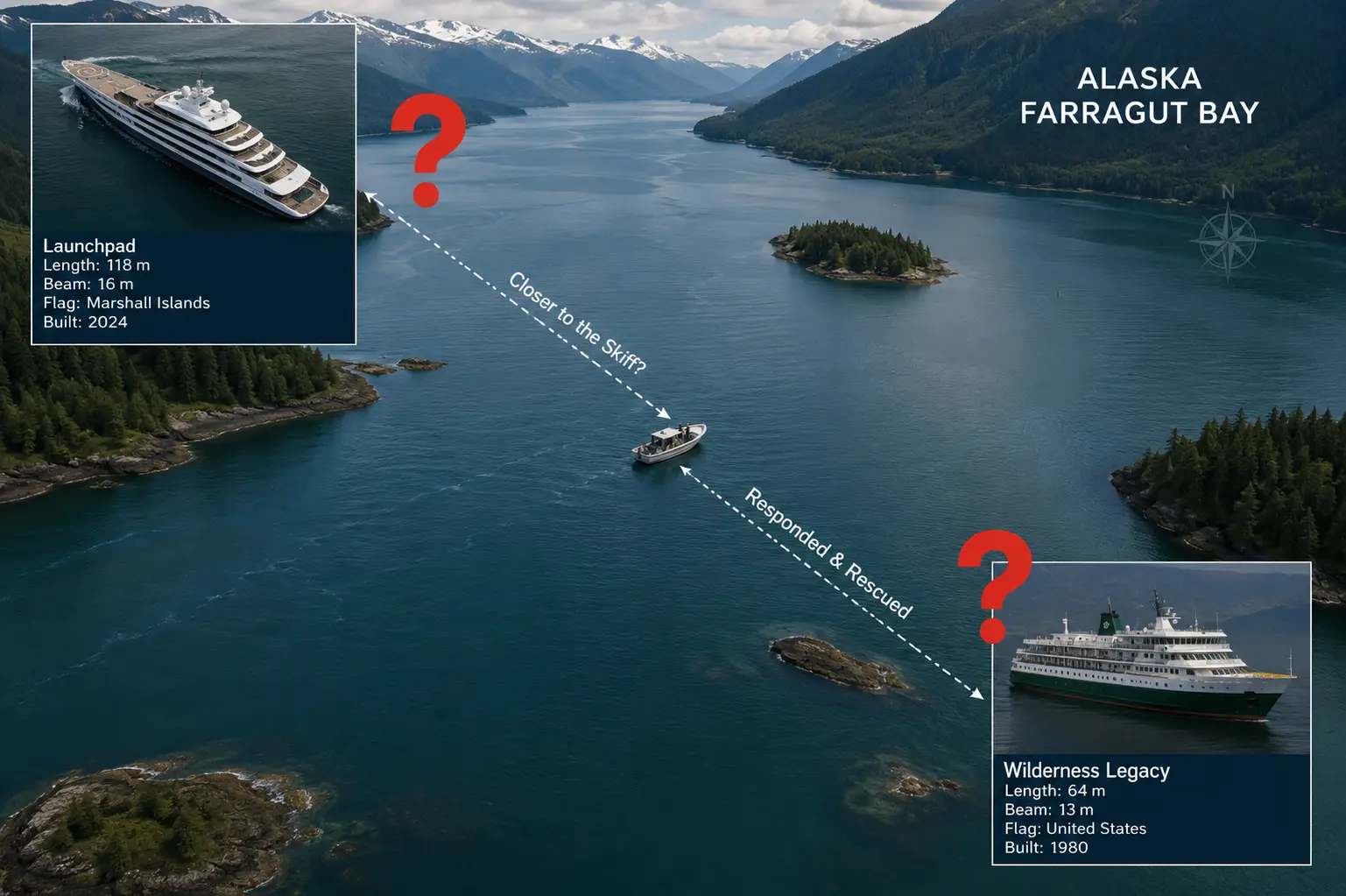
According to reports, the skiff was operating between Petersburg and Juneau when it ran out of fuel. The nearby Wilderness Legacy, a small expedition cruise vessel, eventually responded and towed the stranded boat to Farragut Bay, where everyone was brought to safety.
The controversy began because AIS tracking reportedly showed Mark Zuckerberg’s superyacht Launchpad closer to the stranded skiff than the Wilderness Legacy.
That immediately created a simple question for the public:
If the closest vessel did not respond, did it violate maritime regulations?
From a mariner’s perspective, the answer is more complicated than the headlines suggest.
Launchpad: Mark Zuckerberg’s Superyacht
Launchpad is a 118-meter Feadship superyacht associated with Meta CEO Mark Zuckerberg.
The vessel was built in 2024 and flies the Marshall Islands flag. Available specifications list her beam at approximately 16.3 meters and her draft at approximately 4.6 meters.
Launchpad specifications
- Name: Launchpad
- Length: 118 meters
- Beam: 16.3 meters
- Built: 2024
- Flag: Marshall Islands
- Builder: Feadship
- Draft: approximately 4.6 meters
However, one important detail should be made clear: Mark Zuckerberg himself was reportedly not onboard the yacht at the time of the incident. His spokesperson said that the crew did not hear the Coast Guard’s assistance request initially because they were operating on another radio channel. By the time they became aware of the situation, assistance was already underway.
The Vessel That Actually Responded
The vessel that ultimately assisted the stranded skiff was Wilderness Legacy, an expedition cruise ship operated by UnCruise Adventures.
According to reports, the vessel altered its course, reached the stranded boat and towed it into the sheltered waters of Farragut Bay. Everyone aboard the skiff was safe.
Wilderness Legacy specifications
- Name: Wilderness Legacy
- Length: approximately 64 meters
- Beam: approximately 13 meters
- Flag: United States
- Built: 1980
The rescue itself was successful. The controversy is really about why Launchpad did not respond first.
What Do Maritime Regulations Actually Say?
This is where the story becomes particularly interesting for anyone working at sea.
Many people immediately referred to SOLAS and COLREGs, claiming that the nearest vessel was legally required to go and rescue the skiff.
That statement is too simple.
SOLAS and the duty to assist persons in distress
SOLAS Chapter V contains a general obligation concerning assistance to persons in distress at sea.
The IMO states that the master of a ship at sea that is in a position to provide assistance, after receiving information that persons are in distress at sea, should proceed with all speed to their assistance, provided that doing so is possible.
This is an important distinction.
The obligation concerns people in distress—not every vessel that needs routine assistance.
In this particular case, the U.S. Coast Guard reportedly determined that the skiff was not in distress. Instead, the Coast Guard issued a marine assistance request after determining that the people aboard were not facing an immediate emergency.
That changes the legal picture considerably.
Running Out of Fuel Is Not Automatically a Mayday Situation
From a mariner’s point of view, this is probably the most important part of the story.
A boat running out of fuel can certainly become a serious emergency.
If the vessel is drifting toward rocks, there is severe weather, people are injured, the vessel is taking on water, or there is an immediate threat to life, the situation can quickly become a genuine distress case.
But simply running out of fuel does not automatically mean that the vessel is legally in distress.
This is apparently what happened in Alaska.
The Coast Guard received the request and assessed the situation before determining that the skiff was not in immediate distress. It then sought assistance from vessels in the area.
Therefore, saying that Launchpad definitely “violated SOLAS by refusing to rescue the boat” would go beyond what the available facts establish.
What About VHF Channel 16?
There is another part of this story that needs some clarification.
VHF Channel 16 is the international distress, safety and calling channel used in maritime communications. Ships subject to the applicable GMDSS requirements have specific watchkeeping and radio obligations.
However, it would be incorrect to say that every Mayday transmission can automatically be heard by every vessel within 100 miles.
Radio range depends on factors such as antenna height, propagation conditions, equipment and the location of the vessels.
COLREG Rule 5 does require vessels to maintain a proper lookout by sight and hearing, as well as by all appropriate available means.
But that does not mean a vessel is guaranteed to hear every radio transmission in the surrounding area.
And in this case, Zuckerberg’s spokesperson specifically stated that the Launchpad crew did not hear the Coast Guard’s assistance request initially because they were monitoring another channel.
That is very different from proving that the crew heard a Mayday and deliberately ignored it.
Why Was Wilderness Legacy Able to Help?
This is where the practical side of seamanship becomes important.
The Wilderness Legacy was considerably smaller than Launchpad and was operating in the same Alaskan waters.
A 64-meter expedition vessel may have considerably more flexibility when operating in confined or shallow waters than a 118-meter superyacht with a deeper draft.
However, the size of the vessel alone does not determine whether it can perform a rescue.
The master must consider:
- Vessel draft
- Available depth
- Maneuvering room
- Weather and sea conditions
- Towing capability
- Crew safety
- The condition of the disabled vessel
- Risk to both vessels
- The instructions of the Coast Guard or rescue coordination authority
The master always has to consider whether an operation can be performed safely.
As IMO guidance makes clear, assistance to persons in distress is an important maritime obligation, but the circumstances of the situation and the ability of the assisting vessel also matter.
So Did Zuckerberg’s Yacht Do Something Wrong?
Based on the information currently available, I would be very careful about saying that Launchpad broke maritime law.
The public story makes it sound like this:
A boat was in distress, Zuckerberg’s yacht was nearby, ignored the call and another vessel had to rescue them.
But the actual situation appears to have been more complicated.
The Coast Guard reportedly classified the incident as a marine assistance request rather than a distress situation.
Zuckerberg’s spokesperson also said that the yacht’s crew did not initially hear the request because they were working on another radio channel, and that assistance was already underway when they became aware of it.
So there is a major difference between:
“The yacht heard a distress call and refused to help.”
and
“The yacht did not initially receive the assistance request, while another vessel responded.”
Those are two completely different situations from a maritime regulatory perspective.
The Bigger Problem With the Story
As someone working in the maritime industry, I think the most interesting part of this story is not necessarily Zuckerberg himself.
It is how quickly a normal maritime assistance operation can become a worldwide news story when a famous billionaire’s name is involved.
The rescue was successful.
The Wilderness Legacy responded.
The stranded boat was towed to safety.
Nobody was injured.
And the Coast Guard was involved in coordinating the assistance.
Yet the story became:
“Zuckerberg’s yacht ignored a boat in distress.”
That headline is much more dramatic.
It is also why mariners should be careful when reading viral maritime stories.
There is a significant difference between a MAYDAY, a PAN-PAN, a routine request for assistance and a situation where the Coast Guard is coordinating a response.
Those distinctions matter.
My Opinion as a Mariner
Personally, I would not compare this incident to a vessel knowingly ignoring people who are in immediate danger.
If there had been people in the water, a sinking vessel, fire, collision or another immediate threat to life, the situation would be completely different.
In that case, the obligations under international maritime law are much clearer.
But if a recreational boat simply runs out of fuel, contacts the Coast Guard and is assessed as not being in distress, the situation becomes much closer to a towing or assistance operation than a conventional search-and-rescue emergency.
In fact, the situation is somewhat similar to running out of fuel on a highway.
Imagine running out of gasoline on a highway and a famous billionaire driving past without stopping.
You could certainly criticize the person for not helping.
But that does not automatically mean they have broken a law.
Maritime law and maritime courtesy are not always the same thing.
A professional mariner may still choose to help when it is safe and practical to do so—and in this case, the crew of Wilderness Legacy deserves credit for doing exactly that.
But turning the incident into proof that Zuckerberg’s yacht violated international maritime regulations would be premature based on the information currently available.
The Alaska incident is a good reminder that maritime stories need to be examined from a mariner’s perspective, not just through viral headlines.
Launchpad was reportedly closer. Wilderness Legacy responded. The stranded skiff was safely assisted. But the available evidence does not establish that Launchpad deliberately ignored a distress call or violated SOLAS.
The most important question is therefore not:
“Why didn’t Zuckerberg save the boat?”
It is:
“Was the boat actually in distress, did Launchpad receive the assistance request, and was Launchpad legally and operationally required to respond?”
Based on the information currently available, the answer appears to be no clear violation has been established.
And perhaps that is the real lesson from this story: before judging a ship’s crew, understand the difference between a distress situation, a safety call and a request for assistance.