Anchoring a ship looks simple from the outside.Stop the vessel, drop the anchor, pay out some chain and wait.But How to do anchoring and drop anchor properly here the full guidance,
1. Planning the Anchorage
Good anchoring starts long before the anchor reaches the seabed.
I normally think about anchoring in the same way as passage planning:
Appraisal → Planning → Execution → Monitoring
The same idea can be applied to anchoring.
Before approaching the anchorage, you should know:
- Where you intend to anchor
- Water depth
- Type of seabed
- Expected wind
- Expected current
- Weather forecast
- Nearby vessels
- Available swinging room
- Amount of chain required
- Possible hazards
- What you will do if the anchor does not hold
The anchorage should not be selected simply because the chart says “anchorage.”
You need to understand what is actually happening in that area and it all depends on your loaded & ballast condition as well , for proper stability calculation
1.1 Check the Water Depth
The first thing to check is the depth.
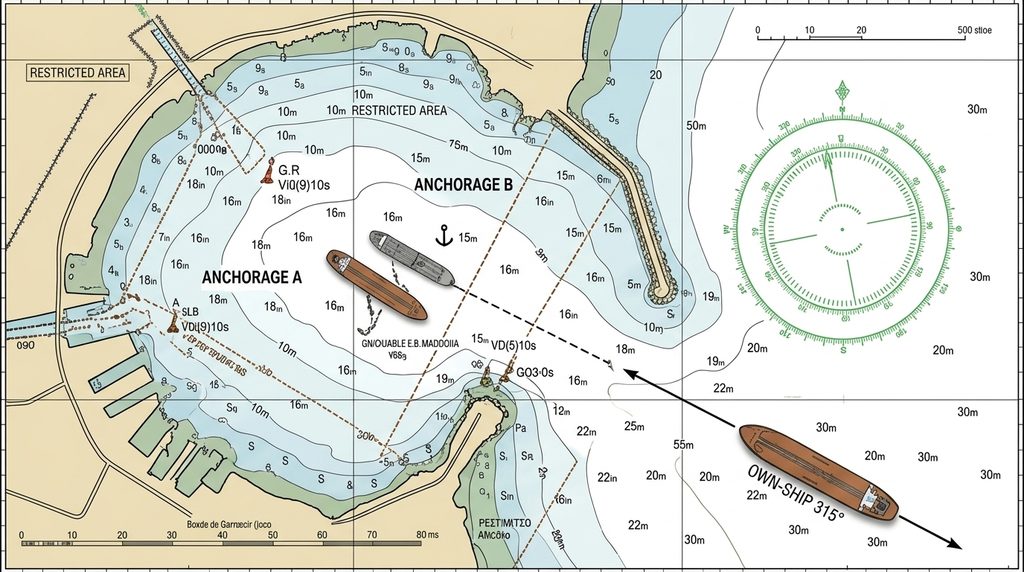
Look at the Admiralty chart or the appropriate electronic chart and identify the depth at the intended anchoring position.
The depth has a direct relationship with the amount of cable you may need.
There is no single amount of chain that is correct for every situation. Company procedures, vessel characteristics, weather, seabed and local requirements all have an influence.
Some companies may restrict anchoring in deeper water or require additional precautions when the depth becomes significant.
For example, depending on the vessel and company procedure, the anchor may need to be walked back rather than simply allowed to fall.
In my own experience, I would be very careful about using too little chain.
As a personal rule developed from my time at sea, I would not want to give less than four shackles without a very good reason and proper consideration of the conditions.
This is not a universal rule. The correct amount depends on the circumstances and the Master’s instructions.
I have anchored in different conditions where the amount of chain required was very different.
For example, at Fos-sur-Mer in France, I have experienced anchoring in relatively shallow water, around 11 metres in ballast condition. In such conditions, if the weather is suitable, the amount of cable required can be quite different from a deep-water anchorage.
At Piraeus, the situation can be completely different. Vessels may anchor in considerably deeper water, sometimes around 80 metres for operations such as bunkering.
In deeper water, the amount of chain can become significant. In good weather, a vessel may be able to use a large amount of cable according to the vessel’s procedures and local conditions.
Personally, I would not want to remain at a crowded anchorage such as Piraeus for a long period if bad weather is expected.
The important lesson is that you should not decide the amount of chain only from the depth.
Look at the complete situation.
1.2 Check the Seabed
The seabed is one of the most important factors when selecting an anchoring position.
Mud and clay are generally considered good holding ground because the anchor can penetrate the seabed and develop good holding power.
Sand can also provide good holding in suitable conditions, but its behaviour can become less reliable when weather deteriorates.
I have experienced this in the La Seine Bay area in northern France, where the seabed is predominantly sandy.
In calm conditions, anchoring there can be perfectly normal.
However, when strong northwesterly weather develops, the situation can change considerably.
The anchor may not hold as reliably as it does in good weather, even when additional precautions are taken.
This is one reason why I do not like looking only at the charted depth when deciding whether an anchorage is suitable.
Two anchorages can have the same depth but completely different holding characteristics because of the seabed.
In difficult conditions, simply putting down more chain does not automatically guarantee that the anchor will hold.
The charted seabed information should therefore be checked together with the expected weather and current.
Local experience can also be extremely useful.
If pilots, port authorities or experienced local officers know that a particular anchorage has poor holding in a certain wind direction, that information should be considered during planning.
A good anchorage in calm weather is not necessarily a good anchorage in bad weather.
1.3 Check the Weather
Weather is another major part of anchoring preparation.
You should not only look at the weather at the moment of anchoring.
You should consider what is expected while the vessel will remain at anchor.
A ship may remain at anchor for several hours, several days or, in some situations, even much longer.
Therefore, the worst expected weather during the planned stay should be considered.
Check:
- Wind speed
- Wind direction
- Forecast changes
- Gusts
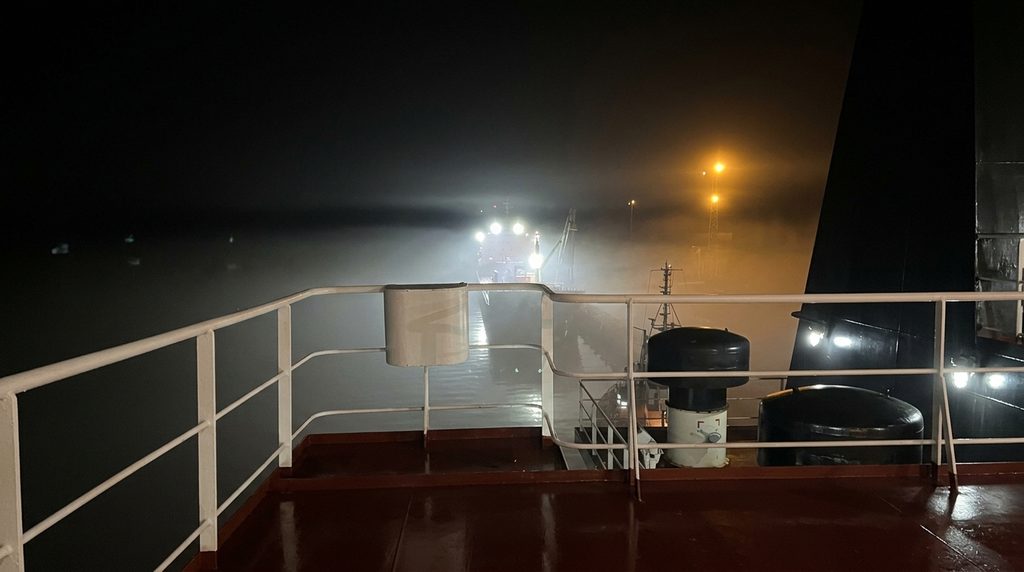
- Rain or reduced visibility
- Sea conditions
- Storm development
- Current and tidal conditions
For example, a vessel may be safely anchored with 15 knots of wind.
If the forecast indicates that the wind will increase to 35 or 40 knots later, the anchoring plan should be based on the stronger conditions rather than the conditions at the moment the anchor is dropped.
The same applies when the wind direction is expected to change.
A change in wind direction can cause the vessel to swing through a large arc and put different loads on the anchor and chain.
1.4 Wind and Current
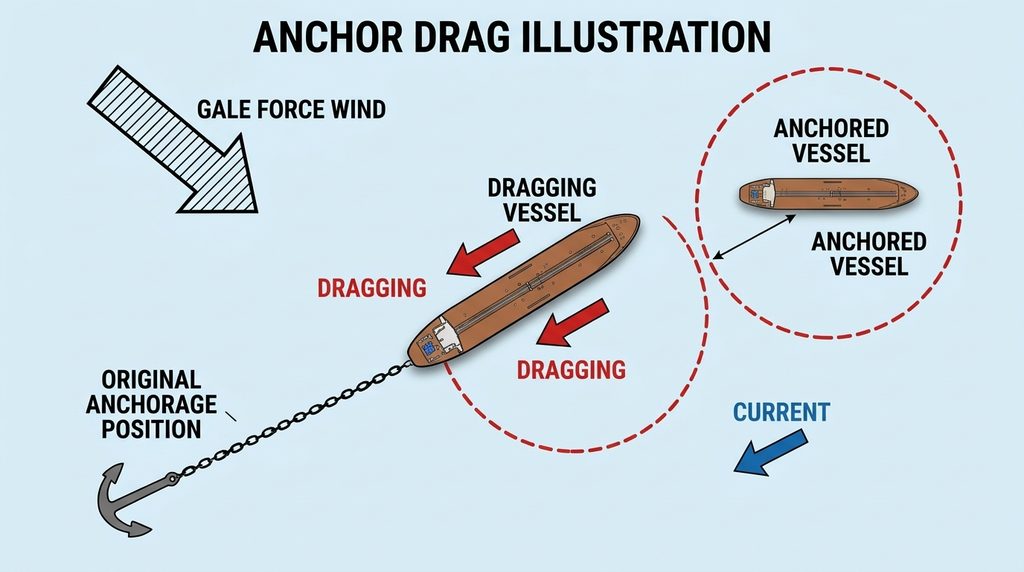
Wind is one of the main forces acting on an anchored vessel.
However, current can sometimes become even more important.
Wind direction is relatively easy to understand because you can check the weather forecast and the anemometer on the bridge.
Current can be more difficult, especially when you are anchoring somewhere unfamiliar.
I experienced this in Chittagong, Bangladesh, where the current can become extremely strong.
In some situations, the current can reach several knots and have a much greater effect on the vessel than the wind.
One way to recognise this is to compare the wind direction with the vessel’s actual heading.
For example, imagine that the anemometer shows a 25–30 knot wind coming from the northwest.
Normally, if the wind is the dominant force, you would expect the vessel’s bow to tend towards the wind.
But if the wind is coming from the northwest and the vessel is lying towards the northeast, something else may be controlling the vessel.
The current may be stronger than the wind.
This is particularly important with a large loaded vessel because the underwater profile of the ship can make the current’s effect significant.
I have also experienced the influence of tidal current around Southampton in the UK.
During tidal changes, the vessel’s movement and heading at anchor may be influenced considerably by the current.
The ship may not simply point into the wind.
This is why I would not recommend looking at the wind alone when preparing to anchor.
Before anchoring in an unfamiliar area, ask the local pilot, port authority or another reliable local source about the current.
Check tidal information where applicable and observe the vessels that are already anchored.
Sometimes the vessels already at anchor can tell you something that the weather forecast cannot.
If several vessels are lying in a direction that does not match the wind, there may be a strong current affecting the anchorage.
Wind tells you one part of the story. The actual behaviour of the vessel tells you the rest.
1.5 Check Other Vessels
Before dropping the anchor, look carefully at the vessels already at anchor.
Every vessel needs enough room to swing safely around its anchor.
In reality, this is not always available.
Some anchorages can become extremely crowded, especially around major ports and bunkering areas.
I have experienced this at the anchorage south of Istanbul Strait, where vessels may wait for bunkering, provisions or other operations.
The anchorage can become very congested, and sometimes the distance between vessels can be less than two cables.
In such a situation, there is very little room for mistakes.
You need to consider:
- Where the other vessels are anchored
- Their approximate swinging circles
- Their headings
- Wind direction
- Current direction
- Your own swinging circle
- Possible escape routes
- What happens if your vessel starts dragging
If your vessel begins to drag, you may not have enough time or space to simply wait.
For this reason, when operating in a heavily congested anchorage, I prefer to keep the vessel ready for action.
If the vessel is there only for bunkering or provisions, I would want the operation completed without unnecessary delay and the vessel ready to leave if conditions require it.
A crowded anchorage requires much more attention than an open anchorage with plenty of sea room.
1.6 Check for Underwater Hazards
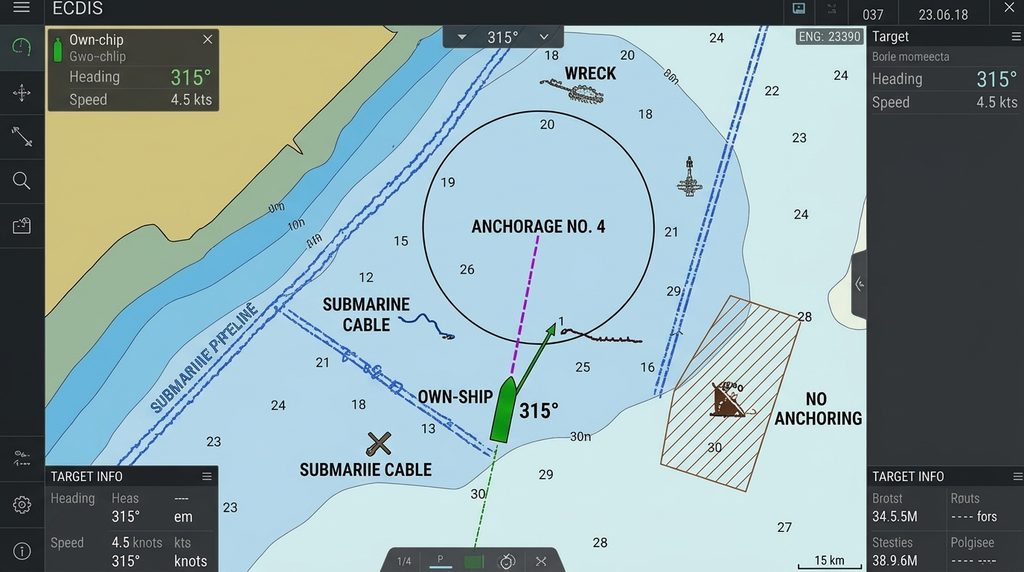
Before anchoring, check the chart for hazards.
These can include:
- Submarine cables
- Pipelines
- Wrecks
- Rocks
- Obstructions
- Restricted areas
- Dredged channels
- Other charted hazards
Dropping an anchor onto a submarine cable or pipeline can create a serious situation.
It can also make weighing anchor difficult if the cable or pipeline becomes fouled.
The intended anchor position should therefore be checked carefully on the chart and ECDIS before the vessel reaches the anchorage.
1.7 Always Have an Alternative Plan
Do not assume that the first anchoring position will always work.
Your alternative plan may be needed if:
- Another vessel approaches your intended position
- The anchorage becomes crowded
- The current is stronger than expected
- The vessel does not slow as expected
- The weather changes
- The depth is unsuitable
- The seabed is unsuitable
- The vessel cannot safely reach the planned position
Before approaching the anchorage, I prefer to have a second option in mind.
It does not need to be complicated.
Simply knowing where you will go if the first plan does not work can make a big difference on the bridge.
2. Preparing the Ship and Forecastle Team
Once the anchoring position has been selected, preparation should begin.
The bridge and forecastle team should understand what is going to happen.
Communication is particularly important.
Before arrival at the anchorage, the Master or officer in charge should make sure the forecastle team understands:
- Which anchor will be used
- Whether the anchor will be let go or walked back
- Expected amount of cable
- Communication method
- Required PPE
- Windlass condition
- Brake condition
- Chain stopper condition
- Any special hazards
The windlass should be ready for operation.
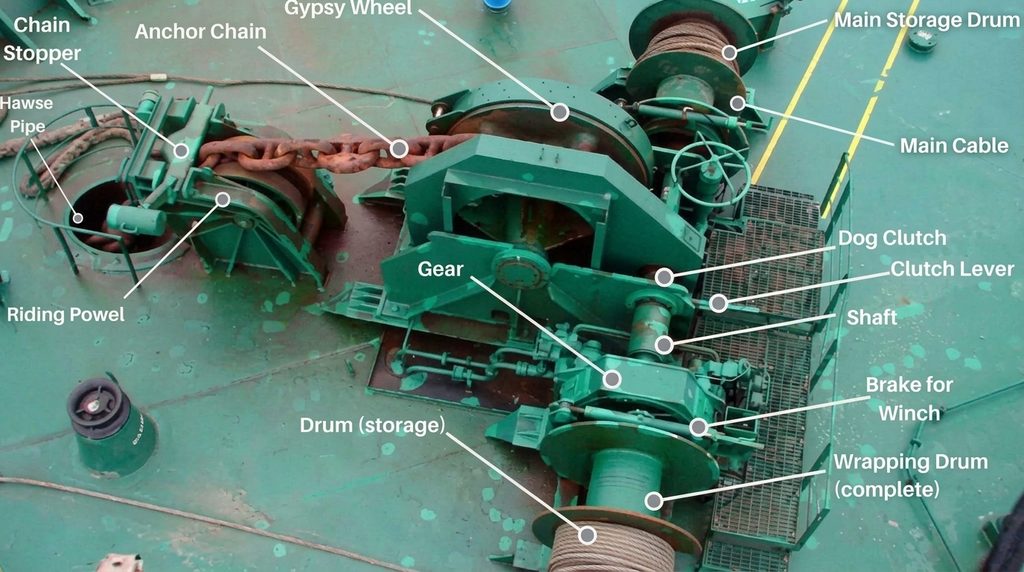
The anchor lashings should be released according to the vessel’s procedure.
The chain stopper should be prepared.
The brake should be checked.
The team should also confirm that the anchor can be controlled safely.
2.1 PPE and Forecastle Safety
Anchoring is a high-risk operation.
The forecastle team should use the PPE required by the vessel’s risk assessment and company PPE matrix.
This may include:
- Safety helmet
- Safety shoes
- Boiler suit
- Safety goggles
- Gloves
- Lifejacket where required
- Portable radio
- Torch during night operations
The crew should also stay away from dangerous areas around the chain and windlass.
The anchor chain contains enormous amounts of stored energy when under tension.
Nobody should treat the forecastle as a place where you can simply stand anywhere and watch the operation.
3. Approaching the Anchorage
The approach to the anchorage requires careful control of the vessel.
The first thing I consider is the relationship between wind and current.
As mentioned earlier, I have experienced situations where the wind appeared to be the dominant factor, but the current was actually controlling the vessel.
This can change the way you approach the anchorage.
A loaded vessel may also behave differently from a ballast vessel.
A large loaded ship does not always slow down or turn as quickly as expected, especially at low speed.
Therefore, you need to start reducing speed early enough.
Do not wait until you are directly over the anchoring position before trying to stop the vessel.
3.1 Approach from the Cleanest Direction
Ideally, approach the anchoring position from a direction that gives you the most control.
Consider:
- Wind
- Current
- Traffic
- Depth
- Nearby vessels
- Available sea room
The final heading should normally allow the vessel to settle into a safe position before the anchor is released.
The exact approach depends on the vessel and environmental conditions.
3.2 The Final Approach
As the vessel approaches the final position, speed should be reduced.
The objective is not simply to stop directly over the position.
You need to control the vessel so that the anchor can be deployed safely and the chain can lead correctly.
Depending on the conditions and vessel configuration, the vessel may use engine movements and bow thruster assistance.
There is sometimes an attitude that using the bow thruster during anchoring is somehow a matter of pride.
I do not agree with that approach.
If the bow thruster is available and using it appropriately makes the operation safer and more controlled, there is nothing wrong with using it.
The objective is safe ship handling, not proving that you can operate without assistance.
4. Letting Go or Walking Back the Anchor
There are two common methods of lowering the anchor:
Letting go
or
Walking back
The correct method depends on the vessel, depth, company procedure and circumstances.
4.1 Letting Go the Anchor
Letting go is quick and simple when conditions are suitable.
I have used this method many times in water depths of approximately 20–60 metres, including on older vessels around 180 metres in length, without problems.
However, the fact that it worked in those situations does not mean it is automatically the correct method for every vessel or every anchorage.
Company procedures should always be followed.
Before letting go, the vessel should be under proper control.
The forecastle team should confirm readiness.
When the vessel is sufficiently stopped, the anchor can be released according to the Master’s order and vessel procedure.
Once the anchor reaches the seabed, the chain should be controlled carefully.
4.2 Walking Back the Anchor
Walking back provides more control, particularly in deeper water or where the vessel’s procedures require it.
Instead of allowing the anchor to fall freely, the windlass controls the speed at which the chain and anchor descend.
This can reduce uncontrolled running of the chain and allow the crew to monitor the operation more carefully.
In deep water, walking back can be particularly useful.
Again, the method should be based on the vessel’s SMS, Master’s instructions and the actual conditions.
5. Paying Out the Anchor Chain
After the anchor is on the seabed, the chain should be paid out under control.
Communication between the bridge and forecastle is extremely important.
The forecastle should report the condition of the chain.
A simple practical description is:
Short Stay
The chain has little tension and is relatively relaxed.
The anchor is not yet taking the full load of the vessel.
Medium Stay
The chain is becoming more horizontal and tension is increasing.
The anchor is beginning to hold the vessel.
Long Stay
The chain is strongly tensioned and the vessel is properly brought up on the anchor.
Once the vessel has settled and the engine is stopped, the chain may relax again depending on wind and current.
The officer on the bridge should not only listen to the report from the forecastle.
The vessel’s movement on ECDIS, radar and visually should also be monitored.
6. How Much Anchor Chain Should You Use?
There is no single number that applies to every anchoring situation.
The amount depends on:
- Depth
- Weather
- Wind
- Current
- Seabed
- Vessel size
- Vessel condition
- Length of stay
- Company procedure
- Local requirements
- Available swinging room
As a general practical concept, more chain gives the anchor a better chance of developing a suitable horizontal pull, but more chain also means a larger swinging circle.
This is especially important in crowded anchorages.
For example, putting down a very large amount of chain in a congested anchorage may create a swinging circle that overlaps with another vessel.
Therefore, the amount of chain must always be considered together with the available space.
7. Calculating the Swinging Circle
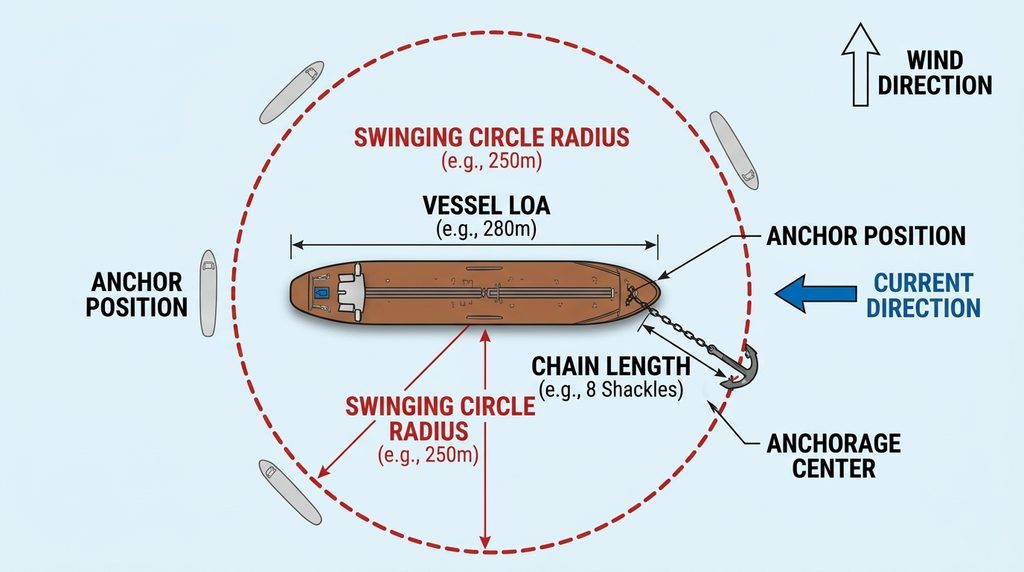
The swinging circle is one of the most important things to consider before anchoring.
When a vessel is anchored, it does not stay directly above the anchor.
It swings around the anchor as wind and current change.
A practical way of estimating the radius is to consider the length of cable plus the vessel’s length.
For example:
Swinging radius ≈ Anchor cable length + LOA
If you want the result in nautical miles:
Swinging radius (NM) = (Cable length in metres + LOA in metres) / 1852
Consider a vessel approximately 190 metres LOA.
Suppose the depth is around 40 metres and the vessel uses 7 shackles.
One shackle is approximately 27.5 metres.
Therefore:
7 × 27.5 ≈ 193 metres
Add the vessel’s length:
193 + 190 = 383 metres
So the approximate radius is:
383 / 1852 ≈ 0.21 NM
In practice, I would not use the exact theoretical number as the only safety margin.
I would consider a little additional space, for example around 0.25 NM, depending on the situation.
The actual behaviour of the vessel can be affected by the depth, catenary of the chain, wind, current and vessel characteristics.
The important point is not to treat the swinging circle as a perfect mathematical circle.
Use it as a practical safety reference.
8. Monitoring the Vessel at Anchor
Anchoring does not finish when the anchor is on the seabed.
This is where anchor watch begins.
The vessel should be monitored continuously according to the Master’s instructions and the vessel’s procedures.
There are several useful methods.
8.1 ECDIS and GNSS
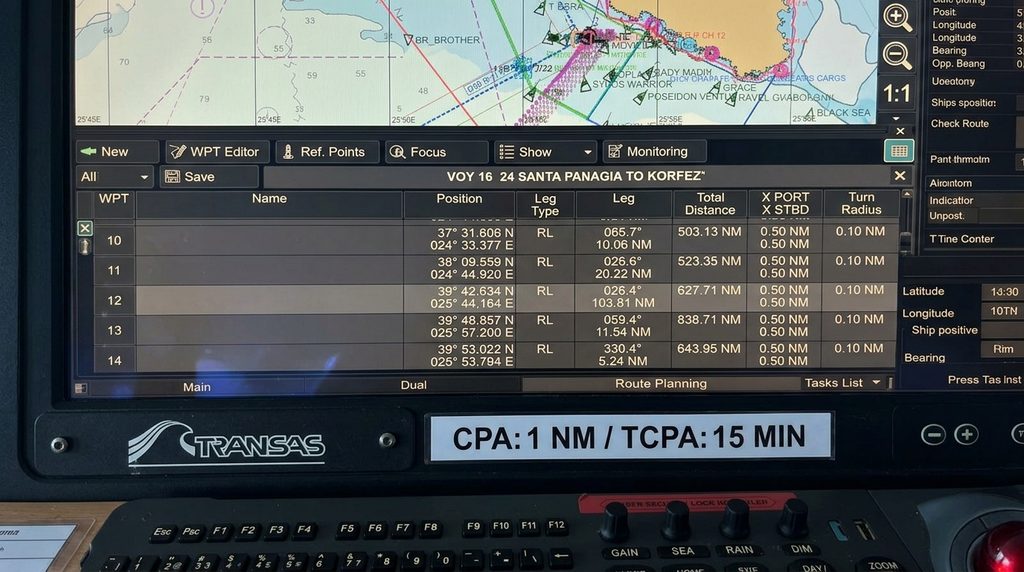
When the anchor is dropped, mark the exact position where it was released.
Modern ECDIS systems may have an anchor watch, anchor drop or MOB-type function that can be used for this purpose.
The vessel’s position can then be monitored relative to the anchor position.
You can also establish a suitable safety or swinging circle.
If the vessel moves outside the expected area, this should immediately attract attention.
8.2 Radar
Radar is another very useful tool.
Fixed objects such as:
- Breakwaters
- Buildings
- Headlands
- Buoys
- Other fixed structures
can provide useful range and bearing information.
This is particularly valuable at night or when visibility is poor.
8.3 Visual Bearings
Traditional visual bearings are still useful.
Take bearings of suitable fixed objects and monitor whether they change.
For example, if a breakwater, lighthouse or shore structure should remain at a particular bearing but the bearing changes continuously, this may indicate that the vessel is moving.
Electronic navigation equipment is extremely useful, but traditional methods should not be forgotten.
9. Anchor Watch and Dragging
A vessel can appear to be safely anchored and then begin dragging.
The first indication may not always be obvious.
On the bridge, you may notice unusual vibration or movement.
In my experience, there can be a short period of vibration, then it stops, and later the vibration happens again.
The ECDIS track can also provide useful information.
If the vessel starts moving in a direction opposite to the expected wind direction, this can be an indication that something has changed.
An increase in SOG can also attract attention.
For example, if the vessel is supposed to be safely anchored but you begin seeing movement around 0.50–0.70 knots, together with other indications of movement, you should investigate.
This number should not be treated as a universal alarm limit.
A vessel can move slightly while safely anchored because of wind and current.
The important thing is to look at the overall movement pattern.
10. What If the Anchor Drags?
If you suspect that the anchor is dragging, the Master should be informed according to the vessel’s standing orders and procedures.
The correct response depends on the situation.
Consider:
- Wind speed
- Current
- Direction of movement
- Distance from other vessels
- Available sea room
- Weather forecast
- Engine readiness
- Whether additional chain can help
- Whether a second anchor is practical
If the vessel is dragging towards open sea and there is plenty of room, there may be more time to take action.
If the vessel is dragging towards another anchored vessel, shallow water, a channel or a hazard, the response must be much faster.
10.1 Use the Main Engine
One of the most important preparations for bad anchoring conditions is engine readiness.
If the Master decides that the engine should be used, the vessel may need to regain position or reduce the load on the anchor.
The engine can be used carefully to help control the vessel.
The exact manoeuvre depends on the conditions and Master’s instructions.
After the vessel is stabilised, the anchor may be reset or another anchoring plan may be required.
10.2 Pay Out More Chain
If the vessel is dragging because the anchor is not developing sufficient holding power, additional chain may sometimes help.
However, this should not be treated as the automatic answer.
If the seabed is unsuitable or the weather is becoming too strong, simply adding more chain may not solve the problem.
There is also the limitation of available swinging room.
10.3 Use a Second Anchor Carefully
Using a second anchor can be considered in certain conditions.
However, it introduces another problem: the two chains can become crossed or fouled.
If the vessel swings significantly, the chains may interact.
This can create a much more complicated situation during weighing anchor.
Therefore, using the second anchor should be a planned decision rather than something done automatically.
11. When Should You Consider Leaving the Anchorage?
Sometimes the safest anchoring decision is not to remain at anchor.
If:
- The weather is deteriorating rapidly
- The anchor repeatedly drags
- There is insufficient swinging room
- Nearby traffic creates a risk
- The seabed is unsuitable
- The current becomes too strong
- The vessel cannot maintain a safe position
the Master may decide to leave the anchorage.
This is why the alternative plan is important.
Before dropping the anchor, you should already know where the vessel can go if remaining at anchor becomes unsafe.
12. Weighing Anchor
Weighing anchor is another operation that requires preparation.
Before starting, the engine and bow thruster should be ready as required.
The forecastle team should be prepared.
The windlass should be checked.
Communication between bridge and forecastle should be established.
Once the windlass starts recovering the chain, the forecastle should report the chain condition.
If the chain is short stay, the windlass may recover it relatively easily.
As the chain becomes medium stay or long stay, the vessel may need engine assistance depending on the conditions.
The objective is to avoid putting excessive load on the windlass.
12.1 Anchor Aweigh
When the anchor leaves the seabed, the forecastle should report:
“Anchor aweigh.”
At this point, the vessel is no longer being held by the anchor.
The officer on the bridge needs to know how the vessel is moving.
If there is plenty of sea room, the vessel may be allowed to drift slightly while the anchor is being recovered.
If there is traffic, shallow water or another hazard nearby, the engine and rudder may need to be used immediately.
The situation is different for every vessel and anchorage.
12.2 Wash the Anchor and Chain
When the anchor and chain are coming onboard, they may carry a large amount of mud and dirt.
The fire main or suitable washing arrangement can be used to clean the chain and anchor according to the vessel’s procedure.
This is not only about keeping the forecastle clean.
Excessive mud and dirt entering the chain locker can create problems later.
A clean chain locker is much easier to inspect and maintain.
Anchoring without checking the current
The vessel may behave very differently from what the wind direction suggests.
My experience at Chittagong is a good example of why current should not be ignored.
Looking only at depth
Depth is important, but seabed quality can be equally important.
Dropping the anchor too fast
The anchor should be controlled according to the vessel’s procedure and conditions.
Not monitoring after anchoring
A vessel can drag hours after the anchor was initially holding.
Having no alternative plan
If the first anchoring position becomes unsuitable, you should already have another option.
Treating one anchoring method as suitable for every vessel
A method that worked perfectly on one vessel may not be appropriate on another.
Most useful tactic : If you having problems with anchor holding due to ship desing or vessel working area seabed problems , check the chart and find a place where your anchor depth will be more than ships gps position depth which means you will drop anchor to 25 meters but you will be on 20 meter area where anchor will hold due to height in the water much better.